Saturday, October 06, 2012

Redistribution: Public Good turned Tyranny of the Majority?


As we discussed in class, one popular view is that redistribution is a public good, to help out those less fortunate than ourselves.  However, this group of “less fortunate” people has grown exponentially in the last couple decades.  According to the article Tax Equity and the Growth of Non-Payers:

“42 percent of citizens had no income tax liability after taking deductions and credits.  In addition to these 42 percent, there are millions of Americans that do not earn enough to be required to file an income tax return.  When these non-filers are added to the number of non-payers, the total number of Americans outside the income tax system jumps to roughly 50 percent of all households by some estimates.” 

The group of “less fortunate” people in this country, whom we want to help out because of our interdependent utility functions, will soon become the majority if they have not already.  Those outside of this majority, which used to have somewhat of a say in whether or not they felt compelled to help out those “less fortunate”, will now fall under the tyranny of the majority.  Of course the non-payers will vote to continue not paying income taxes, why wouldn't they?  After all, they are rational, self-interested citizens, who want what is best for them.  And since they have the majority of the votes, there will be nothing the minority of tax-payers will be able to do to stop them. 

Have Wheels, Will Travel. (...to the Median)

Though this post may not have to do strictly with Public Choice, it is a relevant example of Spatial Location Theory--the basis of the Median Voter Theorem. Our stimulating discussion of hotdog stand placement really got me thinking about whether or not real businesses can afford to move strategically towards each other in order to garner the most business. The largest costs of starting a business are typically the 'bricks and mortar' expenses that you incur to putting up a storefront, so it would be financially unwise to periodically move toward the median location with your competitors. The only way you can exercise the Spatial Location Theory would be in the initial placement of your business or in the placement of your next branch or franchise, right?? Not if your business is based on wheels...


Apparently the three big car dealers of Charlottesville understand this theory and have put together "Car Wars" as a joint event to sell inventory and compete for business. This is only a short term event and not a final equilibrium, but it is probably the closest that any major business can get to shifting locations to the median. After some searching on google maps, it turns out that JPJ is actually located more or less equidistant from all three dealers. JPJ is 4.8 miles from Pantops (where Battlefield and Brown have locations) and 4.5 miles from the north end of Seminole Trail (where Brown and Jim Price have locations). Coincidentally, JPJ is also one of the few places in Charlottesville that can handle the inventory capacity of these three dealers. There are definitely many advantages of having a joint event--sharing costs of advertising, location rental, and converging on prices/rates--but the long term goal is to garner repeat business from those customers who are geographically on the other side of town, who would probably under normal circumstances go to one of the dealers closer to home So, if a dealer can somehow make their business/cars more attractive at this joint event, then they don't have to permanently move to a median location to steal long term business from the other dealers! It's actually quite a genius plan and a great advantage of having a mobile product.

This is a slight deviation on the theorem because these dealers do not have strictly identical products, but from a buyer's perspective there probably isn't a substantial difference between a Chevy, Ford, and Toyota.

Tuesday, October 02, 2012

Bringing Morals into the Voting Debate


            In my family, there is always a heated debate around election time because my dad, while being an eligible and well-informed citizen, refuses to vote.  Try as they might, my dad’s siblings, nephews, nieces and children cannot get him to go to the polls.  I had obviously been thinking about this predicament a lot while reading the Johnson article, so much so that when I finished it, I called him to get a straight answer.  I knew that Johnson’s arguments of rational abstention and rational ignorance did not apply to my dad.  He would gladly give up an hour of his day to vote if he someday changed his mind and he is not rationally ignorant nor indifferent.  After convincing him that I was not another family member attacking him and that I really just wanted to know, he explained his opinions clearly.  Basically, he does not vote because he “does not like the candidates our political system produces.” The founder of the Center for Morality in Public Life, Andrew Haines, seems to express similar opinions to my dad.   

The act of voting, in this case, isn’t something we can assess under a utility-driven approach to social welfare (e.g., sorting out the lesser of two political evils). Instead, voting is a reflection of right reason in action—and because of this, it can only engage positively (i.e., we can only cast an unspoiled ballot) when the intellect is given enough fodder to make an informed judgment.”

After our discussion in class today, I feel I can possibly see his point of view.  Because the U.S. is a two party system, the candidates tend to race toward the median voter, as we talked about in class.  This makes them very similar and moderate, leaving someone like my dad, who holds more extreme views, alienated without an ideal choice.  He then applies Haine’s argument above in that instead of choosing a lesser of two evils, he abstains altogether.  This point of view is more philosophical than economical because his actions are not consistent with his best interests.  He could save a lot of time (by not having to always argue) and avoid a lot of social pressure by just voting.  Rather, his actions are consistent with his morals so he refuses to participate in anything he feels will jeopardize this.  Life would be much easier if there was a candidate he felt was "worthy" of his vote.  However, if a candidate were to move far enough down the political spectrum to persuade my dad to vote, they would probably lose all the moderate and ample median voters they set out to get.  
        

Obamney

Today we talked about the median voter theorem (MVT).  A key implication of the MVT is that, under certain circumstances, two  candidates will begin to look eerily alike.  Oh peaches!! I just came across this video that shows how Romney and Obama may have already morphed into one candidate!


Notice how they both stick to similar topics when they are apart.

Old Gus is curious to see if the upcoming debates will clarify any distinctions between the two candidates.  Downs might suggest that they will use the debates to try to magnify policy stances of their opponent that are far from the median. 

Monday, October 01, 2012

Delicious Invisible Meat


I was really struck by our discussions in class about why it isn't economical to vote. I think the arguments for why it is unwise (if not patently irrational) to vote are very persuasive (though I still plan to vote in November because I personally derive a fair bit of utility from the act of voting). As I mentioned in class, I have many times in the past tried to persuade friends to vote (to help to raise their social benefits of voting), but have been met with strong opposition when they reply with arguments similar to the ones we made in class. Once my (very smart) friends start down this line, I usually give up -- they're just right.

So, recently, I've gone the other way, and despite my continued plans to vote, I've switched to making the case to people that they should not vote. Faced with the same airtight logic we discussed in class, all of the ones who didn't immediately agree struggled to make an argument is to why voting is a good thing. In almost every case, the eventual response was, essentially, "but if everyone did that, the political system would collapse!"


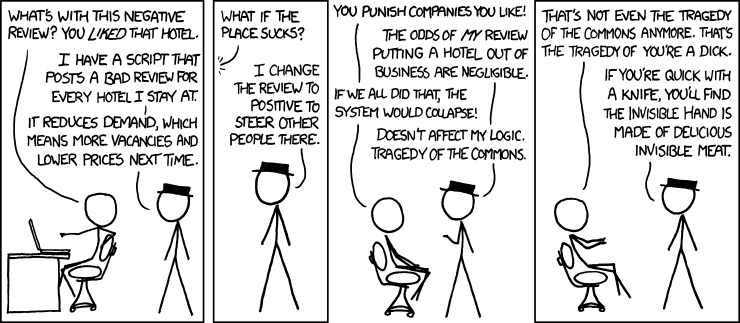
This is the same message as this issue of my favorite webcomic (this comic is about hotel feedback behavior, but the issue of "I do something rational that I'm glad not everyone else does" is identical). Black Hat Guy responds to this line of argumentation the same way I do to my friends:
"Doesn't affect my logic. Tragedy of the Commons."
There are some interesting questions about how to handle the tragedy of the commons issue of not voting (if fewer people vote because they realize how irrational it is, it becomes less irrational because fewer voters means your vote has higher electoral value and so that will reach a proper equilibrium, etc.), but given the present state of affairs, it's still irrational to vote, and concerns about "it'll ruin everything if other people decide similarly!" are unfounded, and shouldn't affect your decision to [not] vote. That's an individual choice, and it's okay to behave according to your self interest.

*  *  *

On a not-totally-related-to-this-particular-class note, Black Hat Guy's final line in the comic,
"If you're quick with a knife, you'll find the Invisible Hand is made of delicious invisible meat."
is one of my favorite quotations.

Talkin' Bout (Y) Generation

We've all experienced the relentless social media barrage of pleas, primarily by the Obama campaign, for young Americans to replicate the stunningly adequate turnout of young voters in 2008. However, in a piece sure to appall those young ideologues hopeful of a similarly impressive showing from college-age voters, Forbes contributor J. Maureen Henderson claims  that the contingent of young voters she broadly designates as "Generation Y" has demonstrated far less interest in 2012 despite the pressing economic issues looming over new and hopeful entrants into the job market.

Henderson cites an array of polls and figures to highlight that, even though the value of a favored candidate winning has ostensibly risen due to spiraling loan debts and diminishing quality of life, Generation Y's concerns "don't seem to translate into political engagement." Certainly, as Johnson indicated by noting that "less than one-fourth" of eligible voters under 25 participate in Congressional elections, young voters have never enjoyed a sterling voting record. But on the heels of a staggering 51% turnout for "eligible youth" in '08, the plummeting enthusiasm in voting or in even keeping abreast of election coverage imply that young voters, in addition to the concerns about low probability of making a difference that often fuel rational abstention and ignorance, actually place a lower value on the winning candidate despite the seemingly astronomical stakes. Given Henderson's discoveries that only 37% of women feel that politicians "reflect the interests of young Americans" and that 50% less young people have followed election coverage, it follows logically that Generation Y places comparatively less weight on the impact of their political involvement on their welfare than they did four years ago--and that what Johnson calls the "optimal amount of information" lies at a far lower quantity.

Of particular interest is Henderson's contention that young voters "tend to adopt a 'What's in it for me?' attitude." Imbued with such a mentality, young voters are more inclined to conclude, rationally, that respect for the "men and women who have sacrificed their resources" does not  retain the infinite benefit of voting which so many Americans irrationally seem to assign. When making the decision to vote with a far lower "sacrifice" value in mind--and, again, with a lower monetary value stemming from sentiments of disillusionment or insignificance--many Generation Y voters will rationally decide to "opt out on November 6."

On a brief concluding note, the statistical discrepancy between those "planning" to vote and the quantity of actual voters reinforces the conjecture that the urge to "seem involved" and conform to social norms influences voting behavior.


Sunday, September 30, 2012

But What About The Walruses?


            For years, scientists have been concerned about the effects of greenhouse gas emission. By trapping heat and preventing it from dispersing into outer space (the greenhouse effect), global warming is considered to be the most concerning effect of these emissions. A recent focus has been placed on encouraging human activity that decreases emission of these gases, such as turning lights off when not in the room and reusing goods whenever possible. This article examines a negative externality of greenhouse gas emission that is imposed on walruses of the Arctic: 

            “Scientists blame a combination of natural fluctuations and climate change caused by human emission of greenhouse gases, like carbon dioxide, for the recent record lows in sea ice… The melting sea ice raises a host of questions about the walrus, according to Jay. Will it affect the calves' survival? Are they spending more energy to swim further offshore to feed? Is the availability of their prey changing?”

            Although sea ice typically retreats north in the summer, the edge usually remains over the continental shelf where the water is shallow enough for walruses to feed. In the last 5 years, however, the sea ice has retreated farther north, over deeper waters where the walruses are unable to feed as easily. Thus, production of consumption goods, via emission of greenhouse gases, imposes negative production externalities on the walruses. The resulting decrease in sea ice has placed a burden on the walruses in several ways. As previously mentioned, acquiring food in deeper waters is more difficult for the walruses, causing them to expend more energy. This difficulty has caused record numbers of walruses to migrate to the coast, which presents another issue. Where as walruses historically spread out into smaller groups surrounding the Alaskan coast, they now congregate in large groups. This can present a problem if the walruses are startled, however, because it can lead to problems with lethal stampedes. These are all negative production externalities because they are costs due to the production of greenhouse gases that are borne by a party different from the producers greenhouse gases. Thus, these costs are not taken into account in the decision of the producers to produce.
One way of compensating for this market failure that we learned about in class is government regulation. Rather than government regulation of production that emits these gases, however, the article notes that some costal communities are trying to reduce the effects of this negative externality by implementing flight restrictions to keep planes from getting too close and startling the walruses. Unlike the examples of government regulation in class, this solution does not impose restrictions on the actual production goods requiring emission of greenhouse gases, and thus does not fully compensate for all effects on the walruses. In order to fully internalize the negative externality, government regulations or taxes should be placed on the actual emission of these gases, such that ozone depletion will occur at a slower rate than ozone creation and former environmental conditions can be restored.

Some Economist Love (and Politician Hate)

There's nothing worse than sub-optimal economic policy, however, time and time again, policies that would deliver positive net benefits don't get passed. Six policies, summarized in Six Policies Economists Love (And Politicians Hate), are prime examples. On NPR's Planet Money podcast, five economists, each having a different political ideology, are given "a simple task: Identify major economic policies they could all stand behind."

I'm going to discuss the public choice context of Proposal One- eliminate the mortgage tax deduction (I'll leave Proposal Six--legalize marijuana-- for somebody else to rant about).

When I read Mueller 5.1, on majority rule and redistribution, I thought of this proposal as a good example of the majority imposing a tax on the whole to subsidize the consumption of one group. Apart from home ownership being a quintessential part of the American dream, it doesn't provide any positive externalities over renting. However, this deduction discourages renting (which is a better option for lots of people, it lubricates their employment possibilities), redistributes money to the middle and upper-class individuals who purchase homes, and, worse yet, distorts both the housing and loan markets (causing inefficient allocation of scarce resources).

A politician who votes in favor of dismantling the mortgage tax deduction, however, wouldn't get to stay a politician for long. According to the US census, about 70% of homes are occupied by their owners. A proposal that would increase taxes for 70% of people isn't going to win a majority. People vote, not for fair policy (this is just one of many regressive redistribution schemes!), but to maximize their own utility.

Economists don't like to agree with each other, so when 5 different economists unanimously see positive net benefit that could be inexpensively realized, decision makers should listen. In a representative democracy, considering the well-being of, not just the majority, but the whole, is the only ethical (and by ethical I of course mean economical) way to act. Ethics, however, never got anyone elected twice.


Pollution/Coasian Solutions


Recently, a coal power plant in Alexandria run by the company GenOn has closed.  The coal plant had been in operation for 63 consecutive years, and drew public protest due to the large amounts of pollution it released into the air.  Ultimately, the plant was closed not due to the activism but the "changing economics" of running a large coal plant.

The article demonstrates the difficulty of implementing Coasian solutions to externalities in the real world, where property rights are not clear and many costs and benefits are not easily quantifiable.

GenOn's Alexandria coal plant, described as a air polluter, had a clear negative production externality.  The smog it produced was not only unsightly, but, according to activists, had significant deleterious long-term health effects.  Yet it was one that was never resolved through private or government channels; the problem simply went away on its own due to other considerations.  Partly this is due to unclear property rights.  There is no mention of a court case where a ruling was made in one way or another about the plant's right to pollute the air (or de facto air ownership).  Presumably, no mutually beneficial transfer payments would be made until such a case has been heard and property rights established.  Secondly, it is impossible to quantify the damage the smog caused to the community not only due to logistical considerations, but because one cannot force people to reveal their true preferences.  While negative health effects may be approximated through hospital bills from conditions related to smog exposure, such estimates would be tentative at best (causality in medicine is often complex and unclear).  Additionally,  costs would be greater than simply the medical bills, but would include opportunity cost of lost time due to illness, and some compensation for lost utility from healthiness itself.  The cost of the "unsightliness" of the plant is similarly difficult to quantify, because there is no current mechanism to force people to reveal their true preferences.

Higher Education: a Public Good

In a recent New York Times article, Andrew Rice discusses the reasons for President Sullivan’s resignation this past June.  One part of this article in particular stood out in relation to our class.  Rice quotes Hunter Rawlings, the chief executive of the Association of American Universities:

“There was once a consensus in America that higher education was a public good,” Rawlings says. “What is new now, and radically different, is that after five, six, seven years in reductions in state funding for higher education, the whole system is under stress.” 
I’ve never thought of higher education as a public good.  After all, at the University of Virginia (a public school), there is both excludability and rivalrous consumption.  Many students who would want to attend UVA are kept out (excludability) and even those admitted find themselves fighting to gain one of the limited spots in the classes they hope to enroll in. The classes are limited in size because they, on average, exhibit the qualities of rivalrous consumption – the more people in the class, the less you enjoy it [can’t participate/ask questions as much, distracted by classmates who are on Facebook, etc].   So from that view, it is not clear at all that higher public education is a public good. 
 
However, Rawlings was considering not the actual education but the effects of higher education when declaring it to be a public good.  Bill Clinton explained it well in his speech at the Democratic National Convention:

“It turns out that advancing equal opportunity and economic empowerment is both morally right and good economics, because discrimination, poverty and ignorance restrict growth, while investments in education, infrastructure and scientific and technological research increase it, creating more good jobs and new wealth for all of us.
The benefits of having public colleges affect everyone.  More people are educated, which means they (theoretically at least) have better jobs or are more productive at their jobs.  Consequently, they are able to create better products or perform services better for the rest of us to buy.  They can also create new technology.  Since others having an education makes us all collectively better, the idea behind public goods is that we should all help pay for this education; otherwise public education will be under-consumed.  Since people won’t help pay on their own (due to the free rider effect), the government enforces it through taxation.

Sunday, September 23, 2012

Easing the Burden of Voter Registration


In a recent editorial in the Washington Post, Victoria Bassetti writes about policy alternatives aimed at “Easing the burden of voter registration.” Bassetti contrasts the United States, where the voter is burdened with registration, with many other democratic nations where the government handles registration. She argues that these contrasting registration systems explain why the United States has election participation rates way below those of other nations. Bassetti writes:

“Many political and social scientists believe that our country’s practice of putting the registration burden on individuals, coupled with outmoded, paper-intense registration systems, are major causes of the United States’ perennially low voter turnout. One study estimated that voter registration barriers in the United States depress turnout by 5 to 10 percent.”

Economic theory states that if a voter is a rational decision-maker, they will only vote if the marginal benefits of voting are greater than or equal to the marginal costs. Marginal costs include pre-election day costs as well as the costs incurred on Election Day (i.e. missing work). Bassetti contends that that by requiring the voter to register and through a system that is paper-intense (i.e. requiring printing, buying a stamp, mailing, etc), the marginal cost of voting is very large. It is therefore rational for Americans to abstain from voting, because the marginal cost exceeds the marginal benefit of voting. Bassetti proposes to remove the burden of registration from the voter and place it on the government, decreasing the marginal cost and making it more rational to vote. Bassetti references Canada: “In Canada, election officials gather information on citizens from other data sources (for example, tax rolls) and create a continuously updated, comprehensive list of voters. Almost 93 percent of eligible Canadian voters are automatically put on its voter rolls. The ones who don’t make it can register on Election Day.” Bassetti’s proposal is compelling because it is an actionable way that the government could ease the burden of registration, in the hopes of making the voters’ economic calculus more favorable to showing up on Election Day. I think it is important to point out that for many settled adults, registration is a one-time cost that should not affect the yearly rational calculus except for the election year in which the registration had to be submitted or changed. Therefore other ways to improve turnout should be considered, either by reducing Election Day costs or by increasing marginal benefits through a reform of the electoral system. In addition, a related topic that could be pursued theoretically is to ask whether proposals to reform the system of elections (such as Bassetti’s proposal) would ever make the marginal cost to the government of facilitating elections greater than the marginal benefit to the government.

The Importance of Voting (According to the Media)

Former Governor Jennifer Granholm, host of “The War Room, ” makes an argument focused on increasing the Democratic voter turnout. However, Granholm could benefit from some basic economic theory.  She argues:

“You might think you're too busy to vote; or that the partisan fighting makes you nauseous; or maybe you feel your vote doesn't count.”
From an economic perspective, many people are too busy to vote.  The marginal benefit of voting is very low – around $.01 at the national level in a swing state – due to the sheer number of voters.  Marginal cost is substantially higher because opportunity cost must be factored in – a person must interrupt their whole work day in order to get out to the polls to cast their vote.  Just like in the market place, you should only act if the marginal cost equals the marginal benefit for that action.  Therefore, unless you rank the time it takes you to vote (including travel time) at around $.01, you very well might be too busy to vote.  Granholm could also benefit from a math lesson – the chance of a person’s vote mattering is practically zero in a national election due to the sheer number of voters.  If any one person stays home on Election Day, the outcome will not change, so in fact your vote doesn’t count for it will not be decisive.

Whether on purpose or not, Granholm spends a significant amount of her article attempting to raise the perceived marginal benefit through the promotion of civic duty:

“You -- or someone you know -- may be one of those 90 million choosing not to vote. Voting is not compulsory. America is a free country. A free country honored by 1.3 million soldiers who've died since 1775 defending our nation and our precious right to vote.”
However, it is also arguably rational for Granholm to make this persuasive argument.  Johnson (from our reading on Voting, Rational Abstention and Rational Ignorance) makes the argument that journalists have an especially strong “impact on decision making in the political market” including whether or not a person will take the time to vote in the next election. Granholm’s argument -- that voting is not only your duty but not voting is exactly what the other side wants -- could convince more people to vote. While this article alone will not be enough to make a difference in the upcoming election, it’s a start.  If enough people see these types of articles and videos, are persuaded by them and actually vote, while none of their individual votes will make the difference, collectively these votes could change the outcome of the election.

Rising Obesity Rates in America


A new report released by Trust for America’s Health and the Robert Wood Johnson Foundation finds that the number of obese adults is expected to increase in every state in America over the next 20 years, with some obesity rates over 60%.  Doctors predict that with this rise in obesity rates, type II diabetes, heart disease, and arthritis rates could increase tenfold.  The report finds a direct correlation between obesity rates and health care costs.  The report states: 
By 2030, medical costs associated with treating preventable obesity-related diseases are estimated to increase by $48 billion to $66 billion per year in the United States, and the loss in economic productivity could be between $390 billion and $580 billion annually by 2030.”  
This quote leads to several economic implications.
            In class, we discussed basic externality theory.  Externalities occur when the actions of one party make another party better or worse off, but the first party doesn’t bear the costs nor receives the benefits.  While consumers may think that the obesity epidemic has no tangible effects on a third party, this analysis shows that it could lead to a $390 billion decline in wealth across society.  In terms of externality theory, this negative consumption externality arises from individuals’ consumption of (unhealthy) food and leads to a decrease in the social marginal benefit.  Since private marginal benefit ≠ social marginal benefit, we are no longer at an allocatively efficient point.  Consumers over consume, resulting in a deadweight loss.  If consumers can be enticed to internalize this externality, like with a tax on consumption, the market can again achieve an allocatively efficient equilibrium. Finally, the CEO of the Robert Wood Johnson Foundation recommends that 
“At every level of government, we must pursue policies that preserve health, prevent disease and reduce health care costs.”  
As we also discussed in class, the field of economics avoids normative statements like this one but rather objectively applies models based on certain assumptions, ultimately leading to positive statements, whose interpretation may lead to somewhat subjective policy implications.

Wednesday, September 19, 2012

Regulating Carbon Emissions

In a recent editorial in the New York Times, Eduardo Porter took issue with new energy efficiency standards signed into law by President Obama that will require cars and light trucks to reach 54.5 miles per gallon by 2025. Porter does not take issue with the objective of these regulations, but argues that it could be achieved more efficiently through other means; namely, a higher gas tax:
Consider how a gas tax would work. Because it would make gas more expensive at the pump, we would drive less. When time came to replace the old family S.U.V., we would be more likely to consider a more fuel-efficient option. As more Americans sought gas-sipping hybrids, carmakers would develop more efficient vehicles.
Because the regulations signed by President Obama apply only to new vehicles, they will not have the same immediate effect on consumer behavior that a gas tax would. They are also far more expensive to administer than a gas tax would be, so much so that some economists estimate the costs outweigh the benefits.

The issue at hand is one of a negative consumption externality similar to what we have studied in class. An individual's consumption of oil negatively affects others through the carbon emissions it produces, which can cause asthma, acid rain, and have been linked to global climate change. Both options presented in the article -- the regulations signed by the President and the gas tax advocated by Porter -- involve government intervention; thus, there is no Coasian solution offered that relies purely on the market to resolve the externality. Porter's solution, however, uses government action to alter incentives and then relies on market forces to bring the market to the socially optimal equilibrium. Taxes of this kind that have the aim of reducing a behavior with a negative externality are referred to as Pigovian Taxes, after the economist Arthur Pigou, who developed the concept of externalities. Pigovian taxes may be the most efficient solution to the externality, but, as Porter notes, increased taxation is not feasible in today's political environment, leading us to the second-best solution of externally imposed regulations.

Low Military Absentee Voting Registration

Nearly two thirds of all active-duty military personnel will require absentee ballots in order to vote in the upcoming 2012 presidential election, yet hardly any have requested their ballots. The Pentagon has been trying to increase voter assistance for active military personnel with initiatives such as social media outreach, making call centers available, and establishing more voting assistance offices. The director of the Federal Voting Assistance Program explains that "voting assistance for our absentee military and overseas citizen voters has never been better," yet only 2% of active military personnel from Virginia, for example, have ordered absentee ballots, a far smaller proportion than in previous years.

The marginal cost of voting keeps getting lowered for those in the military who would need absentee ballots, but it hasn't been enough to increase or even hold constant the proportion of military absentee voters. The initiatives, such as adding more voting assistance offices, to make voting easier, have reduced the time and effort one needs to take to request an absentee ballot and vote. If we agree that the marginal cost of voting is decreasing, then since the voting turnout is also decreasing, this must indicate that the perceived marginal benefit of voting is decreasing even more than the marginal cost. This could be the case if active military believe that there is even a smaller probability now than in previous elections of their vote making a difference. Additionally, the marginal benefit could be decreasing if they don't believe there is as much of a potential difference to their future welfare between the two candidates. Alternatively, as an economist might explain the phenomenon, active military personnel may just be starting to think about their vote more logically, now beginning to realize that the marginal cost of casting their vote far outweighs the marginal benefit.