Tuesday, November 09, 2021

“Can You Send the Notes?” and the Class Before Thanksgiving

 I’m not sure if I’m going to class the Tuesday before Thanksgiving. For a variety of reasons, from traffic to family reasons to just wanting to spend a few days with Mom’s cooking, I’m still on the fence about my attendance. But will I get sent the notes for free? Well, if class notes are a public good, I will.

But are class notes a public good? Well, let’s run it through our two-pronged test of non-rival and non-excludable. I think most of us would agree that sharing class notes with a friend does not reduce our utility. Unless we are to get into a debate about how sharing notes with a friends could change a class curve at the end of the semester, I believe we can all get behind an unchanged utility function if our friend gets sent notes from class if they’re sick. Indeed, with this definition, some Samuelsonian economists might consider it a public good.

But what about excludability? In fact, it’s probably pretty easy to exclude me from notes from a day I missed. Even if I text a friend, they could ignore me or decline. They could charge me or even engage me in a bidding war for a picture of notes from Mr. Coppock’s lecture.

But what about socially? If a friend texted you, asking for notes from a day they were sick, would you really ask them their price? Would you ignore their text? I think not. Thus, I argue that class notes are socially non-excludable. Indeed, I can be quite dramatic. “my mom misses me dearly” “my dog wimpers each night I’m gone” “I haven’t seen my Gam Gam in years,” I could probably think of half a dozen excuses to miss class that would make you feel bad if you didn’t send me the notes. Thus, I would free ride off the attendance of others, and still gain some of the knowledge I would’ve gained from attending lecture. A classic example of a public good if you ask me.

So what’s the takeaway? Out of state kids – watch out. You have a text coming your way. I know you guys buy your flights for Tuesday evening just in case you have an exam. See you after Thanksgiving.


Monday, November 08, 2021

Environmental Voter Project and Rational Voting

The day before Election Day, I opened a letter in the mail from the Environmental Voter Project. I wasn’t quite sure what I was expecting, but it definitely wasn’t this letter. The Environmental Voter Project (EVP) believes that it’s easier and cheaper to guess who's an environmentalist and then convince them to vote than it is to convince a voter to start caring about the environment. First, they showed me my public voting record (where they listed me as not having voted in VA in 2019, even though I wasn’t even registered in this state), and then let me know that voter turnout on my street was predicted to be “Above Average” and that I should join my neighbors in casting a ballot. 

Largely due to Public Choice, my very initial reaction was, “Wow, they are trying really hard to add to my D factor!” To most, that would be a very strange sentence to blurt out, but in the context of Johnson’s theory of rational absenteeism, “D” references the idea of civic duty -- that there are some reasons beyond just your benefit for getting your candidate elected that encourages you to vote. Along with social duty, this variable can also include social pressure, utility for the act, and expressive voting. Using my record and my neighbors indicates they’re trying to increase social pressure on me. At the same time though, maybe this strategy can backfire. If my neighborhood is more likely to turn out than average that could also reduce the probability that my vote is decisive and thus reduce my likelihood to vote. It’s unclear whether this intervention should work or not based on theories of rational abstentionism. In terms of the evidence for either direction, EVP claims in their report that 730,000 of the 7.4 million non-voting and seldom-voting environmentalists they’ve contacted since the fall of 2015 are now consistent super-voters, which seems to indicate that their intervention does play a role. But that means only about 10% of those they've tried to reach become voters, and most of those people were contacted in the last 3 years, so it’s really hard to tell how consistent these “super-voters” truly are. 

Though it might be unclear which side the empirical evidence lands on, at the end of the day (though I was already planning on it), I did vote. Did this intervention subconsciously influence my D variable enough to offset the lower probability of my vote being decisive? 

Sunday, November 07, 2021

The Paradox of Voting

 The Paradox of Voting claims that for the rational, self-maximizing individual, the cost of voting will outweigh the benefit. A voter will decide to vote if and only if PB - C > 0, and P is the probability that the individual's vote "matters", i.e. if it is decisive. Because it is so unlikely that the vote will change the results of the election, predicted benefit is extremely small and (any) costs of voting are larger. While in some cases an individual's vote is decisive, this model ignores many other reasons that one might have for voting. A better model is PB + D - C. In this equation, D other reasons to vote such as civic duty, utility derived from the act of voting, social pressure, and expressive value. D does not need to be multiplied by P, because the value derived by the voter does not depend on which candidate wins. 

Principle/Agent Comparison @ Internships

After learning about how to safeguard against the principle/agent problem, I thought back to two of my internships in which I was acting as an agent.  At my first internship, I was working for my ex-girlfriend's Dad, and I slacked off frequently.  I would play games on my phone, read the WSJ, and go on social media.  Looking back, it is somewhat hard to believe I got away doing all this.  But now, I realize why I was able to -- there were no safeguards to the principle/agent problem.  My boss did not monitor me, the output was random/not well-defined or results based, there were no incentives in my contract (hourly pay), and being his daughter's boyfriend, I wasn't exactly replaceable.  Sadly, my slacking was reigned in this past summer.  I interned for a commercial bank where safeguards were erected.  Specifically, my output was quantifiable, I reported to a manager, and alternates could be found easily.  The only time I was able to slack was when I worked virtually, which I think has the potential to be a post-covid problem for many companies.

Saturday, November 06, 2021

The Lengths to Prevent Employee Shirking

 Since the transition to work from home in March of 2020, there have been plenty of concerns surrounding employee shirking. Historically combative practices against shirking include monitoring, shorter contracts/frequent check-ins, having a well-defined output, and choice alternatives. Clearly, in-office work is a more practical setting to monitor employee behavior and ensure regular supervisor check-ins. Therefore, companies have attempted to find methods to recreate that since going fully online. The toy-brand company, Mattel, required job applicants to have a distraction-free environment (with no children, pets, or noise), a secluded office space dedicated to work, and an uncompensated supply of office supplies. The company also required at-home visits. These visits were described as unplanned visits to the employee’s home by a supervisor. These practices give less slack in an environment typically associated with slack, discouraging workers from misbehaving without consequence. While I understand that this is in attempt to prevent employees shirking, the recent success of productivity at home makes such drastic measures seem unnecessary. Working at home may lead to supervisors assuming laziness in their employees, but the trend shows quite the opposite. Sending in supervisors to check in on employees – inspecting their work environment and productivity – seems like an invasion of privacy that wasn’t present during in-office work. There are much better methods for management to ensure employee productivity and success without a breaching of trust like open and frequent communication through online check-ins and clear expectations about the job position. Employees should not be put in a position where their supervisors enter their homes to guarantee work completion.

On Being a Private, Ideological Voter


In our discussion of the Kalt & Zupan article, we talked about the role of ideology in voting. Ideology, defined as a system of beliefs that impacts the way that you view various issues/policies, can cause both voters and their representatives to vote against their pure economic interests and in favor of the so-called “public” interest. Voters may choose to oppose a strip mining bill, even though it would reduce energy costs, because of the damaging and unsightly effects it would have on the environment. They are empowered to vote against their economic interests because the costs of their decisions are widely dispersed, and there is a low probability that their vote will affect the outcome of the decision. 

Citizens “voting” in private markets, on the other hand, will inevitably be the deciding vote of any individual decision and will likely bear the entire cost of their choice. These circumstances make it more likely that consumers will - for example - buy  Nike shoes despite deploring their manufacturing practices. When we discussed this, I realized that I am an outlier among citizens “voting” in private markets; I weigh  ideology more heavily than the average consumer likely does. I came to this conclusion because of my unwillingness to use Amazon. 

For many people, including my parents, Amazon has replaced running errands. It saves time and personal transportation costs, while often providing cheaper prices than alternatives. In this way, it is in my and others’ economic interests to use Amazon for our purchases. However, I believe that Amazon can be harmful to the communities it enters. It can easily overpower and decimate small businesses; it promotes rampant consumerism; and it uses wasteful packaging and transportation processes. According to the Institute for Local Self-Reliance, more than half of American voters believe Amazon’s size makes it so dangerous that it should be broken up.  However, because they bear the whole cost of pursuing more costly alternatives, many of these voters continue to use Amazon. If possible, I don’t - showing the utility I get from ideological “voting” is higher than the utility I would get from pursuing my economic interest in this case. 

Friday, November 05, 2021

Virginia’s Median Voter: A White Woman

Virginia’s gubernatorial election has just finished with Glenn Youngkin beating Terry McAuliffe by about 2.5 percentage points, a swing of over 10 points compared to the 2020 election.  One of the largest swings was with white women, (40% of the electorate) which swung in favor of Youngkin by 13 points.  White women have a history of being an unreliable group but education was the issue that drove them to Youngkin.  Education was the top issue for 24% of white women and 84% of white women thought parents should have a say in what their child school’s teaches, an opinion seemingly not held by McAuliffe.  That alongside Youngkin’s stance against the recent scandals in Loudon County effectively courted the group towards him during the last month in the campaign.

The Median Voter Model states that the median voter will determine which candidate will win the election by voting for the candidate who most closely matches their values.  Since Youngkin won the election, (assuming no abstentions) we can assume the median voter voted for Youngkin. Given the timing of the education scandals, the concurrent rise of support for Youngkin by white women for his stance on education, the large proportion of the electorate white women make up, and the unreliability of white women to vote for either party, it is safe to assume a white woman was the median voter this past election.


Wednesday, November 03, 2021

Pennsylvania state Supreme Court election

    During the new Pennsylvania state Supreme Court justice election, special interest groups have spent over 5 million dollars, potentially even 6, on campaign funding for the two candidates. One of the candidates, Brobson, has even been reprimanded by the bar association due to the nature of his attack ads on his opponent being so disparaging and false. This election is not unlike past campaigns, as previous campaigns have received up to 22 million dollars from special interest groups so that their candidate wins the justice position. This amount of spending on candidates is concerning. It takes away the court's integrity as the benefactors are not donating out of goodwill instead to obtain rulings that benefit them later. 

    The special interest groups in the Pennsylvania Supreme Court Justice election are self-interested actors who strive to capture regulation to benefit themselves. Special interests groups gaining too much power worried Olson. He believed that these groups being overly powerful would lead to the demise of the nation. Like Olson, the author of this article also believes that once special interest groups gain control of political or judicial systems, they lose their integrity. Individuals would be able to pay for outcomes in the courts they want, rather than the judicial process working. These groups are more effective than other parties (voters/citizens) as they can overcome organizational costs to achieve their goals. Unfortunately for Olson and the author, these special interest groups will continue to be more effective as they can place more pressure relative to the other groups (general voters/citizens).


Tuesday, November 02, 2021

The Prisoners Dilemma of Masking Up in Mem Gym

This past Sunday, I decided to dust off the 'halloweekend' cobwebs by going to Memorial Gym for a workout, and I saw something that made the Public Choice alarm bells in my head go off. 

As we all know, UVA has made the decision to continue the policy of forcing masks to be worn inside university buildings for the rest of the semester. This affects me most in classroom and gym settings, and without going into my personal feelings, the low COVID case count in the student population combined with the high rate of vaccination is leading many students to feel like the policy is unnecessary. I go into this because during my time in Mem gym, I noticed that around a third of the students working out were deliberately wearing masks improperly, and some were not wearing them at all and were not being asked to wear them properly by the staff. 

I feel that this situation is a prisoner's dilemma, where the use of policing has been effective, but the policing has begun to cease in the latter part of the semester. I feel that this is a prisoner's dilemma because the dominant strategy of individual exercisers leads to a non-pareto-optimal outcome for everyone in the gym. I see not wearing a mask over one's mouth and nose is a dominant strategy for exercise, because the restriction of breath makes exercise more difficult and/or less enjoyable for most people, and not wearing a mask is seen as better than this. However, gym-goers pursuing this dominant strategy all at once creates a non-pareto-optimal situation for everyone, which is creating a greater risk of COVID spread. (The article makes the point that masks are necessary for exercise, as well as that they are inconvenient for vigorous exercise)

The implications of what I observed on Sunday are that policing is necessary to achieve the pareto-optimal result of minimizing COVID spread, and that we consented to this policing by coming to school this year. Due to fatigue, and less COVID on grounds, however, the policing by gym staff has ceased, and the supposed pareto-optimal condition the policy aims to achieve has been lost. I have continued to comply with mask wearing, but if I am to face no consequences by pursuing my dominant strategy, I will gladly work out without my mask, and bring everyone farther from pareto-optimality. 


Sunday, October 31, 2021

Dairy Farmers as an Interest Group

The phrase "got milk?" is well-known around just about every age group in the United States. Commercials, advertisements, radio announcements, and more all promoted drinking milk for stronger bones for years, and many of us can remember them vividly from our childhood. Further, milk is commonly promoted in school lunchrooms, with the federal government making changes allowing for fattier milks in cafeterias as recently as the Trump Administration. These instances signal the success of the dairy industry's interest groups, but which take on the size of these groups prevails in this instance?

The main distinction is that Olson would argue that the dairy industry must be small, as it would more easily overcome its organizational problems and succeed. On the other hand, Becker would assert that the industry must be large, as this plays a much larger role in his formula for success than Olson's. It turns out that Olson is more correct in this case. In recent history the amount of dairy farms has been steadily decreasing, with the number of dairy operations falling over 55% from 2003 to present. There are currently less than 32,000 left. This means that even with the size of this interest group getting smaller and smaller, their success is still prevalent across the U.S., which Olson would say is because of their smaller organizational costs.

The U.S. Beef Industry as and Intermediate Group

In 2018, four companies slaughtered around 85% of grain-fed cattle in the U.S. The big four processers are Cargill, Tyson Foods, JBS SA, and National Beefpacking Co. With these four firms controlling over 80% of beef slaughtering industry (it depends how you break down the meat industry, but almost any breakdown has these four firms as the dominant firms), they constitute an oligopy. Specifically, since there's no one large firm, they can be classified as an "intermediate" group. The lobbying patterns of the industry support this, with no one firm dominating lobbying, and Tyson Foods and JBS having spent the most and third-most on political lobbying in the general meatpacking industry in 2021

Lobbying across the past 20 years by the industry has also shaped a lot of the legislation with Tyson itself spending $25 million across that timeframe. The lobbying supported specific members of Congress who have voted against climate change legislation and cap-and-trade systems, both of which would force a reduction in meat production or capital investment in greener meat production, ultimately affecting bottom-line profits of the companies. Funnily enough, Clinton was even nicknamed "Chicken Man" becuase of Tyon's support for him during his presidential runs. These lobbing efforts by the oligopolistic industry work to capture favorable regulation for the meat industry. Both the oligopolistic industry structure and the lobbying patterns and efforts of the industry provide a strong example of Olson's "intermediate" groups and of the Stigler-Peltzman Model of Regulation. 

Saturday, October 30, 2021

Who Has The Median Vote?

The Democracy Fund Voter Study Group has just released data on 2016 presidential election voters and their political stances from economic and social perspectives. This analyzes two categories of voter sentiments: economic and moral/identity issues. This presents a four-quadrant chart, divvying people up into populist, liberal, conservative, and libertarian political stances. The results of the chart for 2016 Trump voters was a spectrum on conservative moral/identity issues, but fairly centrist economic views.

Applying the Downsian theory of parties formulating policies in order to win elections rather than winning elections in order to formulate policies, Trump was able to transform his policies to appeal to historically populist voters. Trump was able to rally people behind him by transforming the GOP to appeal to its conservative voters who lean only center-right on economics. On the other hand, the Democratic party has not been able to win elections despite homogeneity among liberal voters because the party’s base is too far left to convince persuadable voters. The GOP in 2016 was able to optimally cater to the median voter while the Democratic party held strong among its base. As the country shifts left, the Democratic party is out of touch with median voter, hence it’s inability to win elections.

Thursday, October 28, 2021

Facebook Regulation

 For the last several years, parties have called for Facebook and other social media conglomerates to be regulated due to egregious abuses of user data. This has resulted from a lack of supervision. As many representatives do not understand the technology and thus do not know its capabilities. A former Facebook employee turned whistleblower has explained to Congress and the public the actual abuses that need to be dealt with. The regulations being called for deal with the "power to request data from Facebook." These regulations are being suggested in hopes that Facebook must offer complete transparency to its user and regulators. Although Facebook has been the target of data privacy protection regulation, much of it has been done for the benefit of Facebook. For example, one law protects Facebook and other social media sites from being prosecuted over their users' posts. The article further discusses how regulation like section 230 lulls users into a false sense of security regarding their private data; however, it does very little in reality.

This article supports the catch theory and Peltzman model of regulation. A powerful firm such as Facebook was able to acquire regulation designed and operated primarily for its benefit: regulation that protects it from lawsuits regarding its users' views and tricks users into thinking it's being regulated. This shows Stigler's greatest fear: special interest groups becoming too powerful. However, the new regulation being pushed is against the interests of Facebook. This supports the Peltzman model as it is a walk-back of the Stigler theory on regulation. It shows that utility-maximizing representatives will create regulation when special interest groups (users and Facebook whistleblowers) demand it. Stigler previously only thought the demand was great enough when an industry giant was applying the pressure. However, in the Peltzman model, the total satiation point is pushed back due to the decreasing marginal benefit to politicians if they make their constituents unhappy. 

Sunday, October 24, 2021

Voting in Fantasy Football Trades

Sitting with a pitiful record of 1-5, my fantasy football team doesn't have a great chance to make the playoffs.  However, I am still interested in my league because of our voting rules about trades.  In my league once a trade is agreed upon, the other teams have 2 days to review it and can vote to approve or veto.  If 4 of the 10 teams vote against the trade, it does not go through.  To me, this threshold seems to balance between decision making costs with external costs, especially since some teams never vote because they are less invested in the league (perhaps because they derive less utility from bragging rights or don't fear the punishment for the last place team).  For example, if one team wanted to trade Tom Brady for a practice squad player, our league could easily rally the numbers to veto and wouldn't need to waste time coming to an obvious decision.  On the other hand, if you make a trade, one or two people can't easily impose an external cost on you by denying it.

This past week was the first time a trade was rejected, and I was surprised.  In my eyes, the trade seemed fair and clearly those involved in the trade did, too, otherwise they would not have agreed in the first place (because trade creates value).  So, I stopped to consider why other teams might veto it.  I noticed that the teams who vetoed were the 4 teams who currently had spots in the playoffs.  It seems to me these four teams did not necessarily vote on if the trade was "fair," but more so on how the trade would potentially affect them.  Although morally questionable, I think voting in this way is completely rational, so I cannot blame the playoff teams for their actions.


Right to Repair and Capture Theory

Right to Repair is a movement that wants consumers to be able to have their products repaired by parties independent from the dealer or manufacturer of a product.  This movement has been growing in popularity in the tractor, medical equipment, and automobile industries, but I will focus on the consumer electronics industry.  To provide an example of the issue, let’s say your MacBook breaks and you need a new charging chip, instead of buying it online and repairing your MacBook yourself or having an independent repair shop do it, you must go to Apple to repair it.

Regulations were previously passed that allowed these practices often in the name of protecting consumers' data.  There is little merit to this claim however as there is little reason to doubt the trustworthiness of most independent repair shops.  Capture Theory on the other hand, offers a compelling reason why Apple pushed for these regulations.  The regulations are a form of entry control that allows Apple to have a monopoly on the repair of Apple devices which allow Apple to create durable rents.  Its clear the regulation are not pro-consumer however the costs are dispersed across everyone and often not large enough for most people to be too upset by. 

That said, there has been recent pushback recently as consumers have become less ignorant of the issue.  Using the objective function of elected representatives under the Stigler-Peltzman model of regulation, h has been increasing causing a decrease in M meaning elected representatives should be more hesitant in supporting the continuing existence of these regulations as their net votes from supporting the regulations decreases.  So far, the change in M has not been significant enough to alter the voting behavior of elected representatives but that could change if the current trend continues.

Government Regulation: The Cure for Negative Externalities of Drug Use?

     Rhode Island is instituting government controlled sites for the injection of illicit drugs. This is quite an interesting turn of events, instead of enforcing the existing laws, this state is changing its policies to effectively end the use of illicit drugs.

    Currently, drug use is countered with fines and prison time. This action has a very high negative externality for society, as the administrative costs and cost of imprisoning drug users is so high. Also, the use of these drugs has further amplified the HIV/Aids epidemic and crime, costing society even more. 

    As illicit drug use is still rampant, Rhode Island has realized its current policies are not working and are implementing a new way to curb drug use: safe injection sites. These locations will provide safe and clean access to drugs and work to slowly get those addicted off of the substances. This will lower prison and crime rates, as well as drug-related diseases as it will all occur under government regulation. This is an exciting new tactic and I hope it will work as it will greatly reduce negative externalities by reducing crime rates (the drugs are freely available and will not need to be purchased by addicts), and increasing healthy practices (clean needles and sanitized injection sites). 

I think this falls under government as a paternal figure when it comes to justifying government regulation, and as our current efforts have not worked, I am hopeful to see if these new practices will effectively put an end to illicit drug use. 

Sunday, October 17, 2021

Example of Creating Social Pressure to Vote

     The other day I came across a very clever ad that well exemplifies social pressure as a cause for people practicing the irrational behavior of voting. Please the 10-second video add a watch here.

    This ad is powerful because it plays on human tribalistic tendencies of group association by creating two distinct groups: those who vote and thus care about the neighborhood and Larry who doesn't vote and thus does not care about the neighborhood. Larry is treated as an outcast being viewed with disdain for not performing the 'good group' behavior of voting. Furthermore when Larry attempts to defend himself by saying "but" he is cut off to neighborhood members judgementally shaking their heads at Larry

    Larry could very well be practicing rational ignorance and not voting because voting is not a utility-maximizing activity to Larry. Larry could have trust that the collective will make a moderate choice due to the rational voter theorem. However, Larry may end up being pressured into voting as a result of ostracization from his neighbors and not because Larry truly finds value in the act of voting.


Wednesday, October 13, 2021

A Brief Analysis of the French Presidential Election Voting System

The French presidential election voting system is a two-round system.  To be elected president, the candidate must be 1 of the top 2 candidates in the 1st round of the election, and then the candidate must beat the other top 2 candidate in the 2nd round.  The 2nd round only occurs if the top candidate cannot secure an absolute majority in the 1st round, but this hasn’t occurred since the system’s inception.

The system is said to allow people to vote first with their heart, and then their brain, but this false.  Since it is almost guaranteed the 2nd round will occur, voters in the 1st round should vote not for their favorite candidate but instead vote in a way that maximizes their expected utility given expected likelihoods of various candidates defeating others in the 2nd round and the expected utilities under each presidency.  For example, a voter in the 1st round may wish compromise and vote for a less favorable candidate if said candidate is more likely to defeat an even less favorable candidate in the 2nd round than their preferred candidate is able to.  Alternatively, a voter may wish to vote for a candidate they dislike greatly in the 1st round if it pushes said candidate into the 2nd round where the disliked candidate is more likely to be defeated by a more favorable candidate than the more favorable candidate is to win against another less disliked candidate.

Less tactical voting produced the results of the 2017 elections where Marine Le Pen of the far-right Front National party narrowly defeated François Fillon of the center-right Les Républicains party.  This resulted in Le Pen getting crushed in the 2nd round by Emmanuel Macron of the centrist La République En Marche! party as the more left-wing parties voted for Macron but Fillon’s votes were split between Macron and Le Pen.  Those who voted for Le Pen in the 1st round likely should have compromised and voted instead for Fillon as they likely would have been happier under Fillon than Macron and Fillon would have been more likely to win against Macron than Le Pen.  As shown in the previous example, the system encourages centrist parties to form since they are more likely to win in the 2nd round.

Could the AP Poll employ a better voting method?

 A few weeks ago, I was scrolling through TikTok and got into an argument with a Virginia Tech football fan about their aggravations with the Associated Press College Football power ranking poll (AP Poll). They felt that the poll was not reflective of actual results, and that pre-season perceptions were being given too much weight. This triggered me to look a little further into how the rankings are constructed on a week-to-week basis. After reading about how the voters are chosen and how the votes are totaled, I tried to tell the VT fan they should look into it too, and they responded “I’ll learn it when they get their **** together”.

Thanks to public choice, I get to blog about this interesting application of Borda voting. The AP poll uses the Borda method to rank the top 25 (of 130) college football teams weekly, with first-place votes being worth 25 points, second-place votes being worth 24 points, and so on. Borda voting does not satisfy the Condorcet criterion where the winner of all head-to-head matchups is the winner of the aggregate election. To get an idea of how the Condorcet (head to head) best team may not actually end up in first place in the poll, think back to Mr. Coppock’s example of the Louisiana Gubernatorial election, where the Condorcet winner was knocked out of contention. This example works the exact same way but with more "candidate" teams and more voters. In this respect, I agree with the VT fan that the poll’s method is not perfect, so I will explore some alternatives. 

The VT fan is correct that the poll could be better, and under a ranked pair voting system the weekly victor of the AP Poll would be guaranteed to be the Condorcet winner. The problem with this, however, is that a ranked pair ballot for 130 teams would force sportswriters across the country to consider over 15,000 hypothetical matchups each week, a prohibitively expensive proposition. Other options for the poll would include other single-round non-Condorcet methods, such as ranked-choice. The reason that Borda is preferable to ranked-choice here is that Borda lets voters rank the team they most believe to be the best, and 24 others, rather than all 130. 

For the reasons stated above, I do believe that the Borda Count voting method certainly has its imperfections, but is the best voting method to accomplish the very unique task of ranking college football games each week less than a day after the games happen.


The Nefarious US Government and Domino's Cheese Ring

     I have long awaited this opportunity to share with you all the greatest government scandal you have never heard of, and with the topic of rent-seeking being brought up, the time has finally arrived. So let's jump into it. 

    Allow me to briefly set the scene. It's 2010 in the US of A and life is good. America, although in the midst of an obesity epidemic, is making strides towards being a healthier nation. One small step being made was the shift from whole milk to healthier options like skim or 2% milk. The US government was pushing for a healthier America and it seemed like the tides may have begun to change for the better, or so it seemed...  The problem with 2% and skim milk is that there's a lot of fat leftover (over 98% left to be exact). This wasted whole milk and excess fat may have been good for the society as a whole, but it was not good for farmers and rural economies who the USDA have a vested interest in because of "a Depression-era commitment to use price supports and other tools to maintain the dairy industry as a vital national resource."

    So what does the USDA do? They create an organization named "Dairy Management." This is the organization behind "Got Milk?" which relentlessly pushed milk in schools (despite the evidence discouraging high consumption of high-fat dairy). This is also the organization that sponsored a $12 million marketing campaign for the struggling Domino's Pizza chain to market their collaborative effort of a new line of pizzas with 40% more cheese. Yes, you read that correctly. The United States government teamed up with Domino's Pizza to market a heart attack of a pizza to their own citizens, despite encouragements from the same exact government department to reduce consumption of saturated fats (which are especially present in cheese).

    Rent-seeking is when resources are spent to obtain rents which derive from activities that have negative social value. Rent-seeking is when the US government spends $136 million to get rid of their excess cheese in the form of contributing greatly to the obesity epidemic plaguing their own people. I rest my case and hope you are equally if not more appalled than I am.

Rent Seeking: Drug Pricing and the Pharmaceutical Industry

I recently came across this article entitled "Centrist Democrats scramble House drug pricing effort" on how three Democrats in the House’s Energy and Commerce Committee blocked a drug pricing plan that was intended to be part of the Build Back Better Act. For context, these reforms would include such measures as having the government negotiate the Medicare pricing of certain prescription drugs and setting the benchmark for these negotiations to the prices paid for the drugs in other developed countries. At first glance, this appeared to be a reflection of the median voter theorem. If we consider that moderate Democrats likely represent and reflect an ideology closer to the median voter than a more left-leaning Democrat, moderates should cast the deciding votes and determine the outcome of policy. However, there was a line in this article that shifted this thought process.

“‘It is disgusting when politicians who supported Medicare negotiation in the past switch their votes in exchange for pharma cash,’ the group Social Security Works said in a statement Wednesday.” This statement shows how this situation is complicated by the rent-seeking behavior of the pharmaceutical lobby, which has already spent over $171 million dollars in lobbying just this year to deter the full enactment of drug pricing policies. In fact, according to the same source, Rep. Scott Peters (one of the three Democrat holdouts) has received the greatest contributions for the 2022 cycle from the pharmaceutical industry out of any House member or candidate. According to Tullock, rent-seeking is when resources are spent to obtain rent which derive from activities that have negative social value. In this case, the millions spent on lobbyists and campaign contributions instead of, for instance, on producing these medicines or conducting research would constitute a misallocation of resources. Further, the scale of their potential “rent” can be seen by how this drug pricing regulation was projected to have generated $700 billion in savings for the government, as stated in the first article. Thus, it seems likely that the percent dissipation will remain low because the total investment in rent seeking by firms appears to still be lower than the total potential rent, even though pharmaceutical companies have spent the largest amount on lobbying out of any industry in recent decades.


Blast from the Past: Analyzing changes in a blog post from 2012

 Where were you in Fall of 2012? What were you doing? As I walked around the halls of my middle school, braces in my mouth and acne covering my face (I was still cool though, fret not), some students at UVA were analyzing rent seeking in the world around us. Indeed, a post by a student boldly named “Unknown,”  rent-seeking by major tech companies faced tough analysis. Citing an article from 2012 (which still has the user interface of 2002), Mr. Unknown suggests Google and Apple spending more on patents than R&D is a prime example of rent-seeking. I think many of us would be inclined to agree.

I researched to see how see how this rent-seeking has changed by these firms since my friends (not I) have gotten taller since 2012. Funny enough, the change has been nearly minimal. The article I found highlights how top tech firms such as Google has spent countless dollars to fight off patent infringement cases. In fact, in 2020, Google was the defendant in 48 different patent cases. While the exact costs of battling these cases was not mentioned, anyone who has googled the salary of a patent lawyer can appreciate the astronomical costs of this rent-seeking. Similarly, Samsung faced 42 patent lawsuits in 2020. Thus, these combined 90 lawsuits from the two firms alone imposed countless legal costs on the other companies as well as the court system – undoubtedly a suboptimal use of resources due to the rent-seeking behavior. In line with the direct mention of legal costs as a subsection of monopoly costs in class, it is easy to see how easily these costs add up. However, the most interesting piece may be the continuity of these issues over time. Ever since some of us were shoving kids into lockers (or in my case, getting shoved into lockers), these few firms alone have spent countless dollars in an allocatively inefficient way seeking economic profits. 

Milgrom and Wilson’s Monopoly Mitigation

    Last week on October 5th, the Federal Communications Commission initiated spectrum auction 110 with the intention of raising government revenue while dividing up slices of the electromagnetic pie among 33 qualified telecommunications distributors. Current spectrum auctions follow an interesting design pioneered in the early 90s by recently anointed Nobel laureates Robert B. Wilson and Paul Milgrom. The offering entails a Simultaneous Multiple Round Auction (SMRA) format which offers companies the opportunity to bid on various electromagnetic spectrum jurisdictions while gaining insight as to what opponents are bidding on at the conclusion of each round. This means that companies that produce more efficiently within certain sectors (i.e., television, radio, cellular) may be more inclined to bid higher for specific categories. Having a plethora of qualified companies contend has diminished chances for a monopoly to arise; in Auction 110, one undisclosed heavyweight has even backed out (possibly Verizon), likely due to their appetite for broadband being satiated in previous auctions. 


    This might not sound all that revolutionary, but when digging deeper into the past methods of spectrum distribution by the government, it is evident that SMRA is wholly superior to our previous alternatives, especially when it comes to monopoly mitigation. Previous forms of auctioning include ‘administrative licensing,’ a form in which major contenders would show off their efficiency in hopes of being awarded licenses. This was followed by a lottery system of distribution. Both methods were inefficient: administrative licensing begged for monopolies via favoritism, and lotteries deployed rights to inefficient producers. There are advantages and disadvantages to any form of auction, but Milgrom and Wilson’s SMRA design has held up (for the most part), and fostered an atmosphere of competition. With the 5G revolution having companies vie for supremacy in the cellular market space, their work has once again proven effective in denying the possibility for monopolies to take hold.


Inefficient Equilibria & Antitrust Law

 In our discussion of contract curves, we showed how any point on a contract curve is an equilibrium. Therefore, any movement from elsewhere towards the contract curve is a Pareto efficient move, but once you get to this line, you’re effectively stuck. Because every point on the contract curve is an equilibrium, any proposed movement along the line will be vetoed since you cannot make any party better off without hurting another. This means that the first equilibrium you reach is the one that you will stay at, at least under the rule of unanimity. The situation described can be illustrated as seen below - 

Recent lectures in my Antitrust class have reminded me of this contract curve phenomenon. We have been studying the potential anticompetitive effects of mergers, and the way the Clayton Act attempts to reduce these harmful consequences. We read Brown Shoe Co. v. United States, a case in which the court blocked a merger between two shoe manufacturing companies. The court stepped in to block this merger, though the companies both had relatively small market shares, because they saw a trend towards concentration in the market that they felt the need to reverse “in its incipiency.” This forward-looking statute is unusual, since it requires that courts estimate the potential dangers of a merger and make decisions based on these predictions, rather than certainties. The reason courts will accept this level of uncertainty has to do with this phenomenon of getting stuck at an equilibrium. Once markets become concentrated, existing law gives the FTC very little power to un-concentrate them. In fact, efforts to try to reintroduce competition into oligopolistic markets have been blocked by the courts, as in Dupont & Ethyl v. FTC. Because of the FTC’s lack of power in this area, once the markets reach an oligopolistic equilibrium, they are effectively stuck there, like A and B got stuck at S1 in the earlier example. Though the situations described here differ - since in the first, market parties are blocking each other’s movement, while in the second, a regulatory agency is unable to force movement of market parties - the phenomenon underlying them is the same.

Saturday Night Live and Rent-Seeking

When I was in high school, one of my bucket-list items was to see an episode of Saturday Night Live in person. I recently remembered this old dream of mine and looked into how one goes about getting tickets to SNL, and came to a realization: this is a prime example of rent-seeking. One cannot simply purchase a ticket to see the comedy show – your best bet is to win a ticket from the standby line that starts to form on Fridays. In this example, the rent that people seek are the free tickets to the live show or dress rehearsal, and they divert their resources to increase their chances of winning by camping out in the standby line. If someone wants to increase their odds of winning a ticket, they must get to the line earlier and wait for a longer period of time (which diverts even more time/resources). 

Here, resources are not allocated efficiently because many people wait in line to increase their odds of winning, but never actually make it into the show. Tickets could be distributed more efficiently by auction or sale, since they would go to those who value them the most; also, people would not divert their resources at a chance to win seats, only to come out empty-handed. So, why would Saturday Night Live distribute tickets like this instead of just allowing the purchase of tickets? One could argue that making show-goers seek tickets by waiting outside the studio is valuable advertising that increases the "hype" surrounding the show. After all, it quite literally demonstrates to onlookers how many people are willing to wait overnight just for a chance to see the show in person. 

The External and Decision Making Costs of the Voting Game

Last weekend, my friends and I played “The Voting Game” for two hours straight. The basis of the game is to pick a description card, for example: “who talks about their ex the most?” and each player individually votes on who in the group best fits the card. In order to win the round, a simple majority has to occur, and whoever collects 6 question cards wins the game. This game concept is a popular one, and taps into the complications that can arise from majority vote in the simplest of settings.


To consider the external costs of the game, it is useful to analyze it from a situation where only one person is required to pick the winner of a round. This can be decided at any moment, and their decision is final. This would have significant external costs on the players, where the enjoyment of all voting on a player and debating the outcome after the round would be diminished. At the current rule, simple majority lowers these external costs by lowering the number of decisions that the individual expects to run contrary to his own desires, which would be to pick a player he didn’t vote for. With unanimous agreement, each player in the game unknowingly picks the same person for a descriptor card. This is rare, but ideal for the most humorous version of the game. In this case, external costs on the individual would be zero as everyone is satisfied with the outcome and it aligns with their preferences.


The decision making costs of the game in a scenario where only one person can decide the winner of a round, on the other hand, is very small. There is no need for the group to spend time debating the outcome in hopes of an overturned decision. When a simple majority is required, the time and effort to secure agreement is introduced. In the aftermath of the round, each person has to reveal who they voted for and why. Sometimes there are such split answers that the majority seems ineffective at fitting a card to a player, and the game turns into a heated debate on who should win. This increases the decision making costs of the game significantly, where the chance of hurt feelings and wasted time is more likely. 


Tuesday, October 12, 2021

My Friends and Restaurants

 When my two best friends and I are faced with the decision of where to eat dinner, we all shy away from choosing. We all just want to go with the flow, and let someone else decide. None of us are very picky eaters, and we like a lot of the same places, so we all end up pretty happy no matter where we go. But if we all have to decide together, it becomes super hard to agree because we all want to default to what the other people want to do. “No, let's go to Roots because it’s your favorite!” is followed by “No, let's go to Guad, it's your favorite!” and we all go back and forth until someone can finally stand to agree to go to their favorite place. 

In Public Choice, I learned more about this predicament. Collective action has two kinds of costs: external costs and decision-making costs. External costs are costs one is expected to incur as a result of actions. In this case an external cost would be how upset I get when we choose to go with my friend's choice for dinner, which is very little. Decision-making costs are costs one is expected to incur during the whole set of decisions associated with a single activity. The back-and-forth we must endure are the decision-making costs in this scenario. Because none of us mind if someone else gets to choose where to eat and it is very hard to agree, our external cost and decision-making cost graph gets completely skewed. A simple majority is not the best way for us to decide where to eat; it is the most efficient for us to let just one person decide. 

Dominion Energy's Rent-Seeking Activities

    Dominion Energy holds government-granted monopoly power over electricity in Virginia - allowing the company to earn 1.1 billion dollars of profit over the past four years. This translates to the corporation earning economic profit, or in other words, rent (returns greater than opportunity cost). Despite public frustration with increased producer surplus (and thereby reduced consumer surplus), Tullock would argue that the rent itself is allocatively efficient. Dominion Energy's monopoly power is redistributing resources from consumers to producers. While this may be considered normatively bad, it is still economically efficient. However, the rent-seeking activities that Dominion Energy engages in in order to retain monopoly power are allocatively inefficient. 

    Virginia Public Media reports that Dominion Energy spent over 2,872,817 dollars over the past four years in rent-seeking activities. This results in a misallocation of resources in order to pursue economic profit and is where the economic problem lies. Instead of spending resources on producing electricity, Dominion Energy is using resources to pay Gordon Morse to write favorable articles about the company in the Virginian-Pilot. Additionally, they are paying lawmakers such as GOP delegate John H. Rust Jr. and former Senator John Watkins. Finally, the report found lobbying happening within the UVA Center for Politics based on payment one of the professors received from Dominion Energy. In engaging in these rent-seeking activities, Dominion is straying from their comparative advantage and misallocating resources. Rent-seeking activities such as these highlight the issues surrounding government-granted monopolies. 

Are South Dakotans Cheaters, Free Riders, or Just Smart Economists?

On October 3, the International Consortium of Investigative Journalists (ICIJ) began releasing a trove of documents collectively known as the Pandora Papers. The ICIJ describes their findings as exposing "a shadow financial system that benefits the world’s most rich and powerful." A surprisingly large player in this story is South Dakota, the 5th smallest state in the US by population. Of the US-based trusts exposed by the Papers, 81 were located in South Dakota, easily surpassing Florida's 37 and Delaware's 35. One such trust highlighted by the Washington Post held millions of dollars from a Dominican sugar company linked to a former president and accused of mistreating its workers. Dozens of other US-based trusts hold assets "linked to people or companies accused of fraud, bribery or human rights abuses." So why does South Dakota allow such activity? They, along with legislators elsewhere in the US, are seeking an economic boost derived from the increased investment in their respective states.

Is South Dakota a cheater? In encouraging admittedly shady investment, South Dakota is not breaking any laws or otherwise cheating or reneging on any agreement. US federal law is very lax in regards to the use of states as tax havens for foreign funds. In fact, the Financial Secrecy Index ranked the US as the second most secretive jurisdiction of the 133 it ranked. It is clear that South Dakota is not failing to abide by any agreements here. What about being a free rider? The state is also not receiving any free rider benefits; other states are not paying any price that South Dakota is not paying, the other states are simply not gaining the benefits that South Dakota is gaining. Perhaps the best argument one could make is that South Dakota is free riding on the strong financial reputation of the US, but this is tenuous at best. Thus we can see that the state is neither a cheater nor a free rider, leaving only one possibility: South Dakota is behaving as a smart, albeit immoral, economist would. The secret trust system operates under standard market dynamics, and by offering the lowest price (in this case zero capital gains and income tax) South Dakota has seen a surge in demand. Unless and until it is determined that prohibiting shady enterprises from storing money in the US is in the public interest, and said determination is codified in state or federal law, there is no rational reason for South Dakota (or any other tax haven for that matter) to change their modus operandi. 

Monday, October 11, 2021

Thank Goodness Grit Doesn't Consider Consumer Surplus

    I'm a huge fan of coffee. Huge fan. I wake up every day excited to craft some sort of oat milk espresso concoction. On days when I need a serotonin boost, I treat myself to a quality Grit coffee. Although pricey, I consider the drink worth the money because the final product is so delicious and guaranteed to keep me alert in class. My go-to drink at Grit, large iced red eye with oat milk and honey, costs about $4.50. Most days, my demand for that drink is roughly at that market price and my consumer surplus is zero. Yet on days when I don’t get as much sleep, my demand is higher, and I’d be willing to pay much more for that same drink. Around finals week when I’m especially sleep and serotonin deprived, I’d probably pay upwards of $9 for the drink, increasing my consumer surplus to around $4.50. All I can say is I am so happy my barista has not taken Public Choice. 

            The reasoning behind this statement is that if the barista had taken Public Choice, he or she would fully understand the concept of consumer surplus. Consumer surplus is defined as “the difference between the consumers' willingness to pay for a commodity and the actual price paid”. During average weeks, Grit should charge the market price for their drinks. Yet during weeks when Grit know students are getting less sleep and thus place a higher dollar value on their drinks, the cafe should increase their prices to meet the new demand and increase revenue. Sleep deprived students are more in need of caffeine and are willing to pay more for the drinks. In economic terms, their demand curves have shifted out and the market price has increased. For me, a relatively broke, utility-maximizing, caffeine-dependent college student, I’m quite happy Grit does not employ this pricing strategy. 

Majorities and the 316 Slush Fund


         316 is both the name and the address of my college house just off grounds behind the corner. A house passed down since the 90s, certain traditions have been maintained for generations, such as the living room stadium seating. A less public house tradition is how the finances of 316 handled. Every housemate, 18 strong, pay a fixed rate for "rent" every month. This amount is set above the monthly lease payment to also cover utilities. Some months, however, the amount owed for the utilities is less than the extra amount paid. Rather than refunding each person, the money is then placed into a "slush fund". This fund is used to pay for everything from house functions to toilet paper. Because everyone has equally payed into the fund, however, we encounter a collective action predicament in deciding how to spend the money.

       Debating this at our first house meeting in August, we concluded that a simple majority of 10 affirmative votes to make a slush fund purchase was insufficient, as nearly half the house could be against any decision. This directly correlates with principles laid out by Buchanan and Tullock in Chapter 6, where the number of the population (n) needed to agree for action increases as the external costs and importance of the decision increases. The number of needed yes votes we settled on is 12, or a 2/3rds majority. We thought this protected from the fund being used recklessly by any internal interest group, such as the house sports bettors, while also allowing for the functioning of the fund in the face of stingy dissenters. Even a 2/3rds majority still leaves room for housemate discontentment, as a slush-financed Walmart trip highlighted last year. Because of this, the types of purchases the slush fund can be used for has been more explicitly defined, further reducing the potential cost to individuals. Altogether, the system has been maintained as the benefit of acting collectively to pay for events and entertainment outweighs the potential external cost of the majority choosing to spend the slush fund in a way one disapproves. 

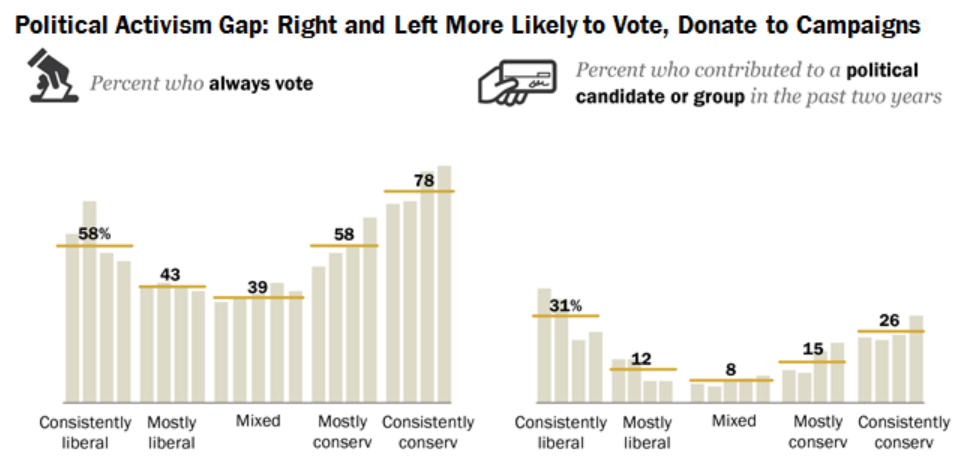
Polarization and The Median Voter Theorem: A Natural Experiment

Polarization and animosity between our two political parties has been rapidly increasing over the past two decades, both among voters and their representatives. In other words, the distribution of voter preferences over the Democrat-Republican spectrum is shifting from single peaked to double peaked.
This intense change in voter preferences provides a natural experiment to test characteristics about voter utility and behavior.

In class, we proved that, given certain assumptions, the median voter theorem holds under any distribution of voter preferences. Since the two new peaks of voter preferences are basically the same size, the median voter stays in the same place and policy should remain unchanged. In particular, we had to assume that abstention was not allowed or at least it was distributed evenly across the distribution, not concentrated in the tails by voters dissatisfied with centrist policies. If there were ideologically motivated abstensions, then a shift of voter preferences to opposite sides of the spectrum would spread the policies of each party apart as well. We can test which one of these models is more accurate by looking at the outcomes of voter turnout and government policies.

Do we see ideologically motivated abstention and diverging policy? No. In fact, it looks like the most extreme voters are also the most politically active.
Additionally, on most important metrics, the policies actually implemented by either party are still similar. Even though the rhetoric between Trump and Biden was more adversarial than ever, both have kept the border closed, both have kept high tariffs, both funded planned parenthood, neither instituted a national vaccine or mask mandate, neither raised the minimum wage, both spent trillions of dollars, both wanted to leave the middle east, and both highly regulated business.

So if the median voter theorem is still holding and policies haven’t diverged, why are the most extreme the most likely to vote and why do the parties and their voters seem to hate each other more than ever? The answer goes back to where voters get their utility. A parsimonious explanation is that voters are motivated more by tribal allegiances and an inherent utility from voting for a favorite team than by policy considerations. The most extreme voters are the most entrenched in the belief that their party is great and the other is a threat to American society, so they get the most utility from voting for their team, regardless of the policies either party passes. Parties want more of these most loyal followers so they fire up their rhetoric to energize their fans and polarize everyone to one side or the other. Hopefully this new strategy for satisfying voter preferences doesn't result in civil war!


Sunday, October 10, 2021

Sports Stadiums and Public Goods

     In my hometown of Tampa, Florida, there has been a big debate for a long time over the building of a new baseball stadium for our professional baseball team, the Tampa Bay Rays. Some people in the community have been eager to get a new stadium built, releasing plans for one with surrounding shops, restaurants, and apartments to provide benefits outside of just the stadium. The stadium could also be used as a venue for concerts, local celebrations, and anything else that requires a large space. However, they have had difficulty determining how much public money versus contributions by the team to use in order to fund the project. After our discussions about public versus private goods in class, this made me question whether this project or sports stadiums in general should be considered at least impure public goods (as Gruber puts it).

I would argue that a sports stadium project such as this should be at least considered an impure public good. It may seem like it would be rival in consumption, as there is only a limited capacity for a certain number of fans at every game/event that takes place. However, I believe it does have certain elements of non-rivalry because everyone gets to take part in the economic benefits awarded by having a new stadium (increased tourism, more notice of the area nationally, etc.) and in this particular case, no one is denied from using the new shops and restaurants developed in conjunction with the stadium. However, the stadium is excludable and cannot be a pure public good because the government/team can ban you from the stadium and there are capacity limits (tickets for the stadium and fire code for the restaurants/shops). But, the fact that a stadium such as this is both partially funded by the government and has elements of non-rivalry should at least make it classified as an impure public good. 


Saturday, October 09, 2021

Simple Majority vs Supermajority Costs

In this opinion article, the columnist is arguing for simple majority to rule in Congress for all decisions. He argues that many bills have not been passed even though the bills have had 51 supporters in the Senate and the Democrats will not get everything they want because their majority is too slim to get over the supermajority requirements, especially that associated with filibusters. He argues that simple majority should be the law of the land so as to be able to pass more laws that represent the beliefs of the majority.

However, this columnist is only looking at the decision-making costs and ignoring the external costs that Buchanan and Tullock present in The Calculus of Consent, Chapter 6. While reducing the requirement to simple majority may decrease decision-making costs in Congress as they would be able to pass more bills quicker, it will likely increase external costs. It would not be optimal to let Congress operate at a simple majority for issues that relate to individuals’ rights, freedoms, or overall welfare because the individuals' external costs will be much greater as it will have a greater impact on their daily lives. A simple majority would represent more than half of U.S. citizens, but a supermajority represents more people, and reduces the external costs associated with the vote because more people's interests are accounted for in the vote. As Buchanan and Tullock argue, there is an optimal Na that minimizes an individual’s costs. And so while this columnist makes a valid argument about the high decision-making costs associated with a supermajority, he does not address the high external costs associated with a simple majority. He only addresses the issues associated with supermajority but fails to address the drawbacks of a simple majority. He does not realize that the supermajority that Congress currently operates at might actually be the optimal Na. Therefore, it would be an inefficient move to switch to simple majority if the supermajority was Na as a move would be associated with increased costs for individual i.

Tariffs on China and American Economic Welfare

Tullock’s model of social welfare loss and allocative inefficiency due to tariffs is being exemplified by the United States’ ongoing trade war with China—especially in the context of goods that American producers depend on. We all know China is an economic powerhouse in terms of production. Thus, maintaining a relationship with them is in the interest of the United States from a commercial perspective. After all, trade creates value (Rotunda Principle #1). Imposing tariffs upon them, however, limits said value by preventing the markets for certain goods from clearing at their optimal (free-market) price and quantity. 

A January 2021 study commissioned by the U.S.C.B.C. (US-China Business Council) found that the tax on goods imported from China is restricting American economic growth. Further, a current decrease in exemptions from this policy is leading more and more firms that rely on China for key inputs to be thrown to the wolves of non-optimality. The Washington Post reports 87% of nearly 53,000 tariff exclusion requests have been denied by the Office of the U.S. Trade Representative as of mid-August. Consequently, there has been a reduction in quantity demanded in many markets amid these heightened input costs, which are being passed on to American consumers via retail price increases. That’s not the only issue. The aforementioned U.S.C.B.C. study found that the trade war with China has contributed to an estimated peak loss of 245,000 American jobs and limited real GDP potential by many tens of billions of dollars. 


Based on these findings, it is clear that the social marginal costs outweigh the social marginal benefits of this policy, so why does it remain in place? That answer isn’t as clear to me. What I am certain of, however, is that homoeconomicus would not be pleased with this market condition. 


Rent-Seeking in the Arts Market

In the art world, the value of art is defined by a small number of gatekeepers - the curators, gallery owners, and auctioneers. Therefore, the market is characterized by very subjective prices. This means corruption and collusions are incredibly common, such that art donors can turn a profit on it. Basically, when a person donates a piece to a non-profit museum, they can get a tax-write off. For example, when someone donates a piece that is valued at 10M dollars, they don't have to pay 4M taxes on 10M dollar worth of income, meaning that they save 4M from their pocket. The process of determining the art's worth is difficult and the IRS requires that each art to be professionally-appraised before the write-off. The manipulation of the appraisal process is where rent-seeking behaviors come in. Each year, among all art works donated that had been audited by the IRS, nearly 1/3 of them are overvalued by appraisers by 38%. IRS also only audit a selective amount of art donations each year, which enables donors to take chances with raising the true value of their art. This can happen very easily, where a wealthy art donor could buy off an appraiser to have the assessment price jacked up.  Essentially, a rich person could buy a piece of art for 4M, wait for its value to appreciate a little over the years, then look for an ideal appraiser, then donate the art for 10M and receive 4M in net tax benefit; at this time, they have already reached a break-even point. 

During this process described above, no additional wealth is created and the government is harmed because they lose tax revenue. This is a good example of rent-seeking that generates no value for the society in a highly exploitative market. The art market is indeed created by the rich and for the rich. 

Sunday, October 03, 2021

Omnibus Bills, The Modern Day Logroll

On Monday of last week, a judge in Arizona struck down a ban on face-mask mandates by school districts. The judge's reasoning was that the ban violated the "single-subject rule" for legislation due to its being passed as part of a large state budget bill. Her exact ruling stated that "the bill is classic logrolling - a medley of special interests cobbled together to force a vote for all or none." It's interesting to note, however, that in many ways this situation differs from classic logrolling. The traditional logrolling situation involves agreeing to vote affirmatively on separate issues in order to secure support on your own issue of choice. Arizona legislators, however, included all such issues in one single "omnibus" bill. Arizona is not an outlier here; the federal government frequently debates omnibus budget bills and is currently debating a multi-trillion dollar infrastructure bill that could easily be described as omnibus legislation. Given the proliferation of such bills, we have to ask if they even constitute logrolling and, if so, are they more efficient than traditional logrolling?

I agree with the Arizona judge that this does constitute logrolling. Each legislator can include their own priorities in exchange for agreeing to pass the entire bill. In other words, they convince others to support their own priorities by voting for the priorities of others. The entire process is simply condensed. Does this improve on classic logrolling? I argue that, on the whole, it does not. On the one hand, it eliminates the issues of cheating and bluffing that Mueller describes in 5.9. You can't renege on a deal when there is only a single vote. On the other hand, logrolling on such a large scale and involving so many tradeoffs amplifies possible inefficiencies and makes Tullock's concern with government overspending that much more important. Omnibus bills seem to be the natural evolution of traditional logrolling and highlight the inefficiencies that can come with it.

Jury Voting Costs for Criminal Trials

     In the American courts system all criminal trials require a unanimous jury decision to pass down a verdict. Hence Jury voting is an interesting application of External Costs and Decision-Making Costs as described in The Calculus of Consent chapter 6.

    The External Costs in a criminal trial are disproporiantly high for the accused since a conviction can result in the revoking of the inalienable rights of property, liberty, and in some states even life. However, External Costs for the Jury are low since it is unlikely that a jury member's utility is dependent on the livelihood of the defendant. I feel the requirement of a unanimous verdict for criminal convictions is justifiable due to the severity of the external costs imposed upon the defendant under a guilty verdict; the limiting or revoking of fundamental individual rights that pre-exist government. An implication of the unanimity requirement is higher decision-making costs since all jury members must vote for the same verdict (analogous to unanimous preferences). The main cost for jury members is the opportunity cost of their time which is best illustrated in the movie "12 angry men" where the protagonist is the holdout on a guilty vote which prevents another jury member from being able to watch a baseball game that night.

    It is interesting to study a non-economic field, Law, from a Public Choice economics perspective. Curious to hear others' thoughts about how I applied the concepts of External Costs and Decision-Making Costs or anything another perspective you all have about instances of collective choice in trials/law.