Tuesday, September 17, 2024

A Rambling Response to Another Class's Problem

My Intro to Public Policy class has several connections to Public Choice. More than just acting as a helpful review for this class, it’s fascinating to see public choice from the policy side so I can get a complete picture of the topic. We’re currently discussing market failures and comparing the effects of government intervention and failures to market intervention and failures, specifically around the climate crisis. An article by the economist Paul Krugman, advocating for government intervention, promoted Pigouvian taxes to limit pollution. Another article by the economist John C. Goodman advocated for a Coasian solution, trying to limit transaction costs by using the market instead of government.


I disagree with many of Goodman's points, but I'll focus my attention on his view of politics and climate change. He claims politicians have no incentive to move toward a Pareto optimal condition. I would disagree. In a representative form of government, politicians only hold power because the people placed them there in the first place. To argue that politicians won’t move toward a socially optimal equilibrium is wrong. Take, for example, the use of Pigouvian taxes mentioned in Krugman's article. There, politicians tried to manipulate the market toward a socially optimal point, minimizing the negative production externalities of climate change.


Goodman claims climate change results from a government failure, not a market one. Government inaction has indeed placed us in this position. However, a push toward profit maximization, spurred by Adam Smith’s ideas, led to the Industrial Revolution. The Industrial Revolution led to massive amounts of pollution and climate change. Government has had the chance to mitigate the effects of climate change through Pigouvian methods, but proponents of a free market solution have curbed their ability to succeed. Effective governments can help their citizens in ways markets cannot, a point Goodman seems to miss here.

A Pure Theory of College Classes

College classes seem to mimic Tiebout’s explanation of neighborhoods, in a way. Just as local government public goods provisions are given and the entity that adjusts is consumer-voters, class rules, policies, and topics are given and students must pick between them. Just as with realistic neighborhoods, Tiebout’s assumptions do not hold up perfectly when applied to the world of college classes. Perfect mobility ends with the add/drop deadline and may never exist at all given that some classes require prerequisites or approval to get into. Perfect information is helped by sites such as Course Forum, but one doesn’t know exactly what the assignments and professor will be like, even after reading the syllabus. There is a relatively large set of class choices, but availability depends on one’s enrollment time. “Job constraints” in this context translate to one’s required major classes, which of course constrain choices. In terms of externalities, I would argue that classes absolutely affect each other in terms of how the room is left and how much energy/time students have left to devote to other classes. However, optimal n* class size definitely holds up and professors make attempts to reach this size by setting a cap and may even promote their class to arrive at n* students.


Despite these imperfect assumptions, we can learn something from the application of Tiebout’s model to classes. It makes the case for “local” decisions. By letting departments/professors design their own courses students are left with a market of choices from which to choose from, as opposed to administration mandating all classes to be offered. With this system students are able to choose their optimal revenue-expenditure patterns (how much work a class requires and what one can learn from it).

Sunday, September 15, 2024

Allies or Freeloaders?

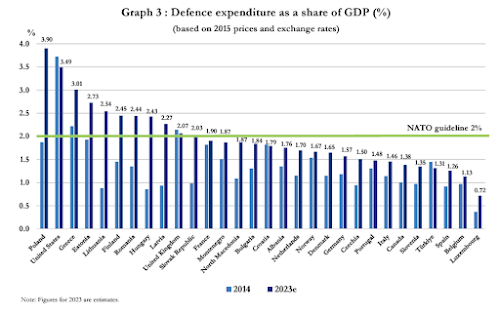
In 2006 NATO mandated its members to spend 2% of their GDP on military defense. As of 2023, only 10 of the 32 countries were hitting this target. Without any enforcement mechanism, this is an example of the free rider problem. 

The mandated spending program exists to share the burden of protection amongst all members of NATO, making them stronger as a collective. Although all countries are required to spend 2%, this does not mean the same amount is contributed by each member. The United States is projected to spend 3.38% of its GDP in 2024 compared to Poland’s 4.12%, however, the U.S.’s contributions account for two-thirds of NATO’s overall military spending. Other countries have an incentive to free ride off of the contributions of these big spenders without contributing their share, secure in the expectation of aid. Instead of pushing to reach their 2% minimum, they drag their feet, slowly increasing over years. Following Summer 2024, 23 countries are expected to reach the required spending, a massive increase in one year. This suggests two things: first, they were capable of reaching the spending floor the entire time and, second, there is a threat incentivizing them to increase individual military spending. The first reinforces the notion that this has been a problem of free riding for 18 years and the second is a sign of a potential war. 


Thursday, September 12, 2024

Club Running: A Public Good?

The Running Club at UVA is up there as one of the most disliked clubs around grounds. We are the weirdos who live for the pain, jogging mile after mile in tank tops and short shorts. But, as a Club Running Economist, I was wondering: can the club be considered a public good? To be considered a pure public good, it must be both non-rival and non-excludable. For the purposes of this discussion, I will consider Club Running to be non-excludable, as it is in our Constitution that anyone can join us. By technicality, we could prevent someone from running with us, but to me that would be like forcing someone out of a public park.

The real question comes with non-rivalry. When more people run with us, does the utility of my run increase or decrease? Certainly, there are many social benefits involved with running as a group, such as group motivation and improved performance through competition. However, when the group size gets too large, I start to worry about tripping over someone else's legs, and it can be overwhelming to run with so many people you don't know. Thus, as n = 1 runners in the group begins to increase, initially my utility also increases (non-rivalry), however, as n continues to rise, my utility starts to decrease as I worry about falling. This ultimately means that with large groups, I enjoy my runs less. Because of this, it seems although at some points there is non-rivalry, I cannot consider Club Running to be a pure public good.


Wednesday, September 11, 2024

The Public Good of Success

            As a member of the baseball team at UVA over the past two years, I’ve been fortunate to be a part of two very successful seasons. While not very easily quantified, the success of our team in its most basic sense can be viewed as a public good— each individual member adds different production to the team, amounting in some level of success throughout the season which everyone can benefit from. Although it is not quite pure since members can receive more or less benefit depending on how they contribute, everyone receives some level of benefit at the end of the season.

My two years as a member of this team provide a good example of how the team’s success is a public good. Our team reached the College World Series in each of the last two years, which provides a nice control for the public good (our overall team success). In my first year I contributed greatly on the field, but last year I missed around ¾ of the season with an injury. Even though my contributions varied greatly, in both years I got to benefit from being a member of a championship team.


While technically Gruberch would consider me a free rider last year by circumstance, our team can generally mitigate the deliberate free rider problem. Gruberch mentions in chapter 7 how in more trusting communities, the free rider problem occurs less. Immense trust in each other is one of the core foundations instilled in our team culture, which is likely a large reason why free riders are uncommon within our community.

Sign posted around the baseball stadium,
shows commitment and trust in our team community

Above the Clouds, Beneath the Trash: Everest's Waste Problem

After visiting a climbing gym with friends this summer, I briefly entertained the idea that I might someday summit Everest. Although my initial optimism has since waned, I afterward went down a rabbit hole of Moutain Everest documentaries. Each documentary posed an almost insurmountable problem: the accumulating waste on Everest. 

Beyond Camps Three and Four, climbers face steeper terrain, increased physical exertion, and the need to rely on oxygen tanks. Unfortunately, many climbers shed their used gear once it's no longer needed, leaving thousands of empty oxygen canisters, tents, and waste on the once-pristine slopes. For individual climbers, it’s beneficial to discard used gear to lighten their descent. However, this practice diminishes the experience for others by contributing to the significant litter problem on Everest. The complexity of cleanup is further compounded by the fact that only experienced climbers can perform such tasks, and each climber is limited to carrying an additional 25–30 pounds.

What's the solution? The Nepalese government plans to impose an additional $4,000 fee per climber, raising the cost of a foreign permit to nearly $15,000, and limiting the number of climbers each season. In a sense, Nepal is creating a market for climbers (litterers) and placing an extra tax on them to combat the peak's desecration. While this policy may aid future cleanup efforts, the current solution still relies heavily on the goodwill of climbers to protect the mountain from becoming an even larger landfill.

Tuesday, September 10, 2024

Cops and Donuts

 During the Gruber reading he talks about externalities focusing on the polluted streams example though he makes reference to others. One in particular that I found interesting was the example of the donut shop and the neighborhood. In this example the  cost of police protection wasn’t factored in donut cost. I found it interesting because I’ve heard that reference before but didn’t know the origin so I decided to look further into it. 


The cops and donuts stereotype began in the 40s. Donut shops were the only stores open all night so policemen would often eat there. Since donut shops were the only ones open late this made them susceptible to theft and other crimes. This made for a symbiotic relationship as security was expensive and policemen were able to enjoy a quick snack. However this is also an example of a positive consumer externality because the policemen provided protection without receiving any added benefits.

Sunday, September 08, 2024

The Battle of the Courts

While walking, a friend and avid pickleball player shared she had “used tennis courts when pickleball courts were full but felt bad about it. They hate that.”

This didn’t sit well with my inner economist. Tennis courts are accessible to all UVA students; why can’t they be used in whatever way maximizes students' utility? If pickleball courts are overpopulated and tennis ones are not, the market is demanding more pickleball than tennis. Why is moral wrongdoing placed on pickleball players?


To approach this situation from a Coasian perspective, I considered property rights. According to social norms, pickleball courts belong to pickleball players and tennis courts belong to tennis players. UVA’s online court booking system helps assume low transaction costs.


The irreciprocal nature of court usage–tennis courts can be used for pickleball but pickleball courts are too short for tennis–means pickleball players always impose on tennis players’ property rights. In order to most efficiently use university resources, pickleball players could pay damages to tennis players for their repurposed court time slots. From a practical perspective, however, delineating people who were genuinely planning on playing tennis from those booking online slots just to resell them would be challenging.


Government Monopoly On Grounds

In the reading Role of Government in a Free Society, Milton Friedman argues that natural monopolies are a threat to strictly voluntary exchange. One of the possible, although not preferred by Friedman, solutions is a public monopoly: the government itself takes over the private firm and manages its business activities. 

In our class discussion about examples of public monopolies, I was reminded of a global sustainability class where I learned that the city of Charlottesville owns the gas utility that services the area. Charlottesville Gas is a municipality-owned natural gas utility and a prime example of a public monopoly. The high entry costs of laying down additional natural gas pipes to both new and existing infrastructure constitute some of the barriers that discouraged other competing firms from entering the market and thus created the conditions of a natural monopoly that the city decided was best addressed through government ownership. The city controls manages pipe construction and gas prices while residents pay their gas bill directly to the city. Fun fact: if you are constructing a new building in Charlottesville, the city will build natural gas piping that connects to the new building for FREE.

Border Burden in Texas

The influx of immigrants crossing the US-Mexico border raises significant economic concerns, particularly related to the free-rider problem. Public goods such as healthcare and education are generally funded by taxpayer dollars. Public goods are characterized by their non-excludability, meaning that regardless of how much one group contributes to their funding, the goods are available to everyone. This trait in particular can lead to the free-rider problem, especially for border states like Texas. According to Debusmann, thousands of immigrants pour into the US daily, and they are crossing and staying without paying taxes. 

Under the Biden administration, Texas has been ordered to provide accommodation for the immigrants regardless of their immigration status as Biden strives to hold to the United State’s original anthem of being a harbor for refugees. However, this has been a point of contention in the political sphere even resulting in legal battles between the state of Texas and the federal government. This free-rider scenario has resulted in a negative ripple effect on much of the nation lining the border. As of August 9th, Texas Governor Greg Abbott mandated that hospitals collect the immigration status of patients starting November 1, 2024 to “hold the Biden administration ‘accountable’ for its ‘costly and dangerous’ border policies”. In this mandate, Governor Abbott explains that, “Texans should not have to shoulder the burden of financially supporting medical care for illegal immigrants.” This mandate attempts to address the free-rider problem at the southern border: Texans are paying taxes to fund public goods, yet these immigrants are using these goods without paying taxes themselves. This increasing number of immigrants is inadvertently putting strain on the quality and availability of these public resources for everyone else in Texas as a result.

No love: Lead is in the air

I grew up in Eagan, Minnesota, a suburb of Minneapolis. Each morning on my way to school, my skyline consisted not of the Foshay Tower and U.S. Bank Stadium (highlights of Minneapolis), but rather the billowing smokestacks of Eagan’s Gopher Resource recycling plant. My elementary and middle school was less than a mile from the plant, and I often wondered what exactly was spewing out of those chimneys. 

(This is the plant's good side)

While caught in a doom scroll on Instagram last week, I came across an ad for a class-action lawsuit against Gopher Resource in Eagan. The settlement payout includes those who “lived within, attended a school within or worked within one mile of the stack of the Eagan Facility from January 1, 2000 to July 24, 2024”. I went 3/3. The settlement claims that the facility exposed me and my neighbors to “lead, cadmium, arsenic, sulfur dioxide” and other chemicals that I would rather not inhale. My exposure to these chemicals is a negative production externality; because this plant polluted the environment, I suffer the consequences. 

A father whose child attended school near a different Gopher Resource plant in Florida originally filed suit. In making this decision, he opted against a Coasian resolution to this problem, settling instead for collective action and state intervention. While Coase would say this is outside of the government’s intended role, I’ll certainly enjoy the extra cash in my wallet.


Friday, September 06, 2024

Free riding is rubbish

 Last year I lived on Rugby Road and would walk down Chancellor Street to get to the corner. I remember at the beginning of last year that my journey became more and more unpleasant due to an ever accumulating pile of trash and boxes on the sidewalk of Chancellor Street. After a couple weeks it got so bad that the boxes blocked the entire sidewalk and I was forced to increase the riskiness of my trek by venturing into the street just to get around this mess. As a third party who did not live on Chancellor Street, a negative externality was being imposed on me. How rude, I thought to myself–the residents leaving their boxes on the sidewalk are only considering their marginal private cost (and MPB), not the higher marginal social cost of them producing this trash. I suppose I could’ve offered them a Coasian solution such as paying them to remove their boxes, but magically one day they disappeared and I never thought about it again…


…until now. The tables have turned and I am now a resident of Chancellor Street. I now see that trash is a fee based service. Even though we pay, for some reason Charlottesville doesn’t collect our large boxes and they have now accumulated to a sidewalk-blocking level. Now that I am no longer a third party, I have a bit more insight into why this problem persists. The trash bins are shared between six different units. Hence, we have a free rider problem. There are many of us who could remove this trash ourselves or call the trash service and get it sorted out, but we all hope someone else will take this cost on. All residents of the six units will get the benefit of a cleaner sidewalk regardless of who bites the bullet and cleans it up, so alas we are in a stalemate of wills.


Tuesday, September 03, 2024

Free Markets and Small Government: The Cure to the Healthcare Crisis

Though government schemes such as Medicare exist, the healthcare system in the U.S. is mostly privatized, using markets to distribute healthcare resources according to individual demand. However, many problems persist, including an effective monopoly in the pharmaceutical industry, primarily due to poor execution of patent laws and firms lobbying a government which holds far too much power to interfere in markets, which, much of the time, fare better if left to their own devices. 

Conversely, suggesting in an assembly of a European government that markets should be utilized to distribute healthcare would be political suicide. Policy in these settings is dictated by the belief that healthcare is a human right, making any proposal for market-based solutions appear morally suspect. Even American proponents of a single-payer system seldom focus on efficiency, instead opting to frame any opponents to their ideals as driven solely by “profit” - a buzzword often used to discredit market systems. I propose that a market solution could distribute healthcare more efficiently than a government service such as the NHS. If predatory monopolies can be addressed, markets could reach an efficient allocation of healthcare resources, which is unlikely under government control, as that would necessarily lead to a public monopoly, or a monopoly propped up by government regulation and assistance, which, according to Milton Friedman, is far from desirable. Thus, the most moral and efficient way to distribute healthcare is through a market system and the notion that economists are committing a moral evil by opposing government monopolies of healthcare is unfounded.

Sunday, September 01, 2024

The Genomic Gold Rush

My biology class on DNA was just visited by Eric Green, the director of the National Human Genome Research Institute and a significant participant in the Human Genome Project (HGP).

Originally a $2.7 billion dollar project approved by Congress and funded by the NIH, the HGP focused on sequencing the human genome in its entirety. Unlike USPS’s monopoly on US letter delivery, this government-funded endeavor was not legally protected as a monopoly. A race to be the first to completely sequence the human genome ensued between the HGP and the private company Celera.


The HGP presents an interesting overlay of several concepts discussed in class; the extraordinary start-up costs required for early sequencing efforts (namely the equipment and specialized labor) means it exhibited some characteristics of an economy of scale, but not so much as to wholly prevent competition. The HGP involved government action opposed by some congressmen, introducing Friedman's "strain" to society. The HGP is now widely regarded as a positive externality, benefiting humanity by aiding in the development of medical advancements such as gene therapies, custom medications, and earlier disease diagnoses. Although the "race" ended in a tie, by competing with Celera and providing publicly accessible data, the HGP prevented monetization of the human genome through Celera’s planned subscription service.

Wednesday, November 29, 2023

Where is my Monégasque passport, Tiebout?

The Annual Monaco Yacht Show occurred recently, and if you already knew that, you should consider paying the estate tax. As I was reading about the show and its picturesque setting, I wondered what it would be like to live in Monaco. If Tiebout's assumptions all held, many people (perhaps including myself) would move there. But they haven't, so they don't. Let's see why:

1. Perfect mobility. Tell that to my couch.

2. Perfect knowledge. Monaco is pretty in the pictures I've seen of it. But do I know the details of their taxation system? Their public services and regulations? Their freedoms and law? The answer comes readily when I note that I know little of those things for the city in which I have always lived.

Skipping to 4. No employment restrictions. In case I got sick of the job search here in the USA, Monaco has preemptively made it nearly impossible for me to work within its borders. Back to LinkedIn it is...

5. No externalities to Revenue Expenditure Patterns. Monaco does not fund its own defense, but instead relies implicitly and explicitly on its friends and neighbors. Being surrounded by Europe has its advantages.


Sunday, November 19, 2023

Condorcet's Paradox Through the Eyes of Borda

This past Thursday, me and two of my suitemates were deciding on a single activity to do together as we wouldn't be seeing each other for a while due to Thanksgiving break. I wanted to play a few rounds of Mario Kart, Quinn wanted to play poker, and Raj wanted to watch Stranger Things. As we started to discuss our various preferences for the activities, I started to draw them out in the table below
Upon examining the table, I quickly realized that our group preferences were intransitive and would result in Condorcet's Paradox. I explained to my suitemates that our votes, aligned with our preferences, would perpetuate a cycle unless someone changed their preference and consequently their vote. My suitemates were a little confused with my explanation (I got really excited in explaining but wasn't as clear as Professor Coppock) and asked me to model this with the Borda Count which had helped us pick an activity for Diwali last week. I agreed and gave 1st preference 3 points, 2nd preference 2 points, and 3rd preference 1 point.
Showing them the numerical calculation helped them understand my explanation from earlier, and in a non-economist fashion we decided to call our last suitemate (who had gone home earlier in the day) for his input and he said he would watch Stranger Things as a first choice which allowed us to make our decision for the evening!

"Any Economist Can Cook!"

Incontestably the greatest movie of its time, Ratatouille captivates with its mouth-watering meals, comical characters, and superb writing that appeals to all ages. However, upon closer examination this Pixar film can also be hailed as a perfect ode to Economics, specifically the Principal-Agent Problem (PAP). 

The PAP can be summarized as a conflict of interests amongst a principal (employer/boss) and the agent (an employee, or party entrusted to carry out the wishes of the principal). The agent is essentially incentivized to behave in a way that conflicts with the principle, hence the PAP. In Ratatouille, Gusteau and Chef Skinner can be likened to the Principal and Agent respectively. 

Gusteau asserts that his restaurant should be the home exceptional and innovative cuisine, focusing on the artistry and joy of cooking. However, Skinner is more concerned with protecting the restaurant's reputation and profits. When Gusteau dies, Skinner seizes the opportunity to use Gusteau's image and name to market and sell a line of frozen foods, prioritizing financial gain over Gusteau's culinary principles. This situation exemplifies the PAP as Skinner, the agent, deviates from Gusteau's original vision for the restaurant as an employee of the restaurant, pursuing personal interests (financial success) at the expense of the true essence of Gusteau's culinary philosophy.

Luckily for us, this PAP was resolved by the artistic, persistent actions of Remi the rat who studied economics in between cooking meals

Forcing PPL Out of Ignorance

 About a month and a half ago I wrote a blog post called "Just Some Rationally Ignorant PPL" where I discussed how bringing up the justification of voter ignorance wouldn't go well in one of my classes (Law, Morality, and the State). Well, I was in a debate for that class on democracy, and I decided to rock their worlds by imparting some serious wisdom. I'm kidding, but I did bring it up.

I had to argue against Kevin Elliott's claims in Democracy for Busy People and defend mini-publics to become a mainstay of our democracy. Basically, I had to argue for groups of randomly selected citizens to act as our governing bodies rather than our current system of direct democracy. While this was a bit of a challenge, I drew from some of my economic knowledge. 

One of my arguments relied on our little friend p*B + D - C ≥ 0. Elliott was concerned about participation in democracy, and thought demanding forms (like mini-publics) would hurt it. He wanted instead to make voting as easy as possible to discourage apathy. My argument was that since our p, the likelihood your vote matters, is so small in direct democracy, changing your costs makes virtually no difference so long as there is any cost at all. If we instead increase our p, which mini-publics will do significantly for those selected, citizens perviously apathetic to politics will have a strong reason to be participate. This reason to participate might even encourage a deeper level of understanding in policy which could increase B as citizens become more invested, further increasing their expected utility for voting. 

I was never planning on discussing the role rational ignorance plays in politics with my classmates, but alas, their rational ignorance on rational ignorance was broken. 

Virtue Signaling for the Median Consumer

One of the effects of the spatial location theory that we briefly discussed in class is the consequence of under-representation. Citizens on the outskirts of Charlottesville have to drive 20 minutes for fried chicken. People on the end of the beach have to walk a mile to get a hot dog. In the eyes of preference-outliers, it may appear that firms are discriminating against them, when, in reality, firms are incentivized to maximize profits by appealing to the median consumer.

With a greater emphasis on diversity and inclusion in recent years across American businesses, one might question whether the spatial location theory still holds up. Why do companies now appeal to the minority groups on the ends of their consumer base spectrum? Did they become benevolent?


In the case of LGBT inclusion, it’s clear that firms are trying to maximize profits and appeal to the median consumer rather than having some altruistic motivation. When looking at which companies changed their logos for pride month last year, there is an industry and geographical bias. Mercedes-Benz changed their logo in North American and European countries where tolerance is higher, while maintaining their standard logo in Middle Eastern and Asian countries. Big Pharma expressed unanimous support, and coincidentally happen to profit greatly from the lifelong drugs they sell for transgender treatment and gender dysphoria. Whether the median consumer identifies as LGBT or has pro-LGBT views and gets utility buying from a like-minded brand, spatial location theory remains an accurate explanation for the “inclusive” activities of firms today.

Don't tell me what to do

Last weekend I was engaged in a political conversation with my parents and my aunt and uncle. They are all very concerned about a potential Donald Trump presidency. My beliefs are not so certain as theirs are, meaning I would not identify as a Democrat when they all would; but, I definitely tend to have more liberal beliefs. In the conversation they basically told me that I had to vote for Biden because any vote not for Biden would be beneficial for DJT. As soon as they told me I had to do something my "dont tell me what to do" hat came on. I told them that I do not need to do anything because, at the end of the day, my vote will not put Biden or Trump in office, so I can vote for either or neither and it won't make a difference. I also said I would prefer to vote for a third party candidate because I don't really like Trump or Biden. My uncle immediately said that I cant do that because if I voted for someone other than Biden it is basically a vote for Trump. They gave me compelling reasons as why another Trump presidency would be dangerous for American democracy, as well as reminding me about our family members that would be marginalized by the policies Trump would want to enact. This all has influenced my willingness to vote because of the D in p * B + D - C >= 0. D in this case is social pressure from my family and it is very powerful. I still am unsure if I will vote (either for Biden or a third candidate), but I am more compelled to vote because my family really wants me to and I would also be voting thinking of other people who would be negatively impacted more than I would from a Trump return to office.  

Karachi's Water Tanker Mafia

Last week, I called my cousin in Pakistan. He is visiting Karachi and was complaining about how often the water runs out there. At one point, he'd been in the middle of washing his face when the faucet ran dry! Why does Karachi have such a bad water shortage problem? Because of its notorious water tanker mafia. 

Water is supposed to be provided by a state-run institution, the KWSB, but inadequate supply has led to private vendors selling water at exorbitant prices. Additionally, the tanker mafia will illegally steal water from government-owned pumps, then sell it back to citizens. 

The problem's gotten worse because Karachi elected officials are idealogical "shirkers" - many now collude with the mafia. Karachi politics is strongly divided along ethnic lines. Politicians of different ethnicities will collaborate with the tanker mafia and tell voters the relationship will be used to divert water to their neighborhoods: they take advantage of voter ignorance to shirk. 

In reality, the water either goes to their own homes, or to other interest groups in the party apparatus. In a system as corrupt as Pakistan's, the support of those officials is more important than the average voter's, anyways. Selling water is also lucrative: in Karachi's economy, it is akin to selling gold

Voters appear to be less ignorant as the situation continues to worsen, and mafia connections apparently do little to boost candidate votes. Still, the mafia is unlikely to disappear any time soon.

The Grand Inquisitor

The theory of agency autonomy reminded me of the Grand Inquisitor section of The Brothers Karamazov. Here, Dostoevsky imagines a scenario where Jesus has returned to Earth, only to be imprisoned by a church leader: the Grand Inquisitor. The Inquisitor tells Jesus free will has doomed humanity and argues the "deceit" of church bureaucracy is needed to save everyone from the "torments" of choice. 

Dostoevsky's religious critiques fit nicely into this economic framework.

The "principal" is Jesus/God. The self-appointed "agency" is the church; the Inquisitor is their "Chief Bureaucrat." God's will, aka what the principal requires of the agent, is the spread of Christianity. 

The church is the monopolistic supplier of Christianity. The clergy supplies their own interpretation of the religion to the "uneducated masses," who can obtain no alternatives. This "output" is "take-it-or-leave-it," since Jesus isn't physically present to negotiate on behalf of the masses, or recruit better bureaucrats. This ties to a monitoring problem - who checks the power of this agency? God?

Only the Grand Inquisitor knows the true cost schedule for these services. Rather than maximizing for "budget," he maximizes for "influence," which grants him prestige/perks in this life and, allegedly, God's favor in the afterlife. 

Why I have never voted

Over this semester, I have avoided admitting to the class one of my deepest ideological convictions, out of (1) epistemological humility, knowing that I may be persuaded against my own beliefs as a result of this course, and (2) slight aversion to conflict. For the same reasons, I have not identified myself to any of my classes, until now, since I need to write one more blog post. 

I am an anarchist

As a result of my ideological disposition, my rational voting equation ( pB + D - C ≥ 0 ) is such that my D is actually negative. To wear an ‘I voted’ sticker would be to signal to my peers that I participated in the very thing I detest: government. This is not to say that I do not have preferences on issues being voted upon, since many of my preferences are actually quite strong. I simply do not believe that I, or anyone else (representatives or voters), have the right to impose preferences upon others without voluntary consent. This is to say that unanimity for purposes of collective action would be, in my perception, the only morally acceptable voting rule.

Furthermore, I actually gain a bit of utility from telling friends that I did not vote. Given the high 'civic duty’ that so many others perceive, many people have difficulty wrapping their heads around my thought process, which occasionally makes for fun conversation.

[I have no goal of convincing others, and I am aware that I am a preference outlier]

Saturday, November 18, 2023

The Failure of the Local Bureaucracy

 As a native of Albemarle County, I am quite connected to the local school system, known as Albemarle County Public Schools or ACPS. Growing up, ACPS was known for its accepting community and strength of education, while not making the environment overly competitive or toxic. However, as a result of bureaucratic changes in recent years, ACPS has gone from being the sort of school system that one might want to move to and instead a place from which they would want to leave. And while I'm glad that I have escaped the horrid nature of the current school system, my sister is still trapped in it, giving me a reason to still feel invested.

The full story of what has recently happened with ACPS is a long one, so the short of it is that as a result of new policies that are being pushed through by bureaucrats, "half of all county schools failed to achieve acceptable state accreditation ratings in the last year." The head of this, or the Senior Bureaucrat as Niskanen might say, is Superintendent Matthew Haas. When the voters signed a petition to prevent his contract from getting renewed, his office blamed the School Board instead. This problem is most certainly of the principal-agent variety, seeing as parents put their kids in school to get an education, and they vote for members of the School Board to put in place policies that agree with their ideals. Somewhere along the road, something appears to have been lost in translation, to the point that the bureaucrats are openly hostile to the voters, who are the people who are indirectly putting them in power in the first place.

psl(F)

Public Service Loan Forgiveness (PSLF), envisioned as a transformative solution for public sector workers drowning in student debt, faces a daunting bureaucratic reality. Despite a potential target audience of 25% of the workforce, the program's impact remains remarkably low. A mere 6.9% of eligible borrowers applied, with only 2.3% approved since its inception, highlighting a stark misalignment between potential and actual relief.

The bureaucratic lens, guided by Mueller's insights into power maximization, reveals a troubling disconnect. Bureaucrats, inherently driven by goals such as salary, power, and patronage, may inadvertently hinder the very program designed to alleviate debt burdens. The PSLF program, riddled with administrative hurdles like annual certifications and complex applications, mirrors the bureaucratic dilemma – a struggle between intended relief and unintentional barriers. The intricate dance between bureaucracy and public service dynamics echoes Mueller's model of bureaucratic behavior, where power maximization overshadows program efficacy.

The PSLF program's potential impact, thwarted by low participation rates, racial disparities, and bureaucratic challenges, highlights the need to reevaluate its design and implementation. As political actors navigate the economic landscape, understanding these dynamics becomes paramount in assessing the tangible impact of policies designed to shape our financial future. The PSLF program, in its current form, falls way short of its transformative potential. If I was a teacher (especially one eligible for PSLF), I would give the program an F for Failure, not for Forgiveness.

Friday, November 17, 2023

Ice Cream Galore

When comparing and discussing the theories of congressional dominance and agency autonomy, I thought of the housing program I am in at UVA. I live in a house with 12 girls, and we are part of a program with 7 guys. In this program, we receive funding for Thursday night dinners. We rotate the cook team that must buy groceries and make dinner for everyone, and the cook team gets reimbursed for the groceries. We have a budget of $175 from the stud to spend per dinner. The stud staff attempts to keep us under budget, explaining that the money we don’t use can go to other uses. However, when we haven’t used the money, it seems to just disappear… I’m sure it’s used for something, but it’s not used directly for us. In other words, we don’t get the direct benefit. AND after maxing out our $125 budget for every meal one semester, our budget got upped. So there are large incentives to use the whole budget: we get the direct benefit of the food bought, and using all of it could lead to increased budgeted money. So, we have a collective agreement. When the grocery shoppers are under budget, what do they do? Buy ice cream. Our freezers are overflowing with ice cream, and we get the benefit of all the money budgeted to our program. Plus, there’s the chance we’ll get more money the next semester, and thus, more ice cream. This is the same problem we have with bureaucracies budget maximizing! Like bureaucracies push past providing the optimal amount of their service, we push past the optimal point of ice cream in order to maximize our budget. 

Not so rotten kids

 College students enjoy brand new freedoms – being able to design their schedules, pick their majors, and engage in new social activities. However, in this new quest of separation and individuation – natural to adolescence – you often hear students still doing what their parents want. 


Now this may be out of love, but I want to consider the deeper reason why a “latent” group like newly solo college students may still respond to their parents’ desires: selective incentives. Olson writes that the only “organizations” with the ability to be coercive or have positive incentives. And parents have both of those! They pay for your tuition and provide a place to sleep during break – so that’s quite the coercive power. They are also (generally) very loving – and may even show extra affection should you follow their wishes – like my mom when I promise her not to ride Veo scooters. 


The idea that kids generally grow to be harmonious and obedient is not new. Becker explored this in his Rotten Kid Theorem, holding that due to the selective incentive power of parents, even your most rotten kids will be heavily incentivized to be well-behaved in the eyes of their parents.

A career in politics? Nah. Give me civil society.

In high school, I dreamed of a career in politics so that I could make a positive impact by writing legislation (or more likely, by allocating budget money to bureaucrats who create policy). But my interests have shifted more to for-profit jobs. Why the change? I derive less utility from pursuing political, ideological behavior. As Kalt and Zupan discuss in their paper, “pursuit of such a [civic] duty is a consumption activity that yields utility in the form of the warm glow of moral rectitude” (280). Looking at our grand challenges, increasing polarization, and worsening cynicism, I realized how difficult it would make a positive impact in politics right now. I no longer get as much of a warm glow from thinking about politics, and my opportunity costs have risen with the skills I have developed in college.

But all is not lost. I still care about civil society (and I know you do too). Michael Walzer defines “civil society” as the space of uncoerced human association and relational networks that form from our interactions with one another. Think about your place of worship, your neighborhood, the school you attend, the CIOs you are a part of, your workplace, etc. These are the places we choose to spend our time, where we take greater interest in the lives of one another, where our utility functions are more tied together, and where we overcome rational ignorance. The stakes here are lower than the political arena, and we have a greater ability to influence the local environment. It's where our interests reach farther than our egocentric goals and where we stay engaged with one another.

So long as we remain invested in the personal relationships we create with one another, we can all reap the “profits” as residual claimants in the shared endeavors that form civil society.

Thursday, November 16, 2023

The Bullet Budget

The summer after my first year, I was a first-hand beneficiary of bureaucratic surplus. For Naval ROTC after first year, everyone spends a month in San Diego where we get a week each with the Surface Navy, Naval Aviation, Submarines, and the Marine Corps to get a sense of what our jobs will be like after graduation. During our Marine week, we were scheduled to go to a range to shoot M240s. We were the last group to go, and we were all supposed to get 100 rounds to shoot. After everyone shot, the Marines realized there was still a lot of unused ammunition. They said that they were required to use all of the ammunition every time they went to the range, so they gave us each another turn shooting. During this, I heard some of the officers joking about how if they were given the ammo they better shoot it or they won't get it again. These Marines are bureaucrats adhering to the fifth assumption in the Agency Autonomy theory which is that the agency exhausts the entire budget. They knew that if they didn't use all the ammunition that they were given for this exercise, the next budget may be smaller to eliminate the waste. The Marine Corps and the DoD as a whole want to maintain as high a budget as possible. By maximizing the budget, the utility of the senior bureaucrat is maximized which is the foundation of the Niskanen model. They use their entire budget, including all the ammunition they are given, in order to prove to Congress that the money they received for the last year was necessary for their operations when in fact it was just used so that some college kids could have fun shooting a second time. 

The Surplus

Many of life's greatest lessons can be learned from The Office (the American version that is). And no Office character exhibits this microcosm of deep knowledge than the one and only Michael Scott. For those of you who haven't watched the show or don't know who Michael is, how do I put this...let's say that he's interesting. In the "The Surplus" episode, Michael is made aware (like a 5 year old) the branch has a $4300 surplus that it "needs to spend", or it will be removed from the budget the following year. Factions form in the office and tensions rise between the copier and chair lobbyists. But wait, there's more! Michael is also made aware that he could receive an individual bonus for returning the surplus to "corporate".

Besides being a humorous situation, this scenario applies some of the concepts about bureaucracy from Weingast and Marshall. Not only is the principal-agent problem very evident ("corporate" and shareholders want costs lowered, but the agents [employees] are looking to maximize their own benefit/utility by buying an expensive chair or copier) but we also see the behavior of Senior Bureaucrat (Michael) affected by the maximization of his power and salary, both related to the size of the budget he oversees. 

Wednesday, November 15, 2023

Bureaucracy of Hitting a Shark

 Recently, Lex Fridman had Elon on his podcast and they just so happened to talk about his recent struggle with bureaucracies, specifically the U.S. Fish and Wildlife Service (FWS). Elon (as billionaire often do) is trying to launch his rocket, Starship, into space; but he's spent the last few months jumping through some peculiar hoops to do so. 

First, FWS was EXTREMELY concerned about a shark or whale getting his by his rocket on descent. Now you would think they could pretty quickly calculate the probability of this occurring, but it took a few months of dealing with permissions issues and data moving back and forth through internal departments for them to figure it out. Turns out... P(Rocket hitting shark/whale) = pretty much 0.

Then, they were worried about the sonic booms of the rocket launch may disrupt seal procreation in California. To prove this wasn't the case Starlink kidnapped a seal, put headphones on it, and played sonic boom sounds to it...twice. (I swear the picture below is real)

SpaceX VAFB landing facilities


We, the voters, indirectly paid this organization $3.7 billion in 2023. Because we're all rationally ignorant individuals, I highly doubt any of us know in depth what this organization does day to day or even knew it existed at all. However, even if we did, how would we measure their output? The amount of sharks they save from rockets, the number of seals born, or how much they annoy Elon Musk? It is possible that these monitoring problems play significant role in extremely slow and expensive processes or their huge budget. 

Sororities & Bureaucracies

     I currently hold the position of president of my sorority. I oversee eight vice presidents and each of the VPs has a few subsequent Directors that work under them as well. In a way, each of my VPs act as the Senior Bureaucrat of their ‘bureau’, which in this case is their area of expertise, whether that be managing our chapter’s finances, planning our philanthropic events, etc. Each of these VPs has their own portion of the total budget given to us by Nationals each year.

    During recruitment last year, my VP Membership was extremely conservative with her spending, in fear of running out of money. She didn’t end up spending her entire budget and nationals cut her budget for this year by a couple hundred dollars. When finding this out, she was furious. In fact, she plans to overspend so that the budget gets reset to the previous value. This directly reflects the behavior of Senior Bureaucrats who produce past Q* to use up their budgets - because the budgets will get cut if they don’t do so. 

    Each year, chapter members request more transparency on our budget and where their dues are actually going. Unfortunately, we do have a case of the monitoring problem, as the output of each VP is not necessarily measurable and quantifiable, much like the monitoring problem at the federal level. As President, I try my best to ensure that everything that absolutely needs to get done is getting done first, and only then after that do I allow frivolous spending.

Shirking the Lawn

 Last spring my friend Eli was ecstatic to learn he had been accepted to live on the lawn for his fourth year. However, the day of lawn room selection, Eli was tasked with a last minute emergency shift at his job and could not attend the meeting. I received a call from him electing me as his representative. Therefore, a consensual fiduciary relationship of agency had been created. Eli the principal, and I the agent tasked to act on his behalf and choose his lawn room.  

    We all met in a sophisticated conference room, akin to the house chamber, hidden within the labyrinth of Newcomb. Tensions and emotions ran high as the random name generator assigned the order of selection. My heart sank when I saw I would be selecting 41st of 54 people meaning the potential for a principal agent problem of shirking just skyrocketed. Eli texted me a list of 10 rooms ranked in order of preference and they were all gone by the 20s. Among chatter and logrolling between future lawnees, I randomly chose a room number and the conference room halted to a deafening silence. I looked around in confusion unaware that I had just selected a room specifically awarded to students of color at the university. 

I was already embarrassed to be imposing at the future lawnee meeting and now I just looked like an ignorant jerk too. After being informed of the gravity of the decision I just made, I changed my approach and started to act within my own interests. Within the utility equation discussed from Kalt and Zupan, I had an ideological incentive to respect the legacy of lawn rooms, and had an economic incentive to not spend anymore of my personal time here viewing more powerpoints on lawnee protocol. Therefore, regardless of my principal’s preferences, I shirked and chose a random room in order to maximize my own utility function.


Tuesday, November 14, 2023

Seeking Rent in the Big Brother House

Big Brother, like most reality competitions, involves acquiring power through various means such as weekly-competitions or favors from the viewers. Each week the houseguests compete for safety and one player is voted out of the house by the other houseguests.


In a game of social warfare, reality competitions reflect the principles of rent that are explored in Public Choice. Houseguests vie for a limited number of valuable resources such as cash prizes, luxuries, and power (first 36 seconds). Economic rent-seeking activities include forming alliances, lying, and strategic behavior that maximizes benefits beyond what an individual player contributes.


Similar to the real world, rent-seeking behavior in the Big Brother house is unproductive for the social cohesion and experience of the other houseguests. In an environment where you are trapped inside for 18+ hours daily, required to take cold showers, and tasked with the sometimes impossible decision of evicting one of your fellow housemates, social cohesion can be equated to social welfare within the Big Brother economy.


Like our own community, the Big Brother community experiences the inefficiency of rent-seeking behavior.


Sunday, November 12, 2023

The Coasian Cat

This past weekend I had the pleasure of visiting my friend's newly adopted kitten, Billy Bop. I admit that I am a dog person through and through, but boy oh boy did I find true love with Billy Bop. His eyes were so eye-like (round, and so big you can see your soul in them), and his fur was so fluffy it made cotton candy seem hard as brick. 

However, when at my friend's apartment I couldn't help but be distracted by the tremendously loud music and stomping from the ceiling above. It was absolutely irritating. And poor poor Billy Bop who was trying to sleep. My friend was considering calling in a noise complaint, but as I looked Billy Bop in the eyes I was reminded of our beloved Coase. With only two parties (my friend and her upstairs neighbor), and the only presumable transaction cost being the flight of stairs going up to see the neighbor (sorry Coase, there will never be "no" transaction cost), surely a solution could be worked out amongst them both without having to involve an official regulatory body. 

Granted, a third party may be needed to determine who's at fault. If the neighbors were at fault, perhaps they could pay Sarrah in kitten food to continue playing their loud music, hence internalizing the externality. Seeing Billy Bop's face, I could tell he was an eager economist-in-the-making.


Fig 1: Billy Bop
(a kitten that is adorable)