Wednesday, September 19, 2012

Regulating Carbon Emissions

In a recent editorial in the New York Times, Eduardo Porter took issue with new energy efficiency standards signed into law by President Obama that will require cars and light trucks to reach 54.5 miles per gallon by 2025. Porter does not take issue with the objective of these regulations, but argues that it could be achieved more efficiently through other means; namely, a higher gas tax:
Consider how a gas tax would work. Because it would make gas more expensive at the pump, we would drive less. When time came to replace the old family S.U.V., we would be more likely to consider a more fuel-efficient option. As more Americans sought gas-sipping hybrids, carmakers would develop more efficient vehicles.
Because the regulations signed by President Obama apply only to new vehicles, they will not have the same immediate effect on consumer behavior that a gas tax would. They are also far more expensive to administer than a gas tax would be, so much so that some economists estimate the costs outweigh the benefits.

The issue at hand is one of a negative consumption externality similar to what we have studied in class. An individual's consumption of oil negatively affects others through the carbon emissions it produces, which can cause asthma, acid rain, and have been linked to global climate change. Both options presented in the article -- the regulations signed by the President and the gas tax advocated by Porter -- involve government intervention; thus, there is no Coasian solution offered that relies purely on the market to resolve the externality. Porter's solution, however, uses government action to alter incentives and then relies on market forces to bring the market to the socially optimal equilibrium. Taxes of this kind that have the aim of reducing a behavior with a negative externality are referred to as Pigovian Taxes, after the economist Arthur Pigou, who developed the concept of externalities. Pigovian taxes may be the most efficient solution to the externality, but, as Porter notes, increased taxation is not feasible in today's political environment, leading us to the second-best solution of externally imposed regulations.

Low Military Absentee Voting Registration

Nearly two thirds of all active-duty military personnel will require absentee ballots in order to vote in the upcoming 2012 presidential election, yet hardly any have requested their ballots. The Pentagon has been trying to increase voter assistance for active military personnel with initiatives such as social media outreach, making call centers available, and establishing more voting assistance offices. The director of the Federal Voting Assistance Program explains that "voting assistance for our absentee military and overseas citizen voters has never been better," yet only 2% of active military personnel from Virginia, for example, have ordered absentee ballots, a far smaller proportion than in previous years.

The marginal cost of voting keeps getting lowered for those in the military who would need absentee ballots, but it hasn't been enough to increase or even hold constant the proportion of military absentee voters. The initiatives, such as adding more voting assistance offices, to make voting easier, have reduced the time and effort one needs to take to request an absentee ballot and vote. If we agree that the marginal cost of voting is decreasing, then since the voting turnout is also decreasing, this must indicate that the perceived marginal benefit of voting is decreasing even more than the marginal cost. This could be the case if active military believe that there is even a smaller probability now than in previous elections of their vote making a difference. Additionally, the marginal benefit could be decreasing if they don't believe there is as much of a potential difference to their future welfare between the two candidates. Alternatively, as an economist might explain the phenomenon, active military personnel may just be starting to think about their vote more logically, now beginning to realize that the marginal cost of casting their vote far outweighs the marginal benefit.

Tuesday, September 18, 2012

Strict Voter ID Laws' Impact Voting Behavior


In the run up to the 2012 Presidential Election, a few states have controversially tightened voting laws and regulations. Pennsylvania, something of a 'battleground state', is one example. It now requires all voters to present state-issued photo identification in order to vote, not just the usual proof of residency. Critics argue that this new provision is targeted and places an undue burden on specific citizens that will prevent them from voting—those of urban and lower socioeconomic backgrounds, who tend to vote Democratic. This article presents the story of Cheryl Ann Moore, a 54 year-old African American woman who has lived/voted in Philadelphia without any photo ID for years—but due to this new provision, she had to get a photo ID in order to vote come November.
With that, after four hours, Cheryl Ann Moore became the proud owner of a laminated Commonwealth of Pennsylvania Department of State for Voting Purposes Only ID card.  
“I feel good!” she said. She grinned, kissed the card, put it inside a compartment in her knockoff Louis Vuitton purse and zippered it shut.
The economic approach to voting behavior states that people vote only if their marginal benefit of voting is greater than or equal to the marginal costs associated with casting a ballot. As we see from Ms. Moore's experience, the marginal costs of getting this identification are quite high--in terms of time, energy, money, and missed work. Though for Ms. Moore the marginal benefit that she derives from voting must be incredibly high, if not infinite, since she willingly spent the entire day wading through long lines and red tape to get this new ID. Her tirelessly positive attitude at the end of the day just goes to show that her marginal benefits of voting did indeed outweigh the costs--though we can't necessarily pinpoint the precise nature of her benefit. Economic theorists like Johnson would predict that many voters have lower marginal benefits than Ms. Moore, and in this situation would forfeit their right to vote simply because the marginal costs have increased dramatically, likely well beyond their level of marginal benefit derived from voting. An individual voter realistically has little impact on the outcome of the election, and many would rather spend a day doing something other than waiting around the DMV for an ID card. The actual impact on the turnout of the affected Pennsylvania voters remains to be seen, but I personally hope that many people will be like Ms. Moore and highly value the priceless right to vote over whatever obstacles the state puts in the way. 
 
Note: I am including the time spent getting the ID under her marginal costs of voting—even if she hasn’t voted yetbecause I assume for argument's sake that she will vote since she took the time to comply.

NBA Prisoner's Dilemma

A little less than a year ago, the National Basketball Association was involved in an epic dispute between the players and the owners.  The owners wanted to impose a salary cap on the players in order to make their salaries more reasonable.  Before the dispute, the players had received more than 50% of the total income earned through basketball.  As the negotiations progressed, that number steadily decreased but did not descries enough for the owners to be satisfied.  The two sides could not reach an agreement in time to start the 2011-2012 season.  As a result, the first few weeks of the season were canceled and a lot of money was lost.  If the players and the owners had come to an agreement earlier, they would have been better off.  Yet both sides persisted and were adamant about keep that 2-3% of the money that was to be split between them.  This lockout was one of the worst in NBA history, as Mark Medina points out, mainly because of how stubborn the two sides were.

"If the owners honestly wanted to give a fair deal, they would've been satisfied with the $3 billion the players union already gave back through a 10-year period. If the union was honest with its negotiating power, it would've realized earlier that any further offers will only worsen."  
Both sides were trying to wait out the other, while coming to a mutual agreement would have been in their best interests.  This is an example of a prisoner's dilemma, the owners and the players being the two prisoners.  Both players in this game were trying to play their dominant strategy, resulting in a suboptimal outcome.  Although the players and owners eventually worked the 2011-2012 lockout out, it is foreseeable that this kind of dispute could happen again.  This situation justifies a constitution like document for the NBA, seeing as the two sides had such a difficult time coming to a voluntary arrangement.

The Noisy City


Recently Charlottesville has passed a new noise ordinance making the violations pricey for student organizations. The permanent residents of Charlottesville argued that they were experiencing large negative externalities because of student parties. The primary externality was noise pollution, however Erica Goldfarb also emphasizes an ironically understated externality "Police have more important crimes to worry about on the weekends, they can't always be running around to fraternity or house parties trying to quiet the students down," Goldfarb says.

I believe that Erica Goldfarb has just pinpointed a more severe negative externality that is stemmed from the new noise ordinance. Just as donut shops will attract police, new noise violations will also attract police activity, furthering more police away from the actual crimes and leading them on goose chases through student housing.

If Erica Goldfarb and other neighborhood alliances had employed the Coase Theorem, I think all negative externalities could have been diminished without government intervention. The neighborhood alliances could have dealt with student unions, or the University itself, working out a non-government induced allocative efficient situation, such as less parties on weeknights, or earlier curfews. 

Tuesday, September 11, 2012

McCormick Bridge Weight Limit

-->
Due to the deterioration of McCormick Bridge’s deck, the Virginia Department of Transportation has reduced the weight limit for vehicles allowed to cross the bridge.  This decision has had effects on people throughout Charlottesville due to its many uses.
“The bridge carries as many of 2,000 pedestrians per hour, as well as transit vehicles, U.Va. service vehicles, bicycles and emergency equipment, according to a 2010 report prepared for the University by Carol R. Johnson Associates, Inc., landscape architects from Boston.”
In class we discussed negative and positive externalities and the resources we have to combat these market failures: internalizing the externality or using government regulation. The deterioration causing the new weight limit on McCormick Bridge has had the effect of not allowing UTS buses, commercial trucks, and emergency vehicles to pass. This imposes a negative externality on students because UTS buses cannot pass through central grounds. It also poses a negative externality on the businesses that used to drive their vehicles through grounds, and on patients of the Uva hospital (as well as Uva hospital drivers). A positive externality, however, has been imposed on Professor Coppock, who can now enjoy his office without hearing noisy buses outside. The externality has been dealt with institutional regulation to protect the users of the bridge.

Sunday, November 27, 2011

Happy Thanksgiving from PETA

This comedic but disturbing attempt to convince the general public to not eat turkey this thanksgiving is PETA’s most recent attempt to promote their cause. With the fall holiday causing an increased focus on the consumption of mass produced and processed turkeys PETA ramps up their anti-meat efforts in response. In different cities, including Baltimore and Philadelphia, the People for the Ethical Treatment of Animals have been setting up dinner tables with a baby (doll) as the center dish instead of the classic turkey. This outraged many of the turkey lovers across America, but what influence does this lobby group have over our legislators and what influence do they have over the average voter? There other big ad campaigns for thanksgiving have been aimed at influencing children by comparing eating a turkey to eating your lovable house dog, or by emphasizing the less than glamorous processing techniques of large production turkey. Though the FCC banning one of their ads might be the only truly political part of this article, it reminds me of Olson’s take on lobby groups. If the most successful groups are the ones who have political power as a byproduct of another common cause, PETA is doing incredibly well with these ads if they are one of the most well known lobbying group with 2 million members.

Sunday, November 20, 2011

Public Goods and Philanthropy

This article from the Charlottesville NBC is very striking. In the spirit of occupy Wall Street, Occupy Charlottesville has become a very serious social movement. With growing support in this local protest against corporate greed, Occupy Charlottesville has taken a longer term position in Leigh Park in downtown Charlottesville. The protestors who are staying in tents in the park have sparked some ideas about the possibility of letting homeless people make a more permanent residence in tents in any of Charlottesville’s public parks, even when there isn’t a protest happening.

The proposal would give some of the homeless people the opportunity to have a consistent place to sleep, but not everyone is on board. Though there seems to be a decent amount of support from Charlottesville residents, including some of the homeless population, the city doesn’t seem to be very in favor of the bill. Personally, I am confident that this idea, though maybe great at heart, will not pass. Though something similar happened during the great depression, the problem comes down to a public good issue. As soon as public parks allow people to make camp there, the park becomes an incredible “rival” good.

A reason for Penn State's demise

It's already been a few weeks, but the "preference outliers" in support of Penn State are still scratching their heads wondering how this Sandusky abuse scandal could have possibly unfolded over 15 years without any of the countless members of the Penn State football program willing to speak out to end the abuse until now. A potential answer? The bureaucracy of the Penn State athletic department allowed it to. After Mike McQuery witnessed Sandusky abusing a young boy in Penn State athletic facilities in 2002, each subsequent person who was apprised of the situation was able to avoid responsibility and assuage feelings of guilt by passing the buck up another level. The chain of command, and thus the dispersion of accountability follows like this: Grad Assistant McQuery --> Head Coach Paterno --> Athletic Director Curley --> VP Schultz --> President of the University Spanier. Each of these people had a responsibility to report this event to Pennsylvania authorities, each failed, but McQuery still has a job, Paterno and Spanier are unemployed, and Curley and Schultz are facing criminal charges. This is possible because of the different responsibilities of the different levels of command in a bureaucracy and the expectations of accountability that follow these respective roles.
This system exemplifies many of the inherent problems of a bureaucracy that we've discussed. The program has NOT been monitored up until this point; as long as Paterno kept winning, no one wanted to investigate too closely into the suspected allegations. The program is insulated; it functions almost as an elite club that once admitted, members will do anything (including McQuery playing golf alongside Sandusky weeks after witnessing him abuse a child) in order to maintain membership. And, with the exception of winning, there is little incentive for efficiency. Other aspects of running a major department are not the focus, and thus perform inefficiently. There is also no alternative source of information--no one along the chain of command spoke up, there was no way for the information to leak. This combination of bureaucratic elements combined into the perfect storm of passing the blame, ignoring witnesses, and doing the absolute minimum to avoid accountability. Maybe the theory of bureaucracy will help illuminate the confusion and disbelief that myself and all other Penn State fans share.

Honor

Weingast and Moran state that “the threat of ex post sanctions creates ex ante incentives for the bureau to serve a congressional clientele.” If doubt exists in the credibility of the threat of sanctions, then the incentives will be weakened. As a result, behavior will diverge from that which is desired. This same theory can be extended to countless examples, including that of the Honor System at UVa.

The Honor System and the “community of trust” it strives to maintain rest on the principle of “single sanction.” If a student is found to have cheated, he or she will be expelled. However, as of 2001, “of the students who said they were aware of an actual honor violation, 95.4 percent said they did not report it or initiate charges of any kind.” If students do not report violations then the threat of ex post sanctions has no credibility and thus does not create ex ante incentives; that is, if students do not report honor violations then there is no incentive to adhere to the honor code. One possible solution that has been explored is that of a multi-sanction system, but such a system has failed to garner the necessary support and also does not guarantee improved incentives. In order for the honor system to function effectively – with any number of sanctions – it is necessary for students to report honor violations. If increased initiatives are taken to promote honor and support students who report violations, then perhaps the status quo of letting violations go unreported can be replaced by an expectation that students will report violators. This would increase the credibility of the threat of the honor system, and, according to Weingast and Moran, decrease instances of honor violations.

Exploitation of Votes Using Small Parties

This Washington Post article, linked in the title, discusses the current dissatisfaction of Spanish voters with the ruling Socialist Party. High unemployment and the reduction of welfare programs have left many Spaniards, especially younger generations, to become incredibly disillusioned with the government because future economic prospects look bleak. Although the Conservative Party is using anti-Socialist Party sentiment to their advantage, many young voters see the parties' fiscal policies and too similar, and so stated that they were planning on "voting for smaller parties that stood little chance of winning power."
This takes us to Downs' spatial location model in explaining the existence of small parties. According to Downs, small parties are used to influence existing large parties. The small parties exist as a way for voters to threaten large parties with diverted votes if the large parties have alienated them with unpopular policies. In order to show dissatisfaction with the Socialist Party's policies, Spanish voters are planning on voting for small parties, in the hope of forcing the Socialist Party to change its policies or decreasing the influence of the party.

Informative Cainpaigning

In this interview with Piers Morgan from October, Herman Cain outlines his stance on the issue of abortion.  According to his answers in the video, he does not believe that abortion is okay under any circumstances, but he also believes that it is not up to the government: that the decision lies with the individual or family involved, and it should not be legislated.
This is an example of informative campaigning, in which candidates clarify their positions on the issues, as opposed to persuasive campaigning, in which candidates attempt to convince voters that their positions are the best and try to get voters to identify with them.  This is interesting because basically all campaigning is usually persuasive, so as not to risk alienating voters.  If informative campaigning were to dominate, someone near the median would win, but according to Mueller, persuasive campaigning generally dominates, and the two run together to become a single factor affecting the vote percentage gained by a candidate.  In the case of the Republican Primary campaign, there has been slightly more informative campaigning than in a usual campaign in order for the candidates to differentiate themselves from each other, and when candidates have revealed positions that may alienate voters their opponents have latched on and brought them to the forefront in order to draw a larger percentage of the vote.

From Preference to Policy - A Traditional View

In an ideal democracy, the preferences of a nation’s citizens would determine government policy a 100% of the time. However, with a country consisting of over 300 million people (with a wide diversity of interest and knowledge on a torrent of issues) an ideal democracy is impossible to achieve and, to be perfectly honest, most likely not wanted as it would require a tremendous amount of effort on behalf of the voter. Instead, our democracy is based on the decisions made by our elected representatives and those our elective representatives put in charge of specific operations. Nevertheless, government policy should still be roughly in line with the people’s preferences by definition of being a democracy. The question is, “is it?”

Even if our elected representatives are fully committed to carrying out the people’s choices, the likelihood that our preferences for policy are converted into results is far from certain. Because of the sheer amount of legislation that must be implemented, it is necessary for Congress to distribute the workload among different agencies. These agencies are legally liable to Congress, however the problem becomes how well is Congress able to monitor these agencies? While the article presented here might seem a little foolish, it raises a legitimate point. While I don’t doubt the general intelligence of our representatives at large, the fact is that not too many are specialized in fields outside of government and law. Agencies deciding environmental policy or nuclear waste disposal regulations are the clear experts and Congress can really only trust their judgment. This creates a certain degree of agency autonomy that Congress can only loosely regulate.

These agencies have their own utility maximizing functions that are different from Congress and are, in turn, different from preferences of voters. While Weingast and Moran have provided support for the idea that Congress does indeed possess a sufficient incentive system for keeping agency policy making decisions in line, I believe evidence for the traditional view of agency autonomy is still a more aesthetically pleasing argument if not necessarily as strongly empirically supported. If it is true that agencies are indeed somewhat autonomous of Congress, it would seem that our present governmental structure of representative democracy is not the most efficient means of transforming voter preferences into policy results. Then again, maybe turning voter preferences into 100% results isn’t the best thing for a nation anyway.

University Bureraucracies

The article titled "The Growth of University Bureaucracy Revisited" (link in title) talks about how the bureaucracies in universities have significantly increased in the last 40 years. Furthermore, it talks about how not only have the number of top bureaucrats increase but their salaries have risen significantly. It also questions how we really know if the university bureaucrats are doing a good job. If you take the top 10 university presidents in the last two years the turnover has been one or two and probably it has been voluntary. Presidents are seldom kicked out of office and their salary is constantly raised, not necessarily in line with performance.
This article alludes to a lot of the topics we discussed in class when we talked about the traditional view of bureaucracy. Universities, just as government agencies, are autonomous and thus the problems of bureaucracy arise. One of the biggest problems identified by Niskanen is the monitoring problem. It is really hard to monitor universities because output is non-market and it is hard to quantify and the university presidents' salaries are not tied to efficiency or profit because there is no profit associated with universities.
Just as in government agencies, decisions at universities are done by a senior bureaucrat (the president) who, as any other person, is homoeconomicus (utility maximizer). In order for the president to maximize his utility he wants to maximize the budget. Therefore, the decisions made by the president might not always be to maximize efficiency but rather to maximize the budget. This is facilitated by the fact that the state or donors do not see the cost curve of universities (take Penn State's non-disclosure as an example).
Overall, universities, like agencies appear to be isolated and run by budget maximizing bureaucrats. Weingast and Muran would respond to this article by saying that we don't see president turnover that often or other measures of punishment because the reward and sanction system in place for universities is strong enough that it scares bureaucrats to be in line with the broader interests.

Budget Troubles

A recent Washington Post article reported on Congress’s own frustration in meeting its budget deadline. While technically Congress should have a budget put together by April 15, this deadline is now reportedly “routinely blown.” The article outlines how the budget process is supposed to work: the House and the Senate each come up with twelve separate budgets (each one for a different agency) and then Congress comes back together and negotiates on the differences between the two to come to an eventual decision. However, in recent years, this system has failed and Congress has relied on short-term spending bills and omnibus bills that “allow greater speed but less scrutiny of agencies and programs.” This is a solution that Weingast and Moran predicted in their paper because it allows many issues to be voted on at once and thus, minimizes the chance of reneging so many people will agree to it. As a result, Congress has started to propose new solutions to help solve the problem. The ideas include shutting down Congress completely until something is passed, giving Congress two years to approve budgets, and most currently, a bipartisan super-committee.

Although the solutions to this budget deadlock seem logical and helpful, the solutions may not end up offering any relief. As we discussed in class, committees are budget-maximizing groups. That is, unlike the market sector, they do not have any incentive to keep their costs low – rather, just to keep their spending high so their budgets remain large. This obviously creates huge inefficiencies within the American bureaucracy. The current problem Congress is now facing is the simple fact that money is limited and the budgets must be more carefully constructed while each of the agencies have that continuing incentive to be budget maximizing. However, the solutions that Congress is offering to help speed up the problems may not be all that beneficial. If the three assumptions outlined by Weingast and Moran hold that agencies are monopoly suppliers, are the only ones who know the cost schedule and they follow the institutional rule of “take-it-or-leave-it” offers, merely offering more time for Congress to approve the budgets is not going to make a difference. If Congress however, could get knowledge of the 12 committees separate marginal costs, then perhaps, the budgets could become more efficient and Congress could slash budgets and start passing bills again. However, since agencies themselves cannot predict and in some cases, quantify, these costs with complete accuracy, this would be nearly impossible.

Saturday, November 19, 2011

Rational Abstention in Virginia

In this Washington Post article, the author claimed that the election this November would result in a particularly low voter turnout in Virginia. He had several reasons for this prediction. First: “quirks of the state’s calendar…produces a ballot every four years featuring no federal or statewide races to drive turnout”. Second, most of the state is not looking at a competitive election. Also, redistricting in much of Virginia may lead to some confusion of where to vote, which he said could possibly lower turnout. The last similar election similar resulted in only 30% of Virginia voters turning out as opposed to the 75% of registered voters who turned out in 2008. The author claimed that voters should care about this election because “control of the state senate hangs in the balance, and with it the possibility that Republicans could soon control all the levers of power in Richmond”, but he also recognized that voters wouldn’t vote.

Essentially the author tapped in to Johnson’s theory of rational abstention. For several reasons, voters in Virginia decided rationally not to vote. Even though control of the state senate was determined by this election, voters did not find this to be enough of a reason to incur the costs of voting. In class we discussed having to take work off, waiting in line, and confusion in the registering process as reasons not to vote. This author names another; confusion in where to vote, due to the redistricting.

The author claims that independent voters will be the ones to stay home. This could be due to the voters feeling either indifferent to the candidates, or alienated by the candidates. Either the difference in utility the voter would derive from the Republican vs. the Democrat is outweighed by the cost of voting, or both candidates are so far from the voter’s ideology that they would not gain enough utility from either candidate being elected to incur the costs of voting. Finally the voters may have decided, as Johnson would suggest, that their vote does not make enough of a difference in the overall results of the election, to be worth the costs of voting (rational abstention). The author mentions this when he notes that most of the election in Virginia will not even be contested. The fluctuation in voter turnout depending on which offices are being contested is however, not necessarily supportive of Johnson’s thesis. After all, one vote out of all Virginia voters has a higher probability of making a difference, than one vote out of every voter in the US, for a presidential candidate. Yet it is the elections to determine the president that draw the largest percentage of voters. That being said, voters are much less likely to be indifferent to who holds the office of the presidency.

The Super Case-Study

The Congressional Joint Select Committee on Deficit Reduction (The Super Committee) offers an unusual opportunity to study the behavior of our elected representatives. This committee is charged with the task to reduce our deficit and help support long-term financial solvency. The uniqueness of this committee offers an interesting way of thinking about and evaluating the different aspects that effect representative behavior.
Because the deadline is looming, the committee has regained attention. While there is a consensus on the end goal: that the government needs to get its financial house in order, there is left-right disagreement about how to do it.
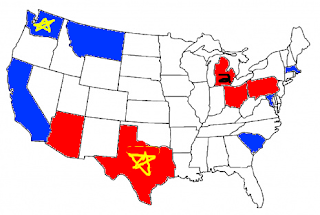
It is clear that 'the people' want to see financial reform, but whether it is through tax hikes or budget cuts is unclear...it seems that some sort of combination would appeal to the median voter (this will be the assumption). Therefore, in order to represent the
median voter 4 people must agree to compromise. In fact, this committee seems to be built in order to incentivize compromise as much as possible. There seems to be no way to form a geographical coalition (see map) and if there were, it is unclear what consensus such a coalition could come to.Cuts will be made regardless of the super-committee but neither side would be happy. While it will cut spending it will largely affect the DoD and Homeland Security. Furthermore, the committee is made up of 6 democrats and 6 republicans: in order pass anything, someone has to cross party lines.
Basically, 'shirking' will happen if the committee fails, the representatives will prove to be strictly ideological in the most important of issues (perhaps revealing their own costs of 'shirking' ideologically) and in fact allow legislation to pass that would not be preferred to almost any compromise. I am not saying that passing legislation would magically appeal to the median voter, however it would do something which most people, it would seem, want.
Ideology is the only barrier to passing legislation. Will this unprecedented super committee compromise, or will they make an irrational decision to accept budget cuts that would not be preferred by any individual congressman (transitive preferences).

Friday, November 18, 2011

The TSA and bureaucratic inefficiency

In class, we have discussed bureaucratic inefficiency and competing theories of agency-clientele relationships. The TSA appears to be a classic example of an oversized, inefficient bureaucracy. In a recent report, Congressmen Paul C. Broun and John L. Mica (House Transportation Committee Chairman) harshly criticized the TSA, calling it "massive" and "bloated." They claim that the TSA has not made flying any safer (despite a $56 billion government investment in airline security) and that the TSA has "wasted money on ineffective equipment." They also challenged the need for 3,986 TSA employees at the Washington headquarters.
The high costs and inefficiency of the TSA make sense if we think of the TSA (or the head of the TSA) as a budget-maximizing agency. The TSA has little incentive to maximize "output" or actually "solve" the problems it is supposed to handle (its existence depends on the existence of these problems). Instead, it seeks to use up as much of its budget as possible. And since only the agency (and not Congress) knows its true cost curve, it has no incentive to be efficient in its use of funds. Nuskanen and other traditional theorists would say that agency autonomy (lack of oversight, etc) makes this bureaucratic inefficiency a fact. Weingast and Moran, on the other hand, would say that the relevant Congressional committees possess a system of rewards and sanctions that is sufficient to effectively align the incentives of the agency with the incentives of Congress.
It appears from this article that the relevant congressmen (which would include Mica, as the House Transportation Committee chairman) either do not possess an effective system of rewards and sanctions, or have not yet put this system into place. The congressmen might want to make greater use of its power of appropriations, and threaten to make cuts to the TSA's budget if the TSA does not 'get in line.'

Thursday, November 17, 2011

Keeping Agencies In Line

Last summer, Representative Cardoza (D-CA) was upset that the secretary of the Department of Housing and Urban Development was flying off to various conferences rather than dealing with the housing foreclosure crisis, so he eliminated the secretary’s travel budget. He said “Frankly I want to cause officials a little personal pain. I want them to understand they’re hurting folks in my district by their lack of actions and so they need to plant their butts at their desk and do the jobs they were appointed to do”. Rep. Cardoza added this cut as an amendment to the Transportation, Housing, and Urban Development spending bill.

If we had read this news story before taking public choice we might think that representative Cardoza lost his temper or overreacted a bit. However, Weingast and Moran enlighten us by explaining this kind of behavior. The Weingast and Moran article argues that Congress has several tools at its disposal to control agency behavior. Congress has created a system of incentives for agencies by rewarding agencies that pursue congressional goals and sanctioning those that don’t. Congress probably exercises its most potent oversight of agencies through the appropriations process. Since Congress controls the purse strings, it can cut off or reduce funds to agencies. Rewards go to those agencies that pursue the policy preferences of current committee members which reflect the preferences of the voters in their district. Specific committees have more influence than the rest of Congress over a specific agency. Cardoza was offended that the secretary of the Dept. of Housing and Urban Development didn’t notice the severity of the housing crisis and how it was affecting his constituents back home who were facing foreclosures. Clearly, the members of Congressional committees play an important role in influencing regulatory policy. Congress can use sticks or carrots to influence agency action and Rep. Cardoza thought sticks might be more effective in this case.

Sunday, November 13, 2011

U.Va Coal Power and the Group

Few may realize that among the numerous coal trains that travel rumble through grounds each day, a small percentage of their cargo is actually destined for right here at U.Va. The strange “chugging” sound that is sometimes present on the corner is none other than the sound of coal being unloaded from train cars and loaded into the silos of the University power plant nestled between the corner and the hospital. According to The Daily Progress, the coal that is burned on U.Va property accounts for about 40% of the total electricity consumption of the University. In addition to this coal, U.Va also burns natural gas and heating oil at the University owned plant while at the same time importing electricity from the national grid. With the average Virginian receiving, on average, 38% of their electricity from nuclear power, the large portion of U.Va that is powered by coal generated right here on grounds has irked many environmentalists here in Charlottesville.

Olson would see the generation of power here at U.Va as a public good being provided by a relatively large group of people. The 20,000+ U.Va students who pay tuition at U.Va and the countless other faculty, staff, and visitors who also have a stake in University activities make up this group and share in the benefits and costs of generating power right here in Charlottesville. A group here at U.Va, Beyond Coal, has embodied some of the issues that Olson finds with large groups. The students among this group could be assumed to have a rather large personal interest in the elimination of coal power at U.Va and would gain a large amount of personal utility if this goal was accomplished. Their proposals for accomplishing this goal are generally a move to cleaner fuel sources such as natural gas and renewable sources such as solar power. These sources of energy would be more expensive to the U.Va community if used to supply the same amount of power currently supplied by coal. I would also argue that the majority of U.Va stakeholders would prefer to have their energy generated in the cheapest possible way and if given the choice of higher tuition costs or continued coal generation, would choose the latter. The relatively small interest group, Beyond Coal, is looking to take advantage of the size of the group by free-riding the cost increase of the cessation of coal generation among the entire U.Va community.

A small group, Beyond Coal is very focused in their interests and has little internal debate among their members about their goal. They would likely be unwilling, however, to take the entire cost that ending coal generation at U.Va would incur and internalize it in their small group. It is likely, however, that they value the cessasion of coal generation at U.Va at more than they would personally pay should the cost be divided among over 20,000 people. They would prefer instead to spread it out among the large group that is U.Va. If they succeed in eliminating coal power at U.Va they would incur a personal utility gain that would far outweigh the personal expense that they would endure once the expense is divided among the whole group. In this way we find a good example of what is wrong with large groups right here at U.Va where a small group has the possibility of gaining a large gain in personal utility at the expense of the large group.