When talking about voting, one of the reasons economists believe people won't vote is because of the minuscule odds that your vote will influence the outcome of the election. In November of 2017, voters in Virginia House District 94 (Newport News) had an election in which a single vote could have decided the outcome of the election. After many recounts, the two candidates Shelly Simonds (D) and David Yancey (R) were tied at 11,607 votes each. Because of Virginia law, the winner of this election was determined by drawing lots; David Yancey's name was drawn. Not only did this decide the representative from District 94, but it also decided who held a majority in the Virginia State House. With that win, Republicans held a 51-49 majority.
This November, Virginians will (maybe) go to the polls as all of the commonwealth's representatives and senators are up for reelection. This past election will probably encourage more people to out to the polls and vote this year. This year there will probably be more voters as people will reevaluate their E[MB]. People will not multiply E[MB] by 1/v as they will look back and remember this instance when one vote did matter; this is because of recency bias as people will remember this and might expect it to happen again. E[MB] will also increase because the differential outcome will be greater as the election of one representative might determine who has a majority in the legislature. Controlling a chamber of the legislature brings with it many benefits such as being able to set the agenda and chairing committees.
Monday, September 23, 2019


Thursday, September 19, 2019
Coasian solution to parking externalities
Below is a diagram of the parking situation at my house. Eight parking spots and seven cars to fill them. Spots A, B, and C are the least desirable due to the possibility of being parked in. Spots D, E, and F are solid, but if you're parking in one of the A, B, and C cars you may be called on to move your car. Spots G and H are the best - neither being parked in nor parking anyone else in. No spots are assigned - first come, first park.

A doable situation, EXCEPT for the fact that one of my housemates who we'll call John has a stick shift car, which imposes a large negative externality on the house. No one else knows how to drive stick shift, so whenever John's car is parked in D, E, or F and John isn't home, one of the cars from A, B, or C is stuck. At the beginning of the year this inconvenienced all of the other drivers of the house at different times. Eventually the other 6 drivers of the house all decided to give John a permanent spot in either G or H. This costs the rest of the house by confining them to generally worse spots. I, for one, have not parked in G or H since making the decision to leave John a spot. However, by exchanging my right to park in G or H more for the right to not be parked in by an immovable car, I (and the rest of the house) am left better off. The market of our kitchen table conversation enabled a mutually beneficial exchange where the externality was mitigated. We judged the amount of parking utility we were losing by being parked in by John greater than the lost utility of one of the best spots in the house. This solution was not mandated by a rental company, and John gets to keep his car.

A doable situation, EXCEPT for the fact that one of my housemates who we'll call John has a stick shift car, which imposes a large negative externality on the house. No one else knows how to drive stick shift, so whenever John's car is parked in D, E, or F and John isn't home, one of the cars from A, B, or C is stuck. At the beginning of the year this inconvenienced all of the other drivers of the house at different times. Eventually the other 6 drivers of the house all decided to give John a permanent spot in either G or H. This costs the rest of the house by confining them to generally worse spots. I, for one, have not parked in G or H since making the decision to leave John a spot. However, by exchanging my right to park in G or H more for the right to not be parked in by an immovable car, I (and the rest of the house) am left better off. The market of our kitchen table conversation enabled a mutually beneficial exchange where the externality was mitigated. We judged the amount of parking utility we were losing by being parked in by John greater than the lost utility of one of the best spots in the house. This solution was not mandated by a rental company, and John gets to keep his car.
The Positive Externalities of Running with Pres. Jim Ryan (plus free Bodos)
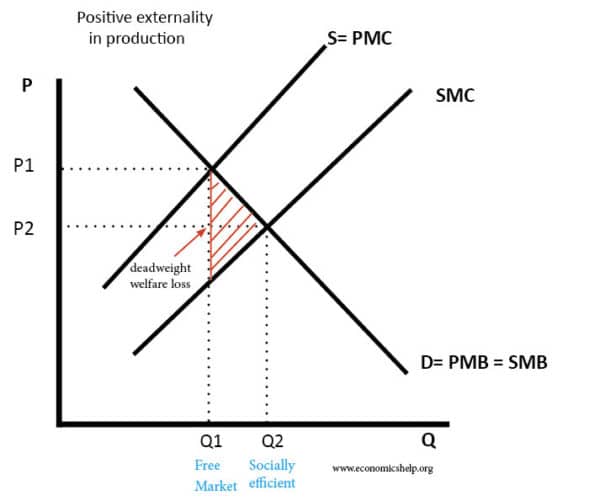
Story time, so earlier today I decided to get up out of bed at 6:15 a.m. Why would I do this given I mostly stay up until midnight on weeknights? (I promise I am usually studying) Well, it turned out President Jim Ryan (who definitely did not steal Professor Coppock's idea) was hosting one of his morning runs at Madison Hall with the CIO #HoosGotYourBack at 7 a.m. Though at first my grogginess from awaking so early appeared to, in economic terms, reduce my utility, the free Bodo's, free coffee, and a free #HoosGotYourBack t-shirt made it all worth it, at least for me. After getting back to my apartment, I noticed that there was a positive production externality deriving from the free goods I consumed. However, one of the most important foundational lessons in economics as a discipline is that nothing is technically "free" given the scarcity of materials and factors of production. Even though I did not have to pay anything for the "free" coffee, bagels, and t-shirt, I still derived utility from my consumption. This a good example of a positive production externality assuming everyone else there also derived utility from the goods provided at no cost to the final consumers (and also the releasing of endorphins from running).
The result of this is a dead weight loss and an increase in consumer surplus since I and most likely all the other attendees would have been willing to pay more than $0 for the goods provided. However, even though a "positive production externality" has a positive ring to it, as mentioned before there is a dead weight loss the producer bears. In order to internalize this, there must be some kind of subsidy in order to move the allocation of goods from Q1 in the graph above to Q2, which would be the allocatively efficient outcome (Q_AE). This situation implies an underproduction of the Bodo's and t-shirts provided. Internalizing the costs through subsidies would help bring the total quantity produced back to the socially efficient quantity of production.
 |
| Source |
Wednesday, September 18, 2019
Fraternity Chapter Attendance
In addition to the extensive "community service" and "academic assistance" that Greek life definitely provides, one of the primary benefits of being in a fraternity is the ease of access to parties. In a sense, these events are a public good to fraternity members; they are non-rival, as the attendance of one brother doesn't affect another's ability to attend, and they are non-excludable, as brothers cannot really be kept from attending, given that members either live in the house in which they are thrown or know the door code needed to enter.
Unfortunately, like many public goods, these parties suffer from a free-rider problem. This is because people are reluctant to help plan them, since they can still receive social benefits as long as others in the fraternity pay the cost of doing so. In this case, the cost of producing parties is attending weekly chapter, as these meetings are the main forum through which event planning takes place. Because each individual's dominant strategy is to skip chapter (as demonstrated by the payoff matrix below), a sub-optimal number of people show up, which leads to an under-provision of parties.
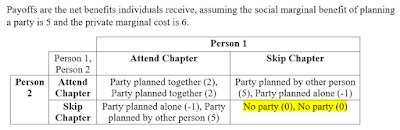 According to Mueller, small groups can move from a Pareto inefficient outcome (the highlighted quadrant in this matrix) to a Pareto efficient one (the top left box) through the use of social pressure to encourage cooperation. This, however, has been unsuccessful for my fraternity, as people are hesitant to exclude or shame their best friends for their simple absence at weekly meetings. In order to overcome this failure, we are instead going to establish a formal sanction system in which people who miss chapter are required to clean up after parties. I hope that this improves attendance, but I also worry, as Mueller would, that this intervention might harm individuals' intrinsic motivation to contribute to the fraternity. For example, people who don't want to clean may just start skipping even more chapters and become even more distant from the fraternity. Over time, they may stop caring if we throw parties and may not feel guilty about leaving behind a dirty house (so much for brotherhood!).
Unfortunately, like many public goods, these parties suffer from a free-rider problem. This is because people are reluctant to help plan them, since they can still receive social benefits as long as others in the fraternity pay the cost of doing so. In this case, the cost of producing parties is attending weekly chapter, as these meetings are the main forum through which event planning takes place. Because each individual's dominant strategy is to skip chapter (as demonstrated by the payoff matrix below), a sub-optimal number of people show up, which leads to an under-provision of parties.

I "negotiated" with a leasing company today
Here's the scoop:
In the face of a recession, my leasing company X has shared their preference to gouge students on apartment leases in the 2020-2021 contract season. My building specifically, is no gem. If I had to compare the likeness of my apartment complex to another spot on Grounds, it would be pre-renovated Clem 1. But amidst a landlord attempting to create a stream of revenue larger than that of an apartment that comes with a rooftop pool, airpods, and a pool table (in the apartment of course), he did offer an additional parking space on the lease. My inner economist screamed side-hustle. I could rent out my additional parking pass to make supplementary income. Though I may not have considered this an optimal trade at first, I soon realized an opportunity to conduct a parking service that would offset the increase in my rent.
The goal: Sell the use of a parking spot to sketchy individuals on a daily basis to limit my personal losses on the higher cost of rent. Acquire a clientele basis that significantly drives up the social cost of my business, by royally upsetting my neighbors. Maybe these people tune up their muscle car at 3am, or maybe they have a drum circle that forms around their car. Ideally the consumer's presence should be so aggravating that people in the building don't want to live here anymore and seek further action. As long as the consumer of the parking spot bothers my neighbors, I will profit from an intentionally formed negative externality. (There is the chance that I would also be negatively impacted by their behavior but I assume that I am not, for the sake of keeping this brief.) If this negative externality gains the attention I intend, X will take action due to complaints from my neighbors. It is quite possible they could find a state ordinance against treating students as first class citizens, but with Coase solutions on my mind I really am banking on the fact that they would be willing to reach an agreement. As one of their residents, if I were evicted or sued in court, I could wreck their yelp reviews. I imagine a Coasian solution to this problem could be X offering to lower my rent, in order for me to end my business practice, which terrorizes my neighbors. They could go further, and begin putting a clause in their leasing agreements that ban side-hustles from taking place in the complex, or a fee that detracts businessmen from operating out of their building.
Sure, it would be less of a hassle for me if I were just given a lower lease price and the leasing company could keep an extra parking spot to sell to another resident who needs it, but if I am given an extra parking spot, you can bet that the hedonist within me is willing to sacrifice the happiness of my neighbors, to minimize the increase in rent by renting out my additional parking spot.
On a sadder note, the landlord just called and is willing to shave $100/month off the lease for that parking spot. As he just internalized the uncertainty I would face in a new business venture by keeping the investment and offering money instead, I am prone to take the side bargain over my business venture. Who would have thought that blackmail encouraged a side bargain.
In the face of a recession, my leasing company X has shared their preference to gouge students on apartment leases in the 2020-2021 contract season. My building specifically, is no gem. If I had to compare the likeness of my apartment complex to another spot on Grounds, it would be pre-renovated Clem 1. But amidst a landlord attempting to create a stream of revenue larger than that of an apartment that comes with a rooftop pool, airpods, and a pool table (in the apartment of course), he did offer an additional parking space on the lease. My inner economist screamed side-hustle. I could rent out my additional parking pass to make supplementary income. Though I may not have considered this an optimal trade at first, I soon realized an opportunity to conduct a parking service that would offset the increase in my rent.
The goal: Sell the use of a parking spot to sketchy individuals on a daily basis to limit my personal losses on the higher cost of rent. Acquire a clientele basis that significantly drives up the social cost of my business, by royally upsetting my neighbors. Maybe these people tune up their muscle car at 3am, or maybe they have a drum circle that forms around their car. Ideally the consumer's presence should be so aggravating that people in the building don't want to live here anymore and seek further action. As long as the consumer of the parking spot bothers my neighbors, I will profit from an intentionally formed negative externality. (There is the chance that I would also be negatively impacted by their behavior but I assume that I am not, for the sake of keeping this brief.) If this negative externality gains the attention I intend, X will take action due to complaints from my neighbors. It is quite possible they could find a state ordinance against treating students as first class citizens, but with Coase solutions on my mind I really am banking on the fact that they would be willing to reach an agreement. As one of their residents, if I were evicted or sued in court, I could wreck their yelp reviews. I imagine a Coasian solution to this problem could be X offering to lower my rent, in order for me to end my business practice, which terrorizes my neighbors. They could go further, and begin putting a clause in their leasing agreements that ban side-hustles from taking place in the complex, or a fee that detracts businessmen from operating out of their building.
On a sadder note, the landlord just called and is willing to shave $100/month off the lease for that parking spot. As he just internalized the uncertainty I would face in a new business venture by keeping the investment and offering money instead, I am prone to take the side bargain over my business venture. Who would have thought that blackmail encouraged a side bargain.
Tuesday, September 17, 2019
Poetry is Not a Public Good
While I’ve been preparing for Flux’s next open mic (this Thursday at 8 pm in Brooks hall!!), I’ve been thinking about how poetry is not actually a public good. It’s usually nonrivalrous, as my enjoyment of a poem about tide to-go sticks does not in anyway limit your enjoyment of the same metaphor. However, any good open mic is excludable. This was best seen at the College Union Slam Invitational 2017, when the “founder of slam poetry” Marc Smith was booed off a stage for his performance of a particularly tasteless poem, Old White Guy Whitey.
Unlike other more traditional poetry venues, property rights are clearly defined in an open mic space: they belong to the audience. At Flux events, the executive board acts as a governing body in that we let the audience know at the beginning of every event that they are not required to tolerate any sort of hate speech. In this scenario, the CUPSI crowd did not attempt to achieve a Coasian solution to this negative externality. Instead, after Smith was kicked off the stage, the audience proceeded to also demand a new host. The remaining competing teams then required that the rest of the competition would not be filmed, which only furthered to increase the excludability, as those (like myself) watching online from home were unable to see any of the poems that made it to the final stage that year.
Monday, September 16, 2019
To Busk or Not to Busk
When I was a second year at UVA, I was part of a trombone quartet called "The Rolling Bones." Like many casual musical groups composed of college students, we were looking to share our craft and make a quick buck at the same time. As a result, we grabbed our trombones and took to the downtown mall to busk our setlist of movie music and rock covers.

In economic terms, our musical performance was a public good, because it fulfills the two criteria that distinguish public goods from private goods. First, our performance is non-rivalrous in consumption. Any downtown mall-goer that listens to our music does not impact the consumption of anybody else within earshot. Second, our product is non-excludable. We have no way to stop non-paying consumers from hearing our music: we have neither the property rights nor the resources to restrict entrance into our portion of the downtown mall. As a result, many people acted as free riders, not contributing any money yet still receiving our product.
After a fun afternoon of sharing our music with Charlottesville residents and making some tip money, we wondered (maybe not in these exact words) whether our profit-maximizing output (q*) was below the allocatively efficient output (qAE) where the social marginal benefit of our performance intersected the marginal cost of preparing and performing the music.

Although our trombone quartet performance is a public good, there are certain factors in the private market that bring our profit-maximizing output closer to the allocatively efficient output, according to Gruber’s theory of public goods. While some mall-goers seemed to enjoy our zany takes on Green Day and Disney soundtracks, others rolled their eyes at four dorky college students playing large brass instruments during their lunch hour. Although the benefits of our performance are shared by all in earshot, the utility gained by our performance varies among individuals. People that particularly enjoy trombone quartets recognized this, and were therefore likely to leave a larger than average tip, pushing our revenue closer to that at the allocatively efficient output.
When you include the utility gained by enjoying the downtown mall on a beautiful afternoon, as well as some post-busking gelato, it was a successful busking outing for “The Rolling Bones.”
Sunday, September 15, 2019
Noise Free-Riding in Quiet Study Spaces
Listen, I enjoy having a quiet place to study as much as the next guy. That is why I study in the government documents room ("gov docs") on Alderman's Third Floor (no this is not an advertisement). Though a seemingly perfect substitute exists in form of Clem 1, I find the slightly more casual atmosphere of "gov docs" to be more appealing (looking at you, the people who glare at others for opening a bag of chips on Clem 1). Plus, I am trying to take in all of what Alderman offers before it undergoes renovations in May. Sometimes however, the noise from other people whispering can coalesce into relatively loud talking not unlike the cacophony resulting from the people who study on Clem 2 (sorry to those who study there). How does this relate to ECON 3330 you ask? Here it is: if we assume, borrowing from Coase's confectioner and doctor example, that I were a "doctor" complaining about my inability to concentrate among the others making noise, I could theoretically reach a Coasian solution with the "confectioner" noisemakers. This would only be the case if there were solely one other person in all of "gov docs" and that person was making noise.
However, this is rarely the case, especially when "Sunday scaries" and midterm season rear their ugly heads. As a result, I am often surrounded by multiple "confectioners", thus introducing a free-rider aspect into the issue. If I were to reach a hypothetical Coasian solution with each noisemaker, then inevitably the rational noisemaker would notice that as the number of noisemakers increases the marginal cost that they would incur of making noise falls. Among 20 people in one room, one extra person making noise is relatively less disturbing than one extra person making noise among five people. Given that each noisemaker is likely rational, the free-rider problem would be exacerbated, thereby resulting in every noisemaker disturbing one's study time. Under these constraints, "gov docs" would be noisy all the time, and I would just have to resort to finding a different place to study. However, it appears that norms of empathy override this urge to de-prioritize others' studying for one's own right to make noise (even for the noisiest of people). I guess this kind of digressed into an open letter to quiet studying rooms (and norms of empathy). Well, quiet studying rooms, you're underappreciated, don't ever change. With dear thanks, a Public Choice student.
However, this is rarely the case, especially when "Sunday scaries" and midterm season rear their ugly heads. As a result, I am often surrounded by multiple "confectioners", thus introducing a free-rider aspect into the issue. If I were to reach a hypothetical Coasian solution with each noisemaker, then inevitably the rational noisemaker would notice that as the number of noisemakers increases the marginal cost that they would incur of making noise falls. Among 20 people in one room, one extra person making noise is relatively less disturbing than one extra person making noise among five people. Given that each noisemaker is likely rational, the free-rider problem would be exacerbated, thereby resulting in every noisemaker disturbing one's study time. Under these constraints, "gov docs" would be noisy all the time, and I would just have to resort to finding a different place to study. However, it appears that norms of empathy override this urge to de-prioritize others' studying for one's own right to make noise (even for the noisiest of people). I guess this kind of digressed into an open letter to quiet studying rooms (and norms of empathy). Well, quiet studying rooms, you're underappreciated, don't ever change. With dear thanks, a Public Choice student.
Saturday, September 14, 2019
Is the Blue Ridge Parkway really a Public Good?
As an avid cyclist, Charlottesville provides me with a fantastic playground for endless adventures on two wheels. One of my favorite places to ride is on the Blue Ridge Parkway. The BRP is considered to be a Public Good because it is non-excludable and non-rivalrous in consumption. As the fall season progresses, people travel from across the country to experience and view the beautiful fall foliage that can be seen along the BRP, all for free because there are no tolls or entrance costs.
On Wednesday, I found myself riding on the Blue Ridge Parkway; however, this time the BRP felt rivalrous in consumption. Other BRP visitors zipped past me in cars, motorcycles, and loud groups of people overcrowded the beautiful overlooks. These negative externalities I faced as a fellow user of the BRP damaged my own consumption. Upon my exiting the BRP, I noticed the swiveling “road closed” gate, usually used for winter storms. I thought to myself: if I just closed the gates, I could make the BRP excludable, so that once again I could reap the benefits and enjoy the BRP to the fullest. Closing the gates would exclude all motorized traffic and tourists from entering, and would only allow the adventurous cyclists and hikers who dare to duck underneath the closed gate. Alas, I decided the cost of closing the gate, a stern talk and ticket from a park ranger, was greater than the marginal damage that I felt on the overcrowded BRP, so I pointed my two wheels back to UVA, and pedaled home.
On Wednesday, I found myself riding on the Blue Ridge Parkway; however, this time the BRP felt rivalrous in consumption. Other BRP visitors zipped past me in cars, motorcycles, and loud groups of people overcrowded the beautiful overlooks. These negative externalities I faced as a fellow user of the BRP damaged my own consumption. Upon my exiting the BRP, I noticed the swiveling “road closed” gate, usually used for winter storms. I thought to myself: if I just closed the gates, I could make the BRP excludable, so that once again I could reap the benefits and enjoy the BRP to the fullest. Closing the gates would exclude all motorized traffic and tourists from entering, and would only allow the adventurous cyclists and hikers who dare to duck underneath the closed gate. Alas, I decided the cost of closing the gate, a stern talk and ticket from a park ranger, was greater than the marginal damage that I felt on the overcrowded BRP, so I pointed my two wheels back to UVA, and pedaled home.
Although my experience makes it seem as though the BRP should not be considered a public good, it rather reinforces Buchanan’s point that public goods fall along a continuum. Public goods can have a degree of “privateness,” and in this case that privateness can be seen in the overcrowding of the BRP, calling for an optimal level of sharing given by Ui = Ui[(Xi1, Nii), (Xi2, Ni2),...,(Xin+m, Nin+m)].


Friday, September 13, 2019
A Good, Old-Fashioned Chore Chart
I live in an apartment with four fantastic roommates. However, some of us are more prompt to clean than others. Last fall, it became apparent that a couple roommates bore the majority of the cleaning duties while the others did very little. But, despite this unequal distribution of duties, every roommate benefitted equally from the clean apartment. Those roommates who acquired the costs of cleaning didn’t reap any more benefit than the ones who didn’t take on cleaning costs.
We were suffering from the classic problem of free riding on a public good! In this situation, the clean apartment can be classified as a public good since it is non-excludable and non-rival in consumption. No roommate can be prevented from enjoying the benefits of a clean apartment and one roommate’s enjoyment of the cleanliness doesn’t detract from another’s enjoyment of it. Essentially, the cleanliness of the apartment provides significant positive externalities.
Because some cleaned and others failed to participate in cleaning while still enjoying the benefits of the clean apartment, our home was consistently under-cleaned. The amount of cleaning we undertook clearly fell below the allocatively efficient level. The cleanliness level was not socially optimal.
We scratched our heads, wondering if we’d need to call in the power of the state. Fortunately, my roommate Rachel, who had a slightly higher demand for this public good than the rest of us, decided to develop a private method of combatting our free-rider problem. She hearkened back to the elementary school days of sticker charts, and chose to create our very own chore chart. She listed five cleaning tasks, listed several weekends, and posted this chart in the kitchen.
Rachel then showed it to us and said that we could sign our initials every time we completed a task. She also specified that each roommate should complete one task a weekend in order to evenly distribute the work. By establishing this system, she unwittingly tapped into the “warm glow” solution Gruber describes in his chapter on public goods. Now, we could see and quantify each person’s contributions. Because of this, we were all incentivized to clean more than we had before. Because we have a small, stable community within our apartment, we were able to mitigate this free rider problem by establishing group mores and exerting positive peer pressure. No need to strain our apartment’s social fabric with outside intervention! Rachel introduced a solution from the inside!

The Exclusive Kitchen Club
I live with seven other girls in a cozy (ie. cramped) house on the corner of 14th Street and Wertland. In addition to a standard kitchen and dining room, you can walk through my friend Hanna's room to reach a second back kitchen. Generally, a kitchen is a non-rivalrous good. However, it can certainly get crowded at meal times, so Hanna's second kitchen provides a great marginal benefit to everyone. That is, everyone except for Hanna.
Hanna was facing a negative consumption externality due to the smell of trash and leftover food creeping into her bedroom. When the kitchen was dirty, this smelly externality caused her social marginal benefit of the kitchen to decrease. While everyone likes the idea of having a clean kitchen, Hanna was the only one whose additional benefit of having a clean kitchen was worth incurring the cost of actually cleaning the kitchen. This led to a free-rider problem in which she would provide a clean kitchen even if no one else contributed towards the cost. As you might guess, Hanna quickly grew sick of this setup.
This Monday, when I walked downstairs to cook breakfast, Hanna's door was locked. When I knocked, she responded that she no longer would publicly provide a clean kitchen to a bunch of free riders (something along those words... perhaps a little less economic and more insulting). Being the rational roommate I am, I explained that we could pay her to compensate for the externality she dealt with when we dirtied up her kitchen. However, she was not into my Coasian solution. Public policy majors, amirite? As I was doing my public choice reading that night, I realized my solution was right in front of me. I rushed down to Hanna's room, and for the small price of taking out the trash, I gained access into the now-excludable back kitchen club. I tipped off another two roommates, and they bought their way in by agreeing to wash dishes. Now, Hanna no longer faces the stinky results of the free rider problem, and each kitchen is shared at an optimal level that allows me to make my meals in peace. Take that, Batten!
Hanna was facing a negative consumption externality due to the smell of trash and leftover food creeping into her bedroom. When the kitchen was dirty, this smelly externality caused her social marginal benefit of the kitchen to decrease. While everyone likes the idea of having a clean kitchen, Hanna was the only one whose additional benefit of having a clean kitchen was worth incurring the cost of actually cleaning the kitchen. This led to a free-rider problem in which she would provide a clean kitchen even if no one else contributed towards the cost. As you might guess, Hanna quickly grew sick of this setup.
This Monday, when I walked downstairs to cook breakfast, Hanna's door was locked. When I knocked, she responded that she no longer would publicly provide a clean kitchen to a bunch of free riders (something along those words... perhaps a little less economic and more insulting). Being the rational roommate I am, I explained that we could pay her to compensate for the externality she dealt with when we dirtied up her kitchen. However, she was not into my Coasian solution. Public policy majors, amirite? As I was doing my public choice reading that night, I realized my solution was right in front of me. I rushed down to Hanna's room, and for the small price of taking out the trash, I gained access into the now-excludable back kitchen club. I tipped off another two roommates, and they bought their way in by agreeing to wash dishes. Now, Hanna no longer faces the stinky results of the free rider problem, and each kitchen is shared at an optimal level that allows me to make my meals in peace. Take that, Batten!
Thursday, September 12, 2019
Mob Boss Negotiations
This past Wednesday was truly a difficult day for me. Around 7 o'clock last night, I finished the greatest tv show that was ever made, The Sopranos. I still haven't gotten over the fact that I've actually finished the show yet. I can sense a deep void forming in the entertainment compartment of my heart. Also, don't ask me about the final scene. I haven't begun to form even an ounce of an intelligent opinion on the matter. Nevertheless, I found solace in the fact that a scene from the final season has inspired a blog post for our class. Let me set the stage.
Tony Soprano, the boss of the Soprano crime family, enjoys partial ownership in an illegally-run, legal construction business. In true criminal fashion, the business cuts corners whenever possible. They hire cheap illegal labor, fake their permits, and most importantly in this episode, they illegally dump their demolition waste. With the help of one of the Five Families of New York, the business improperly disposes their waste in the Lupertazzi family dumpsite, while collecting checks from the government for "following" the EPA's regulations on waste management. The operation was tremendously lucrative, that is, until the Boss of the Lupertazzi family learns of the asbestos in the construction waste.
Under this scenario, the social marginal cost of waste production is above the private marginal cost to the Soprano family. The asbestos from the demolition waste creates a negative production externality to the Lupertazzi family and their dumpsite, particularly in regards to the health of their employees. As a result, the Soprano family is producing too much waste and social efficiency is not maximized. In an effort to reach a true Coasian solution, Phil Leotardo - the defacto boss of the Lupertazzi family - offers to let the Soprano family continue to dump their construction waste in exchange for 25% of all construction profits. With the payment, the PMC curve would move up to the SMC curve, and social efficiency is maximized. Tony, however, mulls the offer over, counters with 15% to no avail, and ultimately determines that the 25% cost is not worth it to him. No deal is to be had.
Unable to internalize the externality, we would all expect Tony to find another dumpsite or shutdown the business altogether. Well, he did find another dumpsite (0:16) - and managed to avoid incurring any extra cost.
Tony Soprano, the boss of the Soprano crime family, enjoys partial ownership in an illegally-run, legal construction business. In true criminal fashion, the business cuts corners whenever possible. They hire cheap illegal labor, fake their permits, and most importantly in this episode, they illegally dump their demolition waste. With the help of one of the Five Families of New York, the business improperly disposes their waste in the Lupertazzi family dumpsite, while collecting checks from the government for "following" the EPA's regulations on waste management. The operation was tremendously lucrative, that is, until the Boss of the Lupertazzi family learns of the asbestos in the construction waste.
Under this scenario, the social marginal cost of waste production is above the private marginal cost to the Soprano family. The asbestos from the demolition waste creates a negative production externality to the Lupertazzi family and their dumpsite, particularly in regards to the health of their employees. As a result, the Soprano family is producing too much waste and social efficiency is not maximized. In an effort to reach a true Coasian solution, Phil Leotardo - the defacto boss of the Lupertazzi family - offers to let the Soprano family continue to dump their construction waste in exchange for 25% of all construction profits. With the payment, the PMC curve would move up to the SMC curve, and social efficiency is maximized. Tony, however, mulls the offer over, counters with 15% to no avail, and ultimately determines that the 25% cost is not worth it to him. No deal is to be had.
Unable to internalize the externality, we would all expect Tony to find another dumpsite or shutdown the business altogether. Well, he did find another dumpsite (0:16) - and managed to avoid incurring any extra cost.
Quick, Bring in the Farmers!
It sounds like farmers could save the world! Or, at the very least, help the world by reducing carbon emissions. According to The Wall Street Journal, there is a cornfield in Iowa that can bestow wisdom on how to solve market failures. In other words, the farm can help combat climate change. A farmer named Mitchell Hora uses regenerative growing practices, which, besides simply being more efficient at farming, carries a significant benefit: the growing practices eliminate the soil carbon released from burning fossil fuels. Yay for less carbon emissions! This is a positive production externality. Mr. Hora's production leads to a social marginal cost that is below the private marginal cost. In addition, the social optimal quantity is greater than the market equilibrium under a competitive market. Thus, Mr. Hora is underproducing. He needs to farm more (produce more) in order to achieve the optimal allocation of resources.
There may be a Coasian solution to this, which is mentioned in the article. A company called Indigo Ag Inc. is setting up a market for carbon credits. Companies that want to reduce their carbon footprint can go to the marketplace and pay farmers to do it for them. So can other parties, such as environmental interest groups. If these groups decide to pay Mr. Hora the marginal benefit (which is the distance between the SMC and PMC curves), Mr. Hora will produce at the socially optimal level without any government intervention, thus solving the market failure, and (hopefully) making the world a better place.
Yes...the government could pay Mr. Hora to produce more and we'd still get the same optimal allocation of resources (even though Coase would be disappointed). But I like the Coasian solution more. It just...makes me happy.

There may be a Coasian solution to this, which is mentioned in the article. A company called Indigo Ag Inc. is setting up a market for carbon credits. Companies that want to reduce their carbon footprint can go to the marketplace and pay farmers to do it for them. So can other parties, such as environmental interest groups. If these groups decide to pay Mr. Hora the marginal benefit (which is the distance between the SMC and PMC curves), Mr. Hora will produce at the socially optimal level without any government intervention, thus solving the market failure, and (hopefully) making the world a better place.
Yes...the government could pay Mr. Hora to produce more and we'd still get the same optimal allocation of resources (even though Coase would be disappointed). But I like the Coasian solution more. It just...makes me happy.

Wednesday, September 11, 2019
The Terrible Neighbors
As a resident of an apartment building on Wertland Street, I was prepared for the parties and loud noises that they bring. However, I did not expect to be living next to people who probably party as hard as the 1990s Miami Hurricane football team. Our neighbors, apart of a certain UVa sports team which I will not name, party all the time. It has been two years and the music has not stopped. Ever. There is music every night, every morning, and even during finals.
These people are living their party lives to the fullest, but our apartment struggles to study, watch movies, and sleep. Not only is there a negative externality on us, but also on them. Last year was the worst year in this team's history and it is not surprising that the star players happen to be our neighbors. Living in this apartment complex, the social marginal benefit goes down even though it is in a great location. Our demand for wanting to pay goes down.
Regardless of our noise complaints, lodged to our landlord, the music continued to play. One of my roommates ran into them the other day and the neighbors were actually pretty chill. In fact, they said that if we ever had a problem with them playing music too loud then we can just knock on the door and ask them to politely turn it down and they would do so. Ever since, the music has been turned down and I have actually started becoming friends with one of them.
These people are living their party lives to the fullest, but our apartment struggles to study, watch movies, and sleep. Not only is there a negative externality on us, but also on them. Last year was the worst year in this team's history and it is not surprising that the star players happen to be our neighbors. Living in this apartment complex, the social marginal benefit goes down even though it is in a great location. Our demand for wanting to pay goes down.
Regardless of our noise complaints, lodged to our landlord, the music continued to play. One of my roommates ran into them the other day and the neighbors were actually pretty chill. In fact, they said that if we ever had a problem with them playing music too loud then we can just knock on the door and ask them to politely turn it down and they would do so. Ever since, the music has been turned down and I have actually started becoming friends with one of them.
The Negative Externality of Loud Garbage Trucks
I’ve lived at The Flats for over a year now, and it’s a great place to live. But one of the big issues for residents including myself is the noise imposed from the train, and specifically for me, the beeping, crunching, screeching sounds of the garbage truck outside my window early in the mornings. Although I’m usually awake during the weekdays when the garbage truck comes, I do like to catch up on rest just a bit on the weekends. Low and behold, I am prevented from doing so because of the beep beep screech beep outside.
This annoying way to wake up definitely imposes a negative production externally on me, and I’m sure it’s imposed on others in the area. Students including myself work ourselves hard during the week, and need that extra sleep on the weekends. My potential marginal benefit of each extra minute of sleep is curtailed without my choice when I’m woken up by the garbage truck. The social marginal cost includes the private marginal cost imposed on the garbage truck, plus the negative externality, thus the social marginal cost exceeds the private marginal cost. The equilibrium point of allocative efficiency is not being met. A Coasian solution to this problem would be to negotiate with the garbage company to convince them to alter their routes so they would come down Main Street at a later time of day, but I would probably have to pool funds from many people who have this problem in order for the company to agree to changing their operations. If the marginal benefit to the garbage company is less than the dollar amount of damages imposed on those who are sleep disturbed, the garbage company would agree to this negotiation.
One of the problems with this Coasian negotiation would be arranging the negotiation in the first place and assigning damage. Measuring how much damage to our sleep this garbage truck is doing, determining how many people in the area have experienced disturbance of sleep due to this garbage truck, and equating lack of sleep to a dollar amount, resulting in total damages, would be an extremely difficult feat. I would also run into free rider problem. What about the people who aren't paying or contributing, yet still benefit from no sleep disturbance that they were not able to achieve before? This would lead those who agree to contribute to potentially see the deal as unfair and withdraw from the negotiation. Another solution would be to assign the damage in monetary terms and have both The Flats and The Standard add an extra fee to everyone's rent. Yet, some individuals may refuse to comply with this new provision, or argue that they do not experience sleep disturbance from the garbage trucks, so the apartment complexes are unlikely to include this fee. As one can see, a Coasian solution to this problem would be extremely difficult to pull off, therefore I must accept that I will be woken up by the beep screech crunch beep sounds every week and wait until I move out of the apartment to achieve some peaceful sleep.
Tuesday, September 10, 2019
I'm Not Sucking Up to Professor Coppock, I'm Just Still Surprised I Got Into This Class
It is no secret that getting accepted into Public Choice is a difficult feat. It is a highly recommended course that hundreds of people apply to take, but only about 25 to 30 students actually make the cut. I and everyone else in this class are lucky to be here — something I try to remind myself of when my alarm rings every Tuesday and Thursday morning to remind me that I have to trek all the way to Ruffner and make it to class by 9:30 *sharp* (as Professor Coppock would say).
Many people I know, specifically those studying economics here at UVA, also know how lucky I am, and often express to me how they tried to get into ECON 3330 but were not accepted. To try to make them feel better, I tell them about the material that's being covered in class — from concepts we've been discussing in lecture to specific readings that Professor Coppock assigns to us — so they aren't completely missing out on the class. Because of my being enrolled in ECON 3330 which allows me to spread the joy that is Public Choice course material, a positive consumption externality is created. By my taking the class, I am personally benefitting by learning about a topic that interests me, therefore this constitutes as the private marginal benefit (PMB) of my being in this course. However, because I then share what I have learned with others who are not in the class, the people I'm sharing this information with are receiving an external benefit from my consumption of taking the course because they are gaining knowledge that they want without having to pay for it in ways that I do, such as waking up early to go to Ruffner or pretending to laugh at Professor Coppock's jokes (I'm kidding!). This external benefit of the education that I am consuming through taking Public Choice is added to the PMB, and the sum of the two then equal the social marginal benefit (SMB) of my taking ECON 3330, making SMB > PMB and thus constituting a positive consumption externality (note: when clicking the link, look specifically at the first bullet about education).
Many people I know, specifically those studying economics here at UVA, also know how lucky I am, and often express to me how they tried to get into ECON 3330 but were not accepted. To try to make them feel better, I tell them about the material that's being covered in class — from concepts we've been discussing in lecture to specific readings that Professor Coppock assigns to us — so they aren't completely missing out on the class. Because of my being enrolled in ECON 3330 which allows me to spread the joy that is Public Choice course material, a positive consumption externality is created. By my taking the class, I am personally benefitting by learning about a topic that interests me, therefore this constitutes as the private marginal benefit (PMB) of my being in this course. However, because I then share what I have learned with others who are not in the class, the people I'm sharing this information with are receiving an external benefit from my consumption of taking the course because they are gaining knowledge that they want without having to pay for it in ways that I do, such as waking up early to go to Ruffner or pretending to laugh at Professor Coppock's jokes (I'm kidding!). This external benefit of the education that I am consuming through taking Public Choice is added to the PMB, and the sum of the two then equal the social marginal benefit (SMB) of my taking ECON 3330, making SMB > PMB and thus constituting a positive consumption externality (note: when clicking the link, look specifically at the first bullet about education).
In Defense of Procrastination
Consider a class at the University of Virginia. In this hypothetical class, the hypothetical professor carries out a strict anti-technology policy. In fact, on the first day of class, the professor accurately stated that the use of computers in class distracts classmates (see point #2 in the link), imposing a negative consumption externality on those sitting in the vicinity of the laptop user. I intend to show, however, that such a ban on technology usage is allocatively inefficient and, indeed, unjust. But before I continue, let me reaffirm that the class of interest here is a theoretical one, and is in no way intended to represent any one class. Especially not ECON 3330: Public Choice. Please don't hurt my grade.
In this class, consider two students, whom we may call Student A and Student B. Student A gets a certain amount of utility from using his or her laptop in class in order to avoid paying attention to Professor Copp - I mean, the hypothetical professor's lectures (personally, I think Student A should be paying attention, but who am I to judge someone else's utility curve?). As mentioned earlier, this creates a negative externality, as Student B is then distracted from the course material. But according to Coase's theorem, Student B may simply offer to pay Student A to refrain from using a laptop during class, and this free market transfer will inevitably lead to the socially optimal level of laptop usage.
In this class, consider two students, whom we may call Student A and Student B. Student A gets a certain amount of utility from using his or her laptop in class in order to avoid paying attention to Professor Copp - I mean, the hypothetical professor's lectures (personally, I think Student A should be paying attention, but who am I to judge someone else's utility curve?). As mentioned earlier, this creates a negative externality, as Student B is then distracted from the course material. But according to Coase's theorem, Student B may simply offer to pay Student A to refrain from using a laptop during class, and this free market transfer will inevitably lead to the socially optimal level of laptop usage.
In this case, both Student A and Student B are better off -- everyone is happy. Student A made a few bucks, and Student B is now able to pay attention in class. The professor's only role should be to determine that technology users are liable for the damages they inflict, allowing the invisible hand to bring us to the allocatively efficient level of output.
Again though -- and I can't stress this enough -- this is a generic exercise talking about a generic class, and I am definitely not Student A.
Wikipedia: The Wonderful Public Good
While I was reading Iliad for my Greek history class, I went to Wikipedia to get a rundown on a character, Menelaus. To do so, I went to a sourced, monitored, free, online encyclopedia, which I was told by my 3rd grade teacher that I should never, ever use. Sorry Ms. Lapinski. In the process, I turned from my $85 textbook to a free and expeditious resource, yet I didn't pay a penny.
With this in mind, I wondered how close Wikipedia is to a pure public good. The closer it is, the more of a cheapskate free-rider I am. Is Wikipedia non-rivalrous? Absolutely. By searching Menelaus on Wikipedia, I will never prevent another user from reading about Menelaus' rival, Paris. Is Wikipedia non-excludable? Based on its own format, yes. At its core, Wikipedia is open-source, meaning it would lose its very character by limiting its user population. I imagine it would have failed already without benefitting from the unlimited fact-checking and potential donor population. Furthermore, even when Wikipedia begs for money, it does so at the top of the page so you can still see your content.

With this in mind, I wondered how close Wikipedia is to a pure public good. The closer it is, the more of a cheapskate free-rider I am. Is Wikipedia non-rivalrous? Absolutely. By searching Menelaus on Wikipedia, I will never prevent another user from reading about Menelaus' rival, Paris. Is Wikipedia non-excludable? Based on its own format, yes. At its core, Wikipedia is open-source, meaning it would lose its very character by limiting its user population. I imagine it would have failed already without benefitting from the unlimited fact-checking and potential donor population. Furthermore, even when Wikipedia begs for money, it does so at the top of the page so you can still see your content.

Wikipedia seems very close to a perfect public good, so I must admit that I am one of many free-riders. Even so, Wikipedia stands the test of time, probably due to behavior that fits outside the free-rider problem. Many altruistic people donate freely, or voluntarily write entries, provide sources, and fact check others. One might argue that, since it resembles a pure public good, Wikipedia fails to meet the socially optimal allocation of resources, yet the fact remains that Wikipedia has come to dominate private encyclopedias. Optimal or not, it beats a $85 textbook.
Monday, September 09, 2019
Free lattes at Hot Cakes - an optimal club?
Currently Hot Cakes in Barracks is running their biannual promotion of two weeks of daily free lattes to UVA faculty, students, and staff. Free coffee and wifi, no questions asked. However, this is not a purely public good, as it is restricted to those affiliated with the University. As Buchanan notes, traditional economic analysis only distinguishes between private and public goods, and not clubs that not everyone has the opportunity to be a part of. The key to determining the optimality of a club is whether the marginal rate of substitution (MRS) of consuming the good is equal to the MRS of producing the good. My utility from consuming the free coffee and wifi is very high - this is one of my favorite times of the year. However, for Hot Cakes this does not seem to be a profitable venture. They get free advertising, but I don't know of many people that regularly visit Hot Cakes year round. They get lots of people in their store, but no one that I know regularly buys additional items from Hot Cakes. Conversely, this is provided at presumably great cost to Hot Cakes. The costs and benefits do not seem to be in line with each other, which makes for a sub-optimal club according to Buchanan.
The Externalities of Dancing
Two weekends ago, I traveled up to New York City for a music festival. The decision to make a 11-hour round trip at the end of the first week of classes was probably unwise, but I was able to see the magic of the Coase theorem in action. Though attending concerts is fun and is correlated with good health, attendees do not always have the greatest time. This is because of the externalities generated from the production of something that usually makes music quite enjoyable: dancing. According to concert etiquette, people should be mindful of those around them when they decide to bust some moves, as their aggressive motions can block the views of others or make them physically uncomfortable. This is quite problematic, as excited concertgoers frequently fail to consider how their dancing might negatively affect other people. As a result, the private marginal cost of dancing is less than the social marginal cost of its production and, thus, people dance more wildly than is socially optimal.
Such was the case during one of the performances that I witnessed at the festival. During the set, a man in my part of the crowd was very aggressively jumping up and down and waving his arms, much to the annoyance of the strangers next to him. The people around him asked a security guard to tell him to calm down, but the staff member insisted that the dancing man was not liable for any damage because he was not physically touching anyone near him and, therefore, had a right to continue his dancing.
Luckily, the power of economics was enough to rectify the situation and avoid any sort of major confrontation. After about a half hour of being annoyed, one of the people near the dancing man offered to buy him a beer in exchange for him controlling his movements. With the cost of this beverage now internalized, the dancing man's private cost of producing his moves increased. He, then, determined that his marginal benefit of wildly dancing was not greater than the cost of dancing plus the cost of a forgone beer and calmed himself down. Thus, just as Coase theorized, with rights clearly established, even without public intervention (from the concert staff), a socially optimal level of dancing was able to be reached.
Such was the case during one of the performances that I witnessed at the festival. During the set, a man in my part of the crowd was very aggressively jumping up and down and waving his arms, much to the annoyance of the strangers next to him. The people around him asked a security guard to tell him to calm down, but the staff member insisted that the dancing man was not liable for any damage because he was not physically touching anyone near him and, therefore, had a right to continue his dancing.
Luckily, the power of economics was enough to rectify the situation and avoid any sort of major confrontation. After about a half hour of being annoyed, one of the people near the dancing man offered to buy him a beer in exchange for him controlling his movements. With the cost of this beverage now internalized, the dancing man's private cost of producing his moves increased. He, then, determined that his marginal benefit of wildly dancing was not greater than the cost of dancing plus the cost of a forgone beer and calmed himself down. Thus, just as Coase theorized, with rights clearly established, even without public intervention (from the concert staff), a socially optimal level of dancing was able to be reached.
Subscribe to:
Posts (Atom)