According to Coase, the
assignments of property rights have no effect in the way economic resources are
allocated, in a world with low transaction costs. If transaction costs were
low, Wang Jing and the indigenous farmers’ Cacique would bargain to get to a
Pareto Optimal allocation. One possible scenario is that all farmers had
legal titles to their lands and Wang Jing pays an amount relative to the market
value of the acres of land the farmers would give up for the canal
construction. If Wang Jing got the rights for the lands instead, according to
Coase’s Theorem, the same allocation result will be achieved. However, in reality, the Cacique is not the sole representative
of the whole indigenous population that inhabits that area, so the negotiation will
not be exclusively between Wang Jing and the Cacique. Due to the large number of parties in the
transaction, transaction costs are indeed very high and bargaining is not
possible. The lack of ownership
(excludability) over the lands gives government authorities the default right
to allocate them however they prefer.
In a country with weak institutions that doesn’t usually lead to a Pareto optimal
allocation that maximizes social benefit. This is a perfect example that shows
how incomplete property rights can create conflict, like Coase suggests.
Tuesday, September 27, 2016
The Grand Nicaragua Canal: Fact or Myth?
Chinese businessman Wang Jing’s
canal scheme is just one more added to the pile. After the Panama Canal
expansion project was completed this year, the grand Nicaragua Canal was put on hold, and perhaps for the best. After several studies were performed to analyze
the socio-economic and environmental impacts of the project, experts started
questioning whether it was a good idea or not to build the canal. China’s
record on environmental matters is very poor, so there is a reason to concern
about the possible negative environmental impacts. In addition, the area
targeted for the project is home to a large population of indigenous farmers
that don’t have formal titles to the lands they have inhabited and cultivated from generation to generation. Thus, there is also a big concern regarding
the people that would have to be evicted from these lands.


Sunday, September 25, 2016
Celebrities say my vote matters, are wrong about everything
In what is essentially an in-kind donation to the Trump campaign, a group of Hollywood celebrities made one of those obnoxious videos where each person is featured individually in front of a blank white background, and they each repeat the same phrase ad nauseam, before finally moving on to another phrase they each repeat ad nauseam, and then to another, before finally forming one complete and coherent thought. The ad doesn't tell you for whom you should vote, just that you should vote (although it's pretty obvious who their preference is). The ad comes from Avengers' director Joss Whedon's new Super Pac, "Save the Day."
A few things stick out.
First, it's clear the celebrities did not take Public Choice. One tearful celebrity I don't recognize implores me to vote because "we can't say one vote doesn't matter." Don Cheadle points at me, and tells me "your vote matters." The tearful, unrecognized then says: "your vote matters." (I warned you they repeat things) Scarlett Johansson tells me my vote "affects everything." This is doubtful. Living in Virginia, I suppose it's possible my vote matters slightly more than a voter in Oregon, but I still wouldn't say a 1 in 10 million chance of casting the deciding vote means my vote matters, or "affects everything." Plus, Virginia is quickly losing its swing state status, so my vote likely matters even less than normal.
Second, the celebrities don't ask me to educate myself -- they just want me to vote. You'd think in the 3 minutes they spend repeating each other they could spare a sentence to ask my to learn about the issues. Is Hillary Clinton's stance on immigration good for the country? How about Trump's plan to increase tariffs? Does Jill Stein's suggestion that Wi-Fi is giving our kid's cancer have merit, and what are the implications if true? These policy proposals actually do matter, and while they probably are unable to "affect everything", their implementation will certainly affect more things than my vote will. A drive to increase voter education, rather than one that simply tries to increase turnout, would be much more beneficial to society. But perhaps Whedon is aware of at least one lesson from Public Choice: remaining ignorant of these issues is rational for most voters, so asking them to educate themselves would likely be fruitless. A Super Pac simply aiming to increase voter turnout will enjoy a much greater return on investment.
A few things stick out.
First, it's clear the celebrities did not take Public Choice. One tearful celebrity I don't recognize implores me to vote because "we can't say one vote doesn't matter." Don Cheadle points at me, and tells me "your vote matters." The tearful, unrecognized then says: "your vote matters." (I warned you they repeat things) Scarlett Johansson tells me my vote "affects everything." This is doubtful. Living in Virginia, I suppose it's possible my vote matters slightly more than a voter in Oregon, but I still wouldn't say a 1 in 10 million chance of casting the deciding vote means my vote matters, or "affects everything." Plus, Virginia is quickly losing its swing state status, so my vote likely matters even less than normal.
Second, the celebrities don't ask me to educate myself -- they just want me to vote. You'd think in the 3 minutes they spend repeating each other they could spare a sentence to ask my to learn about the issues. Is Hillary Clinton's stance on immigration good for the country? How about Trump's plan to increase tariffs? Does Jill Stein's suggestion that Wi-Fi is giving our kid's cancer have merit, and what are the implications if true? These policy proposals actually do matter, and while they probably are unable to "affect everything", their implementation will certainly affect more things than my vote will. A drive to increase voter education, rather than one that simply tries to increase turnout, would be much more beneficial to society. But perhaps Whedon is aware of at least one lesson from Public Choice: remaining ignorant of these issues is rational for most voters, so asking them to educate themselves would likely be fruitless. A Super Pac simply aiming to increase voter turnout will enjoy a much greater return on investment.
The Veterans Health Administration: Are the Benefits Greater than the Costs?
The Veterans Health Administration, an integrated healthcare system for veterans, is provided publicly through the US Department of Veterans Affairs. The effectiveness and efficiency of the public provision of this system have been scrutinized because veterans are often not getting the benefits promised to them in a timely manner, but also defended as many believe that the benefits of the VHA, which include arguably higher quality of healthcare for veterans than common hospitals, outweigh the costs, which have included high wait times and recent scandals. In 2014, numerous veterans died after being left off the long wait list for medical appointments.
In The Role of Government in a Free Society, Milton Friedman addresses the reasons for which government is necessary when the actions of one party affect another without being able to charge or recompense them, or when it is more efficient to have a single producer. By looking at this issue from Friedman's perspective, we may come to the conclusion that the public provision of veteran healthcare isn't justified using either of these rationales. Private provision of veteran healthcare (or, simply allowing veterans to pursue other healthcare options instead of offering their benefits only in the VHA system) does not result in any neighborhood effects where third parties are not able to be charged or compensated for any external effects. In addition, Friedman suggests that the reason the government has prohibited privatization of postal services is that no one else would be able to compete successfully with the current public monopoly of the post office, but he claims that there is no way to know whether this is the case without allowing free entry to test it; similarly, Friedman would say there is no way to completely rule out the possibility of a successful private provision of veteran healthcare until we try it. Open entry encourages innovation, so it may be beneficial to analyze whether the benefits of public provision of veteran healthcare through the VHA outweigh the costs.
In The Role of Government in a Free Society, Milton Friedman addresses the reasons for which government is necessary when the actions of one party affect another without being able to charge or recompense them, or when it is more efficient to have a single producer. By looking at this issue from Friedman's perspective, we may come to the conclusion that the public provision of veteran healthcare isn't justified using either of these rationales. Private provision of veteran healthcare (or, simply allowing veterans to pursue other healthcare options instead of offering their benefits only in the VHA system) does not result in any neighborhood effects where third parties are not able to be charged or compensated for any external effects. In addition, Friedman suggests that the reason the government has prohibited privatization of postal services is that no one else would be able to compete successfully with the current public monopoly of the post office, but he claims that there is no way to know whether this is the case without allowing free entry to test it; similarly, Friedman would say there is no way to completely rule out the possibility of a successful private provision of veteran healthcare until we try it. Open entry encourages innovation, so it may be beneficial to analyze whether the benefits of public provision of veteran healthcare through the VHA outweigh the costs.
Yasuni, A Natural Treasure On Top of a Pool of Money
Ecuador’s economy is highly reliant on oil obtained from Amazonian lands. One of the national reserves is the
Yasuní, considered one of the most bio diverse places on earth. In 2007 an issue arose when one of the biggest oil reserves the country has ever had, was
found underneath the Yasuni. Thus two options were presented, destroy a biologically diverse area, or extract around 800 million
barrels of oil equating a value of $3.6 billion. The President Rafael Correa
reached out for international support, by proposing organizations and countries to cooperate and pay Ecuador for not extracting this natural resource. Since Ecuador is a third world country, in
need of financial support for government expenses, it cannot
afford loosing this much money. After six years of
negotiations, no consensus was reached, and Ecuador started the oil
drill.
This situation can be related to Coase’s theory of social
cost. Just as the rancher’s cattle inflicted damage over the farmers crops, the
oil procedure from the state will damage the biodiversity from
the environment. Besides the destruction happening, the issue is the lack of clear property rights for biodiversity, since it is a purely public
good. Nevertheless, this does not mean that by drilling the oil people will not
be affected, because many value natural resources and
the air will be contaminated. Anyone who has some value over these, will incur
a damage. Thus, if the oil is drilled a negative externality will be imposed on
all the people that are connected towards this good. So what is the efficient solution? According to Coase, assuming no transaction costs, this can
be found through bargaining. Bargaining was the President's intention, asking countries to compensate for the damage incur, in exchange of not using this resource. Some were interested,
but the transaction costs were too high, the biggest one being the free rider
problem, which lead to a failed bargain. If someone agreed to help, other affected countries would still be
benefited despite their contribution, because this is a purely public good with no
excludability nor rivalry. Thus, at the end, no solution was
obtained, without reaching efficiency, which shows a big problem with
public goods of how efficiency is not always possible.
The True Value of a Vote
Although Johnson highlights the economic rationale that the costs of voting in a presidential election will outweigh the expected benefits, I still firmly believe that it is ones duty as a citizen to vote in an election. One's vote is not significant in how it influences the result of the election, but in what it expresses. We are privileged to live in a democracy where the government if "of the people, for the people, and by the people."
The duty to vote however, does not mean that people should be feel pressured by society to vote for one of the two major parties. What makes a vote valuable is not the probability of changing the election, but what is says about our democracy -- that we are allowed to express our opinions. People often cite that if they don't vote for a major party candidate, they are effectively "throwing their vote away." However, this line of reasoning suggests there is no reason to vote in the first place. The expected value of your vote making an impact is almost the same no matter who you vote for -- about 0. This election year marks a particularly bad set of candidate options. Over the past year alone, Trump and Clinton have continually out done each other in giving the public reasons why they are unfit for the Presidency. Peggy Noonan from the Wall Street Journal writes that people don't want to express their voting preferences publicly because they will have to defend what their candidate has done. If this is the case for your candidate, I suggest you vote for someone else. In an election where there are historically low approval ratings, people should vote for a candidate they want to win and not default to one of the two major parties that offer a false sense of vote value. What makes a vote truly valuable is what it represents and not its impact on determining the result of the election.
The duty to vote however, does not mean that people should be feel pressured by society to vote for one of the two major parties. What makes a vote valuable is not the probability of changing the election, but what is says about our democracy -- that we are allowed to express our opinions. People often cite that if they don't vote for a major party candidate, they are effectively "throwing their vote away." However, this line of reasoning suggests there is no reason to vote in the first place. The expected value of your vote making an impact is almost the same no matter who you vote for -- about 0. This election year marks a particularly bad set of candidate options. Over the past year alone, Trump and Clinton have continually out done each other in giving the public reasons why they are unfit for the Presidency. Peggy Noonan from the Wall Street Journal writes that people don't want to express their voting preferences publicly because they will have to defend what their candidate has done. If this is the case for your candidate, I suggest you vote for someone else. In an election where there are historically low approval ratings, people should vote for a candidate they want to win and not default to one of the two major parties that offer a false sense of vote value. What makes a vote truly valuable is what it represents and not its impact on determining the result of the election.
Friday, September 23, 2016
Referenda in light of voter ignorance
As mentioned in class, the purpose of many organizations like "Rock the Vote" is to increase the percentage of voters in each election. Other nations around the world attempt to increase voting through mandatory laws or various penalties. This fails to address the concern of voter ignorance, which can be problematic if this prevents citizens from voting in the best interest of themselves or the society. This phenomenon has been brought up recently regarding Brexit, the decision for the United Kingdom to leave the EU. According to the Washington Post and Google Trends, after the referendum top Google searches in the UK included "What does it mean to leave the EU?" and "What is the EU?". This seems to support the idea that some level of voter ignorance existed when voters entered the polls. If citizens are indeed unable to support the side that would benefit them or society the most, one must consider whether our current paradigm is the best.
While no developed country necessarily discourages the public from voting, the extent to which referenda are proposed to the public varies widely between developed nations. This may be a proxy for level of trust a nation has in its voting populace since instead of having elected officials pass legislation, a referendum directly asks the citizens whether a law should be enacted. The U.S. constitution does not include referenda, but state and local governments often use them to decide on contentious issues. Even at these levels of government, it is likely many voters will remain rationally ignorant and still vote. This fact may have contributed to Belgium's former foreign minister saying: "I'm glad that we have no referendums. How for God's sake are you going to explain a complicated thing like the Euro in a yes-and-no question to voters?" While the costs of becoming informed enough to vote in your best interest have decreased due to online information and political parties endorsing stances on issues, it is still unclear to what extent to rely on the populace to make important decisions.
If voters participate in the referenda process because they overvalue the probability of their vote changing the outcome, it may make sense to reduce the number of issues citizens have the chance to vote on. However, if the act of voting and or being able to express one's opinion is a large benefit to a group of citizens such restrictions may reduce the overall utility of the populace even if we assume elected officials will make better decisions given that they are better informed.
While no developed country necessarily discourages the public from voting, the extent to which referenda are proposed to the public varies widely between developed nations. This may be a proxy for level of trust a nation has in its voting populace since instead of having elected officials pass legislation, a referendum directly asks the citizens whether a law should be enacted. The U.S. constitution does not include referenda, but state and local governments often use them to decide on contentious issues. Even at these levels of government, it is likely many voters will remain rationally ignorant and still vote. This fact may have contributed to Belgium's former foreign minister saying: "I'm glad that we have no referendums. How for God's sake are you going to explain a complicated thing like the Euro in a yes-and-no question to voters?" While the costs of becoming informed enough to vote in your best interest have decreased due to online information and political parties endorsing stances on issues, it is still unclear to what extent to rely on the populace to make important decisions.
If voters participate in the referenda process because they overvalue the probability of their vote changing the outcome, it may make sense to reduce the number of issues citizens have the chance to vote on. However, if the act of voting and or being able to express one's opinion is a large benefit to a group of citizens such restrictions may reduce the overall utility of the populace even if we assume elected officials will make better decisions given that they are better informed.
Wednesday, September 21, 2016
The Rationality of (Writing about) Voting
In a recent New York Times op-ed, "Vote as if it Matters", the author, Paul Krugman argues that the high number of young voters who want to vote for a third party candidate (such as Gary Johnson) in the upcoming election poses a threat to the outcome of this year's presidential race. The author continues his point by stating that if one wishes to vote for Gary Johnson, then that means he or she must be indifferent about whether Trump or Clinton wins the election.
In contrast, the economist Johnson (not the presidential candidate) would argue that each individual's choice to not vote for Trump or Clinton does not mean that they are indifferent about that outcome, but that their expected benefit of voting for either candidate is not enough for them to cover the costs of voting. In fact, someone could have a strong preference for one candidate, but if she is rational, then she will realize that her vote has little chance of making a difference.
Since the voters for Gary Johnson must realize that they have nearly a zero-percent chance of casting a winning vote, then they must be doing so for a different reason: likely they want to vote as a form of expressive behavior.
Overall, Krugman's argument does not hold up against economic logic. He writes that "your vote matters, and you should act accordingly." For each individual, his vote does not actually matter (barring a miraculous circumstance). However, Krugman has an incentive to encourage others to vote, since his article is aimed towards partisan readers, and he believes that his article could encourage readers to vote for his preferred candidate By writing an article, Krugman incurs no costs that are not covered by the benefits of publishing an article, so it is rational for Krugman to encourage others to vote, as a larger group of people could have a slightly higher chance of actually affecting the election results.
In contrast, the economist Johnson (not the presidential candidate) would argue that each individual's choice to not vote for Trump or Clinton does not mean that they are indifferent about that outcome, but that their expected benefit of voting for either candidate is not enough for them to cover the costs of voting. In fact, someone could have a strong preference for one candidate, but if she is rational, then she will realize that her vote has little chance of making a difference.
Since the voters for Gary Johnson must realize that they have nearly a zero-percent chance of casting a winning vote, then they must be doing so for a different reason: likely they want to vote as a form of expressive behavior.
Overall, Krugman's argument does not hold up against economic logic. He writes that "your vote matters, and you should act accordingly." For each individual, his vote does not actually matter (barring a miraculous circumstance). However, Krugman has an incentive to encourage others to vote, since his article is aimed towards partisan readers, and he believes that his article could encourage readers to vote for his preferred candidate By writing an article, Krugman incurs no costs that are not covered by the benefits of publishing an article, so it is rational for Krugman to encourage others to vote, as a larger group of people could have a slightly higher chance of actually affecting the election results.
Tuesday, September 20, 2016
Bridges - deteriorating public goods
As mentioned in class, bridges (like highways, dams, levees, etc.) serve as a great example of a public good. Bridges do not classify as a perfect public good, because, while nonexcludable, they contain a certain degree of rivalry: too many cars can decrease the consumption of other drivers (similar to people on sidewalks). The free rider problem and the inability to exclude people from consumption produces an opportunity for government provision of bridges and other goods, something Friedman describes in Capitalism and Freedom. Friedman mentions that since high access roads have many entry and exit points, it is exceptionally difficult to charge drivers for the specific roads that they traveled on. High access bridges face this problem to a lesser extent - it is possible to place tolls on states' most highly trafficked bridges. Some states have already implemented tolls, such as the Chesapeake Bay Bridge Tunnel Toll. Since they are public goods, bridges are in part funded by the federal government, in addition to state-raised funds.
Recently, however, state governments need to look into options to "close the gate" and charge drivers for their consumption on bridges, since federal funding for bridges is declining. The Highway Trust Fund is the federal government's main way of funding bridge repairs, yet was projected to go broke in 2015. The trust fund is comprised of revenue from a federal gas tax, so as that decreases, states clearly need to look for alternative sources of funding for bridge maintenance and repair.
Deteriorating bridges and a lack of bridge funding may not seem like a pressing issue, especially since the most famous bridge collapse in the US occurred over nine years ago, in 2007. Yet research into bridge inspection data proves otherwise: 25% of the nation's bridges have exceeded their 50 year lifespan, and of the 600,000 bridges in the US, over 61,000 are rated structurally deficient. As previously mentioned, funding for bridge maintenance and repair is insufficient. According to the American Society of Civil Engineers (ASCE), $76 billion is needed currently to repair or replace deficient bridges. In comparison, Congress has allocated that amount over the past 30 years to states for bridge maintenance.
As bridges continue to deteriorate, perhaps consumers will reveal their preferences by moving to communities that best satisfy their preference patterns for public goods, or in this example, bridges. Tiebout writes in A Pure Theory of Local Expenditures that "moving or failing to move...reveals the consumer-voter's demand for public goods" (page 420). If consumers move from a state with a high number of structurally deficient bridges to a state with a low number of structurally deficient bridges, then they are expressing their preferences for communities with safe bridges, all else equal. It will be interesting to see if citizens will move from brown states (PA, IA) to light pink states (GA, TN), shown in the map by Business Insider below, as bridges, a public good, continue to worsen.

Recently, however, state governments need to look into options to "close the gate" and charge drivers for their consumption on bridges, since federal funding for bridges is declining. The Highway Trust Fund is the federal government's main way of funding bridge repairs, yet was projected to go broke in 2015. The trust fund is comprised of revenue from a federal gas tax, so as that decreases, states clearly need to look for alternative sources of funding for bridge maintenance and repair.
Deteriorating bridges and a lack of bridge funding may not seem like a pressing issue, especially since the most famous bridge collapse in the US occurred over nine years ago, in 2007. Yet research into bridge inspection data proves otherwise: 25% of the nation's bridges have exceeded their 50 year lifespan, and of the 600,000 bridges in the US, over 61,000 are rated structurally deficient. As previously mentioned, funding for bridge maintenance and repair is insufficient. According to the American Society of Civil Engineers (ASCE), $76 billion is needed currently to repair or replace deficient bridges. In comparison, Congress has allocated that amount over the past 30 years to states for bridge maintenance.
As bridges continue to deteriorate, perhaps consumers will reveal their preferences by moving to communities that best satisfy their preference patterns for public goods, or in this example, bridges. Tiebout writes in A Pure Theory of Local Expenditures that "moving or failing to move...reveals the consumer-voter's demand for public goods" (page 420). If consumers move from a state with a high number of structurally deficient bridges to a state with a low number of structurally deficient bridges, then they are expressing their preferences for communities with safe bridges, all else equal. It will be interesting to see if citizens will move from brown states (PA, IA) to light pink states (GA, TN), shown in the map by Business Insider below, as bridges, a public good, continue to worsen.
Sunday, September 18, 2016
Tiebout and Charlottesville's Taboo Population Growth
When we talked about Tiebout's "seventh assumption" in class, I was skeptical on how a community could actively limit growth, what I have found out however, is that my own city is try to do just that! To paraphrase Tiebout, communities above the optimal site try to raise average costs to keep population levels down to ensure that each citizen's needs are met and the resources are used at an efficient level. When Charlottesville came in at number 1 on theYahoo Real Estate and Sperling's "Best Places" list in 2011, it helped spark a growth in population that was at the same time anticipated and unwelcome.
In a 2013 forum held by Advocates for a Sustainable Albemarle Population (ASAP), realtor Jim Duncan advised the attendees, "'we don't want to restrict growth, and I think saying 'no growth is absurd''... but 'saying 'unbridled growth' is equally absurd."' His opinions mirrored the conclusion that ASAP reached which was that the combined Charlottesville-Albemarle "community should not grow from its current population of about 145,000 past the 165,000 mark." In order to quell this growth, the following solutions were proposed: evaluating development proposals and raising rent and property values. However, two years later, according to the 2015 census, the total population of Charlottesville is 152,300 which is around a 5% population increase, meaning the Charlottesville-Albemarle community is getting closer and closer to the proposed cap, and residents can already see the detrimental effects of this growth in terms of environmental and infrastructure problems. The Daily Progress made a good point in this 2015 article when the president of ASAP was quoted saying, "there is no indiction that the free market encourages neither treating everyone equally nor the conservation of scare resources... all of us can see the value of a free market up to a point. If we talk about how growth is good, it may make us feel good but it does nothing to assure the protection of the environment or sustainability."One area that is being seriously affected is schools, there are now 39 "portable buildings," essentially trailers at county schools which have been shown to be isolating and time-wasting. This will prompt a proposed budget increase that may manifest itself in taxes, prompting residents to think critically about the education their children are receiving and decide if living in this community is worth it. It remains to be seen how we will grow over the years and whether or not it is really possible to slow down or stop the population growth.
In a 2013 forum held by Advocates for a Sustainable Albemarle Population (ASAP), realtor Jim Duncan advised the attendees, "'we don't want to restrict growth, and I think saying 'no growth is absurd''... but 'saying 'unbridled growth' is equally absurd."' His opinions mirrored the conclusion that ASAP reached which was that the combined Charlottesville-Albemarle "community should not grow from its current population of about 145,000 past the 165,000 mark." In order to quell this growth, the following solutions were proposed: evaluating development proposals and raising rent and property values. However, two years later, according to the 2015 census, the total population of Charlottesville is 152,300 which is around a 5% population increase, meaning the Charlottesville-Albemarle community is getting closer and closer to the proposed cap, and residents can already see the detrimental effects of this growth in terms of environmental and infrastructure problems. The Daily Progress made a good point in this 2015 article when the president of ASAP was quoted saying, "there is no indiction that the free market encourages neither treating everyone equally nor the conservation of scare resources... all of us can see the value of a free market up to a point. If we talk about how growth is good, it may make us feel good but it does nothing to assure the protection of the environment or sustainability."One area that is being seriously affected is schools, there are now 39 "portable buildings," essentially trailers at county schools which have been shown to be isolating and time-wasting. This will prompt a proposed budget increase that may manifest itself in taxes, prompting residents to think critically about the education their children are receiving and decide if living in this community is worth it. It remains to be seen how we will grow over the years and whether or not it is really possible to slow down or stop the population growth.
Pipeline Protester: 'Our Rights as Native People'
In North Dakota, the construction of an oil
pipeline has ceased due to
the Standing Rock Sioux Tribe's protests. The Native American protesters oppose
the pipeline because it crosses sacred Sioux burial ground and additionally
they fear that it could pollute local drinking water. Energy Transfer Partners,
the company that owns the pipeline, was given full property rights to the land
by the U.S. Army Corps of Engineers, but the Obama administration stepped in
and halted construction of the pipeline so that the Corps can reevaluate their
decision to approve the pipeline.
This is an example of poorly defined property rights resulting in
conflict over negative production externalities. The pipeline is a negative
externality to the Native Americans because they would be left without
compensation for polluted drinking water and the destruction of their sacred
burial grounds. Perhaps the two groups could have negotiated to find a
Coasian solution if the pre-requisite of clearly defined property rights had
been met. However, this incident demonstrates that it is difficult for the
government to delineate property rights so finding a Coasian solution is not always
possible.
The Cross Bronx Expressway, Externalities, and the Shaping of the Modern Bronx
In 1948, New York City Urban Planner Robert Moses began work on his Cross-Bronx Expressway, a six-lane highway running East to West across the Bronx that was designed as a means of transportation into the city for commuters that lived in Long Island and New Jersey. The project was controversial at the time and continues to draw criticism today by those who argue that the highway favored a wealthy demographic that could afford cars over the neighborhoods of poor families in the Bronx that were left worse-off because of the externalities created by the expressway. New York City paid families $200 a room to vacate apartments that were in line with the expressway route. While the payment of those displace families ameliorated their displacement to some extent, speaking retrospectively this value does not seem to come near an allocatively efficient solution. First, it did not account for the families and businesses that remained near the expressway and saw their property value drop sharply as the noise from the expressway created a massive externality. Additionally, the wealthier families that previously lived near the highway moved South into Manhattan or were pushed North into Westchester County, leaving many buildings vacant in the South Bronx. The construction of the the Cross Bronx Expressway still has visible affects on the South Bronx, but they likely reached their peak in the 1970s, some building owners chose to burn down their properties to collect the insurance return, realizing that this was not more profitable than expending the resources to maintain largely vacant apartment buildings. The 1960s and 70s also saw the rise of gangs in the South Bronx, a result of the rise of poverty and lack of policing in the post-expressway Bronx. If the Cross Bronx Expressway had been constructed by a private company, there may have been a Coasian solution that came somewhere near an allocatively efficient outcome, perhaps paying neighborhood families enough to negate the externalities and keep them from moving out of the area. Instead, the Bronx was left largely poor and lacking the resources for revitalization.
 |
| President Jimmy Carter visiting the South Bronx in the late 70s |
 |
| 1950s construction of the Cross Bronx Exressway |
Saturday, September 17, 2016
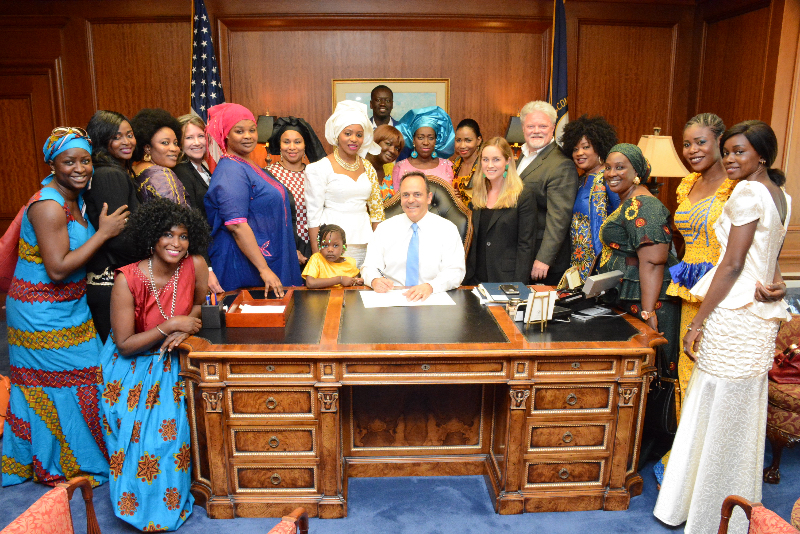
Rent-seeking in Kentucky
In the Kentucky
hair-braiding market, there wasn't quite an alliance between Baptists and
bootleggers like Professor Elzinga observed in Albemarle Country years ago, but it was similar to the current liquor market in
Texas. This ended over the summer, when Kentucky Governor Matt Bevin signed a bill exempting
natural hair-braiders from burdensome occupational license regulations. The
regulations in Kentucky restricted the entrance of new firms into the market by
requiring all hair-braiders take 1,800 hours of irrelevant training to obtain a
cosmetology license and legally open a business. This could cost up to $20,000.
These regulations didn't serve any rational basis. The natural hair-braiders
are primarily West African immigrants who learned this trade from their family
members, and according to the Institute of Justice's report (and, presumably, common sense), the hair-braiding
profession is perfectly safe. In other words, society's health, safety and
morals weren't served by the regulations, but the pockets of some well-connected cosmetologists
probably were. This explains why State Representative Hubert Collins -- "whose wife chairs the Kentucky Board of
Hairdressers and Cosmetologists" -- attempted to introduce an amendment
barring natural hair-braiders from working legally unless they jumped through
all of the Board of Hairdressers' hoops. Similar to the five families in Texas using the force of law to keep out competitors in the liquor market, entrenched interests in Kentucky tried to lobby the state government to erect artificial barriers to entry in the cosmetology market. Fortunately their efforts were defeated, so now these people can make an honest living:
Wednesday, September 14, 2016
Free Rider Problem: French Quarter Edition
In February 2015, New Orleans citizen Sidney Torres privately started the French Quarter Task Force an off-duty police patrol in New Orleans, patrolling a four block radius with brightly painted Polaris vehicles (now Smart cars) in the heart of the French Quarter. He independently spent over $300,000 to get the project up and running for four months. Torres had subsequently hoped that businesses in the French Quarter that were benefitting significantly from the additional police force would contribute to his mission to make the French Quarter safer.
However, Torres encountered a version of the prisoner's dilemma we looked at in class on Tuesday. Because the businesses in the area had a dominant strategy to not contribute and would still benefit from Torres' independent efforts, Torres fell into the trap of the free rider problem and couldn't continue to operate the Task Force solely on his own. Thus, he found a role for government. In October, voters in New Orleans approved a quarter cent increase in the sales tax for the French Quarter that allowed the City of New Orleans to take over the Task Force both administratively and financially and it has been operating (mostly) successfully ever since. This is a classic example of the role for government in solving the free rider problem and providing public goods.
However, Torres encountered a version of the prisoner's dilemma we looked at in class on Tuesday. Because the businesses in the area had a dominant strategy to not contribute and would still benefit from Torres' independent efforts, Torres fell into the trap of the free rider problem and couldn't continue to operate the Task Force solely on his own. Thus, he found a role for government. In October, voters in New Orleans approved a quarter cent increase in the sales tax for the French Quarter that allowed the City of New Orleans to take over the Task Force both administratively and financially and it has been operating (mostly) successfully ever since. This is a classic example of the role for government in solving the free rider problem and providing public goods.
Monday, September 12, 2016
Repair or Resettle: Vote With Your Feet!
Recent flooding throughout Louisiana has raised a massive issue for local and central governments as well as residents effected by the natural disaster. Billions of dollars worth of home cleanup and repairs will be necessary to fully recover from the onslaught of water, but "more than 80% of damaged homes didn't carry flood coverage because they were outside the 100-year flood plain." The governor of Louisiana, John Bel Edwards, has approached the federal government and asked for $2 billion to fund recovery efforts. Because this flood exceeded the 100-year flood plain by massive proportions, local government spending and aid is simply not enough, and people are forced to make the decision to stay in their rotting houses and wait for aid, or leave in search of a new start away from their damaged communities.
According to Gov. Edwards, "the longer it takes to get federal money, more people will decide to leave their homes and communities." The coming weeks will reveal many people's preferences in a typical fashion described by Tiebout. Although many people moved to the areas outside of the flood plain in order to avoid dealing with frequent natural disasters ('voting with their feet' to be out of harm's way), they are now faced with another situation in which they must reveal their preferences over time and either stay and repair their damaged homes and communities, or leave and settle elsewhere for a new start. Additionally, they must consider the revenue-expenditure patterns of the areas in which they live in. If they are settled in one of the areas where FEMA has begun responding as well as where local government has already delegated funds for disaster responses, they are more likely to stay put and allow the government to help them. Whereas if they live in the massive area effected which has no infrastructure to deal with such a natural disaster, they may think twice about whether it is worth staying or leaving for a safer area to settle.
According to Gov. Edwards, "the longer it takes to get federal money, more people will decide to leave their homes and communities." The coming weeks will reveal many people's preferences in a typical fashion described by Tiebout. Although many people moved to the areas outside of the flood plain in order to avoid dealing with frequent natural disasters ('voting with their feet' to be out of harm's way), they are now faced with another situation in which they must reveal their preferences over time and either stay and repair their damaged homes and communities, or leave and settle elsewhere for a new start. Additionally, they must consider the revenue-expenditure patterns of the areas in which they live in. If they are settled in one of the areas where FEMA has begun responding as well as where local government has already delegated funds for disaster responses, they are more likely to stay put and allow the government to help them. Whereas if they live in the massive area effected which has no infrastructure to deal with such a natural disaster, they may think twice about whether it is worth staying or leaving for a safer area to settle.
Sunday, September 11, 2016
Revealed Preferences in New York Suburbs
Home owners who are looking for certain institutions: a busy downtown, good transportation options, good public schools, and an active community say that Westfield, New Jersey has great appeal to them. Especially to families looking to move out of New York City, there are many smaller towns to chose from while remaining within commuting distance. What sets Westfield apart from the rest of these towns is their local revenue expenditure pattern. Things like the community theatre and huge Westfield Memorial Library, as well as a Westfield sponsored 5k and annual Halloween parade, create the community feel that these families want. The public schools in Westfield have higher than state average test scores and the commute to New York City is only 40 minutes.
Those interviewed from this community demonstrate Tiebout’s model where local revenue expenditure patterns are given and consumers vote by moving. Tiebout would argue that with many services provided locally in this town, consumers are able to reveal their preferences by moving. The town’s popularity as a suburb of New York City would demonstrate the desirability of this local revenue expenditure pattern to consumers. In a region where the number of polities is very large and there is a lot of information about the different towns, consumers are able to reveal their preferences by choosing where they live.
The Road to Externalities
Several years back, many Charlottesville citizens grew increasingly worried or excited over the prospect of a new Western Bypass. Those in favor saw a positive externality: this road would make travel easier for many people. However, those opposed- particularly those living close to the possible site of the road- viewed the negative externalities: the road would lower their home values and increase the noise level, disrupting their daily lives.
After taking economics classes, my views on this project have shifted. Looking at roads in general, if a proposed road were built by a private company, which Friedman suggests is an option if the road were excludable, then the residents around the road could work out a Coasian solution. Depending on the property rights, the road builder could either pay the residents for the right to build the road near them and cause them discomfort, or the residents could pay the builders to reduce the size of the road or simply not build it. Under Coase's assumptions, either way would lead to the same outcome. However, in a real world situation such as this, there are not two clear sides. Instead, some citizens will support the road, and some will not, while other free riders will remain uninvolved and hope that their side wins. Therefore, the transaction costs would be extremely high.
In the case of the Western Bypass, the government ultimately decided the fate of the road. Although the government's decision is almost certainly not allocatively efficient, nor is it proportionately representative, it provides a solution to the confusion and chaos caused by the real world negotiations a private market Coasian solution would cause.
After taking economics classes, my views on this project have shifted. Looking at roads in general, if a proposed road were built by a private company, which Friedman suggests is an option if the road were excludable, then the residents around the road could work out a Coasian solution. Depending on the property rights, the road builder could either pay the residents for the right to build the road near them and cause them discomfort, or the residents could pay the builders to reduce the size of the road or simply not build it. Under Coase's assumptions, either way would lead to the same outcome. However, in a real world situation such as this, there are not two clear sides. Instead, some citizens will support the road, and some will not, while other free riders will remain uninvolved and hope that their side wins. Therefore, the transaction costs would be extremely high.
In the case of the Western Bypass, the government ultimately decided the fate of the road. Although the government's decision is almost certainly not allocatively efficient, nor is it proportionately representative, it provides a solution to the confusion and chaos caused by the real world negotiations a private market Coasian solution would cause.
The Importance of Local and State Power
For
the town of Breckenridge CO state law says it is legal to possess and sell
marijuana recreationally according to Amendment 64 passed in November 2012, while Federal law bans its use in all states. On January 1st, 2014, Breckenridge Cannabis Club
(BCC) started selling marijuana for recreational use on Main Street and reaped lucrative profits. After a year of town council votes and deliberation,
local residents overwhelmingly voted to keep dispensaries off of the Main Street and forced BCC to move.
This
situation in Breckenridge, CO resembles what Tiebout thinks the role of
government should be. Rather than having federal restrictions apply to all
people – people with heterogeneous preferences – local laws and regulations
allow people to move to the locality that best fits their needs and wants. One
important factor that is not included in Tiebout’s model but at work in Breckenridge
is the ability for the government to “adapt to the preferences of consumer
voters”. For Breckenridge, the town government was able to
adapt to the preferences of the people in a way that could never happen at a
federal level. Because of heterogeneous preferences, local governments function best because people “vote with their feet” and exert
influence on their local government to better meet their preferences.
Subscribe to:
Posts (Atom)