In class, we talked about how to avoid employees from shirking. 1. monitor(have the knowledge of whats going on). 2. well-defined objectives)single dimension output) 3. frequent performance reviews. 4. secure many alternatives. Based on this metric, it seems to me that it's quite hard to avoid tenured professors from shirking, for the reason that 1. Monitor: It is often difficult to monitor the daily activities of tenured professors since there are various forms of academic work (teaching, research, etc) and can be private. 2. 2. well-defined objectives: Unlike many roles, teaching and research outputs are difficult to quantify consistently, and success in these domains is often subjective. 3. frequent reviews: Tenured professors have limited performance reviews compared to non-tenured faculty. 4. Alternatives: Yes, there may be some alternatives, but universities have limited options to replace tenured professors, given that tenure is a form of job security that makes dismissal challenging unless there is a serious misconduct.
Sunday, November 17, 2024
Slack in universities?
Earlier this week my friend was complaining to me about a class which is about the topic she likes a lot, but she said the professor always seems to come a bit unprepared, and the lectures are a little disorganized. I am not making the argument that the professor is shirking but the word slack we learned in class quickly came to mind. Unsuprsingly, Tenured faculty has a much lower termination rate when targeted for sanctions than fixed-term faculties(16 percent v. 53 percent). It's also universally agreed that it's quite hard to get fired as a tenured professor. So I thought, in the rare case when a tenured professor really is shirking, can we avoid it? I thought about it, and the conclusion I reached was no.


If You Don't Like It, Take Your City And Leave!
About three years ago in Atlanta, I started seeing "Buckhead City" signs in the yards of some of my neighbors, as well as around some of the local businesses in the area. After looking it up, I discovered that these signs were referring to a movement for Buckhead, the northern part of Atlanta, to leave Atlanta and become its own city. Many people were frustrated with the leadership in Atlanta, and felt like they did not have the adequate representation they were entitled to based on the taxes they paid. They felt like the Atlanta government was acting against what they believed to be their own self interest, and they felt a new smaller city could more accurately word towards these interests.
I think in some way this would be an example of Tiebout's concept of voting with your feet. In this case the people would not actually be moving (their feet would not be very involved), but they would be leaving one city to join another where government actions line up more with the things they want. Further, the existing city of Atlanta would have seen real changes in their spending habits from this, as they would have been losing a large source of their tax revenue. Atlanta would have had to then make adjustments to raise its population after losing this significant chunk, according to Tiebout's claims.
To this point, the Buckhead City movement have not come to fruition, and likely wont. Part of this was that creating a new city would have been very costly, and would have required Buckhead to completely recreate many existing and working functions of the city of Atlanta. But another part of this was that the new mayor of Atlanta, Andre Dickens, knew this would have consequences for the city of Atlanta, and acted to make sure Buckhead residents felt heard. In his Inaugural Address, Dickens argued for "Atlanta Unity", saying "We don't need separate cities. We must be one city with one bright future."
I think this move from Dickens proves that Tiebout is onto something. To prevent the move from happening Atlanta had to make itself more attractive for people that would prefer to be elsewhere, to avoid severe population and tax revenue loss. In here we can see economic incentives truly do drive the formation and transformation of cities.
Saturday, November 16, 2024
Plastic Bags and Externalities: How Cities Use Taxes to Address Pollution

As the effects of pollution and climate change become increasingly visible, governments around the world are taking action. On January 1st of last year, the City of Charlottesville implemented a five-cent ($0.05) tax on disposable plastic bags provided to customers at checkout in grocery stores, convenience stores, and drugstores within City limits. Essentially, this tax aims to limit the negative pollution externalities by disincentivizing individuals from using single-use plastic bags and incentivizing individuals to use reusable alternatives. As said on the City of Charlottesville Government website,
“While this does not eliminate the use of plastic bags altogether, it incentivizes the use of reusable materials like bags, boxes, and baskets to transport purchased items. An important provision of the ordinance requires that the revenue from the 5-cent tax be funneled into environmental education, pollution clean-up, and providing reusable bags for SNAP and WIC recipients.”
Therefore, through collective action allowing for government intervention, the negative pollution externalities of plastic bags can be internalized through a market-based solution.
As explained by Ronald Coase in “The Problem of Social Cost,” if property rights are well-defined and transaction costs are low, private parties can negotiate and reach efficient outcomes without the need for government intervention. However, in this case, property rights over the use of plastic bags (the right to pollute) are not well defined, and the transaction costs in negotiating compensation for this widespread pollution are high, making a private solution impractical. Therefore, government intervention is needed to manage this externality efficiently. Overall, a tax on plastic bags is an efficient solution, as it internalizes the external costs while creating an economic incentive for both producers and consumers to reduce their plastic bag consumption.
As explained by Ronald Coase in “The Problem of Social Cost,” if property rights are well-defined and transaction costs are low, private parties can negotiate and reach efficient outcomes without the need for government intervention. However, in this case, property rights over the use of plastic bags (the right to pollute) are not well defined, and the transaction costs in negotiating compensation for this widespread pollution are high, making a private solution impractical. Therefore, government intervention is needed to manage this externality efficiently. Overall, a tax on plastic bags is an efficient solution, as it internalizes the external costs while creating an economic incentive for both producers and consumers to reduce their plastic bag consumption.
Friday, November 15, 2024
Law School Monopoly: Go Into Debt, Do Not Pass Bar
Over the past two months, I’ve been knee-deep in law school applications. Not only is my brain exhausted from crafting essay after essay, but my wallet has taken a hit too. The Law School Admission Council (LSAC) manages nearly every aspect of the law school admissions process, and its fees are staggering: $250 for the LSAT, $200 just to register for the application cycle, and $45 per school application sent through their system (not counting individual school fees). LSAC has effectively vertically integrated itself into this system, making it a one-stop shop for admissions—and a lucrative one at that.
Though LSAC operates as a nonprofit, it works hand-in-hand with American Bar Association (ABA)-accredited law schools. These schools—conveniently the only ones recognized in the legal profession—are bound by an ABA rule mandating that first-year JD applicants take a “valid and reliable admission test.” Unsurprisingly, the LSAT remains the test of choice, as the ABA discourages alternatives by threatening schools with the loss of accreditation. This creates a closed-loop system where LSAC and ABA-accredited schools maintain control over who gets through the gates of legal education.
If this monopoly on admissions feels frustrating, you’re not alone. Millions of students across the U.S. face the consequences of rent-seeking behavior in higher education. Through lobbying efforts, groups like the ABA extract benefits, like maintaining the LSAT’s dominance, while students bear the costs through increased tuition and fees. This creates a deadweight loss, with fewer resources available for improving education and more funneled into preserving the status quo. For example, the ABA maintains a governmental affairs office specifically for lobbying Congress on issues related to the legal profession.
If any of you future economists are debating a mid-career switch to the legal profession, here's a sample LSAT question to get you started:

Correct answer: E
Thursday, November 14, 2024
Negative Breakfast Externality
Earlier in the year we talked about externalities which are byproducts of an action and can be positive or negative. A negative externality occurs when I do something that negatively affects someone and I don't bear any of the costs. I was reminded of this when I was eating breakfast the other day. I like to sleep in so I don't eat breakfast most days but every Tuesday and Thursday I like to eat after class. I like to keep my breakfast simple and I don't like wasting time making a good meal. At the same time I recognize the importance of eating a healthy breakfast so I compromise by eating a mixture of tuna and peanut butter for breakfast with a glass of milk. It has a lot of protein and I'm sure a lot of other nutrients. Many of my housemates do not share my sentiments and often complain about the smell. The smell doesn't really bother me so I'll continue to eat this in the future. Perhaps a coasian solution could be reached if they payed me not it but they'd have to make it worth my while.
Monday, November 11, 2024
The Boot's on the Other Foot: How European Soccer Is Learning From American Socialism
Growing up, I never played soccer because I thought it was un-American. That is a very true story. However, in recent years I've seen the light and now am a proud and anguished supporter of Everton (with their beautiful manager Sean Dyche, pictured at the bottom) in England's Premier League. I love the setup of international football's promotion-relegation, free market approach, where seemingly any team has a chance to win; hypothetically, lowly Swindon Town in the fourth tier of English football could be less than five seasons away from winning the Champions League, Europe's highest title. However, this rarely occurs; in European football, just as in capitalism, the richest clubs win the day.
The European system differs greatly from any American sports league, even our own Major League Soccer. Major American leagues are set up to ensure the security of their member clubs even through financial woes and poor on-field performances. Even the wealthiest clubs have caps on their spending to ensure a fair competitive distribution (unfortunately for my Minnesota Twins, Major League Baseball is an outlier here). This Wall Street Journal article I read highlights the irony of this: America's strong laissez-faire culture contrasts with the socialist nature of American sports leagues, while Europe's more socialist culture supports a very capitalist soccer system. However, Europe's system slowly appears to be shifting toward a more American approach. Europe's major clubs tinkered with a "Super League" consisted of the top clubs from each major European nation, a move that was nearly unanimously shot down but led to a revised Champions League format that placed more focus on European instead of domestic competition. Recently, the EU's top court ruled that Europe's player transfer rules don't give players enough freedom, opening the door for free agency of sorts.
The article caught my eye for its relationship to Buchanan & Tullock's Calculus of Consent. Chapter 6 states, "Since no player can anticipate which specific rules might benefit him during a particular play of the game, he can, along with all the other players, attempt to devise a set of rules that will constitute the most interesting game for the average or representative player. It is to the self-interest of each player to do this." American sports have implemented said rules to create a more competitive league, giving every team a chance to compete or game the system. Europe appears to be following their lead.

Sunday, November 10, 2024
Late Night Election Watching: Am I...Irrational?
I, like many other Americans, found myself up until nearly 4 am on Tuesday night watching the election results. If you asked me why, I would've told you that I felt it was a very important outcome and I wanted to know as soon as I could what was going to happen. I felt like this made sense, and as a result, I was one of the very first people to hear about the election results. The next morning I woke up, and saw many people saying they "woke up to the most ___ news of their life." I leave the blank because obviously, people felt different ways about the outcome, but for many the similarity was they felt the news was extremely important and they woke up to it. In my mind, I wondered why they did not stay up to see if it was so important to them.
The obvious answer here is that most people are not college students, and most college students do not have their first class on Wednesday at noon (though they should try it sometime). For me, the opportunity cost of staying up was very low, while for them it meant showing up tired to work or class, which can have real consequences. But I was not alone in staying up, given this BBC article titled: Staying up? Here's all you need to know about election night. Many others, like myself, stayed up for the important news.
I was also honestly bored watching the results come in. It is pretty slow, and they say the same things over and over again. I can not think of any utility that made it worth it to be low on sleep the next day, and miss a little bit of daylight. Was I acting irrationally? Was there more utility to be gained by going to bed early and checking my phone first thing in the morning? Did anyone else stay up late watching it and feel like they were right to do so? For now, I might just have to live with the fact that I may not be perfectly rational.
The Rational Voter's Dilemma: Avoiding the Hassle
A few weeks ago in class, we posed the question: why do [rational] people vote? Because the expected return of one individual voting to elect one's desired candidate is so low, we concluded that there must be other motives which compel utility maximizing individuals to vote; expressive voting and fulfilling a sense of civic duty are such examples of this phenomenon.
In the midst of all else that was going on during this election cycle, I realized that there was another rational reason to vote, at least in my case. Walking up and down the corner and throughout grounds during the weeks leading up to November 5th, I was accosted on several occasions by random strangers asking me if I had registered to vote. The truth is, I hadn't registered to vote, and was planning to do same day registration (or considering not voting at all). Thus, every time this question was posed, a little bit of negative utility was eating away at me. I did not want to say "Nope" and be asked to fill out some survey or QR code contrivance, but at the same time, I would rather my conscience not be burdened by continuously lying to these campaigners - leaving no positive outcome for this situation. And so, an argument can be made that it would have been rational for me to have registered to vote some time ago, to avoid any hassle from these people. After doing so, I could simply reply "yep" and carry on with my day, not being pursued by the harassment group, and my guilt being assuaged by no longer lying to them.
By-Product Theory and American Physical Society
A couple of weeks ago, I had to head down to UNC Charlotte to present on the research I did this summer. Since it was my first time presenting at an APS meeting, I wanted to make sure I had everything in order before I got to Charlotte. So about a week prior I went about registering for the event. To my surprise, the cost of attendance for a non-APS member student was $60 while that for a member student was $15. Student Membership to APS costs $25 annually, so naturally I signed up as a member, and then proceeded to buy the discounted ticket, saving me $20 on cost of attendance.
Almost every other student I spoke to also signed up on the APS member ticket, which I thought was a really cool example of Olson’s By-Product Theory that we spoke about in class last week. In this case, the primary good being the lower cost of attendance at a conference, and the by-product being APS membership.

An Athletic Prisoners Dilemma

Over the past few weeks, leading up to our last couple of competitions in the fall season, my rowing boat got substantially faster very quickly. Ironically, over this time, everyone in the boat was both putting more power into their oar and, at the same time, felt like they were exerting themselves less overall. We hadn't done any sort of fitness training over that time, so it would seem odd that both could be true. As one of my teammates pointed out during a meeting after practice, it came down to a prisoner's dilemma.
As we row, we look for something we call "swing". This refers to the feeling of the boat moving when rowers are in perfect harmony, both in their rhythm and in their exertion. If any rower changes either of these things, that feeling is lost, and the boat both moves slower and feels "heavier," requiring more effort from hardworking athletes to reach the same speed. This is where a prisoner's dilemma comes in. If any one rower starts working harder, things get substantially worse for that person, as it is both very hard to be the one person pulling harder than the others and very easy to be the one person not pulling in a boat of harder-working athletes. However, if everyone simultaneously starts working harder, we can find swing and move the boat faster with less overall effort. Everyone, though, has an incentive not to act, as an athlete previously putting in minimal effort and then making the change will make their expected workload in the boat greater, regardless of the actions of the others. Instead of a fast, light boat, we get a slow boat with no hardworking athletes in which everyone ends up putting in more effort than if they tried to work harder as one.
This is where my job starts to matter. Although I don't hold an oar, I am the voice in each rower's head encouraging them to do something that, if just one of them chooses not to do, will be extremely difficult and unrewarding for everyone that does it. However, when I can convince everyone to act, we see a pareto-improvement, making the boat faster with no downside to anyone, when compared to a boat with nobody working hard at all.
Samuel Gregg and minimum differentiation
Our class discussed how a location model can be used to analyze how parties position themselves to acquire a majority. A classic Hotelling finding that Downs analyzes is a minimum differentiation solution between two parties, but do we really see that today?
I'm reading economist Samuel Gregg's book "The Next American Economy." Despite current polarization, he claims both parties have systematically questioned the use of free markets. He thinks conservatives, who once championed free markets, now brand their government intervention as "populist" or "economic nationalist."
Gregg's description shows the two parties are closer to 0.5 in a Hotelling model than what we may think. But this is far from a "democracy works because of minimum polarization" finding: Gregg is concerned that Americans have lost sight of the previous century's free-market enthusiasm.
Monday, November 04, 2024
Winners take all
I was intrigued by Stigler's idea on regulation, that "regulation is acquired by industry and is designed and operated primarily for its benefits." After listening to the presentation on Thursday on the Jones Act, I decided to research more into real-life examples of this theory.
Telecommunications Act of 1996 overhauled telecommunications laws to foster competition and reduce regulations, especially in the rapidly evolving communications and media industries. While the Act’s primary goal was to encourage competition within various communication sectors by removing barriers for entry by allowing different types of service providers to enter each other’s markets. However, in practice, it allowed large companies to consolidate thus inhibiting competitions.
Before the Act, there were strict limits on how many television and radio stations a single company could own. The Act lifted many of these restrictions, allowing companies to own more stations within the same market and across the nation. Apparently, large firms benefit significantly from economies of scale, where the cost of service decreases as the company grows. The Act’s deregulation made it easier for big companies to merge and gain these efficiencies, thus discouraging competition. Therefore, though initially intended to encourage competition, this government regulation has worked in the favor of the few, large firms, operated in their beneifts.
Democracy in Action: A Sickos Borda Count
As a big fan of voting (early and often), I was fascinated by the alternative voting rules we learned about earlier this month. The one that stood out to me most was the Borda method, ranking candidates and assigning descending point totals for each (with k candidates, choice 1 gets k, choice k gets 1). This is the preferred method for economists, sports writers, and, most importantly, the Sickos Committee, a group of self-described depraved college football fans with a penchant for the wild and wacky moments in college football.

Sunday, November 03, 2024
RCV>Approval: A Sorority Girl's Op Ed
Within my sorority Pi Beta Phi, I serve as one of 6 members on our Leadership and Nominating Committee (LNC). LNC’s role is to interview and slate members we believe should be on the executive team for the next year-long term. We submit our picks to the current executive branch, and they approve or deny our picks. The general population within the sorority currently has no say in who gets elected since the LNC is picked by Nationals.
I wonder though, how did Pi Phi decide on this voting method? When analyzing how I came to be on LNC today during the 4 hours of interviews I endured, I thought a lot about public choice and our current voting method/whether or not I think it is effective. What I realized was that, I do not think the way we vote is effective in producing Condorcet winners.
Connecting this to class briefly, I noticed that LNC elects their picks through the approval voting method - touched on in Mueller as an alternative to simple majority. Essentially, this just seems like a popularity contest. We pick everyone we like for that position, and the person we like the most (gets the most “approval” votes) wins.
Now, thinking about this, I don’t love the way this sounds, and it didn’t seem like it would produce many Condorcet winners for each position as it would be statistically a low probability that the entirety of the chapter’s values align with the 6 members on LNC for every pick we make. For this reason, it seems to me the way we vote ought to change. An alternative I think would be effective in creating more Condorcet winners would be ranked choice voting, and opening it up to the entire sorority. Ranked choice voting has many pros, including the fact that it decreases the cost of voting by eliminating the need to return to the polls (the Pi Beta Phi chapter room) multiple times. It also allows for there to be multiple candidates for each position. Additionally, in a group of 160, the benefits of voting are drastically increased since your vote actually matters - making it rational to vote and likely meaning there would be high voter turnout - demonstrating its potential as a solid alternative to the approval voting method we now use through the LNC.
A What Kind of Prisoner's Dilemma???
As I was scrolling through the Financial Times (as one does), one article caught my eye: "Google and peers weigh an AI Prisoner's Dilemma". At this point in the semester, seeing the words "Prisoner" and "Dilemma" in any form together warrants my attention, and this article did not disappoint. The author argued that companies like Meta and Google are experiencing a prisoner's dilemma, because although the companies would be better off working together to develop AI, they still choose to compete separately. With trillions of dollars in potential value to be gained from AI, these companies want it all to themselves and thus compete and research AI separately.
While there certainly is a prisoner's dilemma regarding AI development, I think the article is missing another prisoner's dilemma that may occur in a few years. Although there certainly is real value to be had if firms work together to develop a strong functioning AI model, I believe another prisoner's dilemma may occur with pricing. If firms can collaborate on prices, they can charge much higher than with competition. With trillions predicted in a competitive market, the amount of money firms can make together would be astronomical. It remains to be seen if firms will go down this route, but if AI companies can band together, their profits will go through the roof.
Mcdonald's Ice Cream and the DMCA
McDonald's ice cream machines are infamous for being out-of-order. This is thanks to the Digital Millennium Copyright Act (DMCA) which prevents anyone except the original manufacturer from servicing it. However, ice cream lovers can rejoice since the US Copyright Office recently issued a new ruling that amends the DMCA and creates an exception for “retail-level commercial food preparation equipment." Theoretically, this means McDonald's will now be able to service these machines themselves and reduce the average down times.

Got Corn?
Earlier this evening, a sense of dread overcame me as I filled my car with gas. As I watched the meter run over $60, I could feel my wallet let out a quiet weep of despair. While I stood there watching my bank account deplete, I noticed a sticker on the gas pump that said, “Contains 10% Ethanol.”
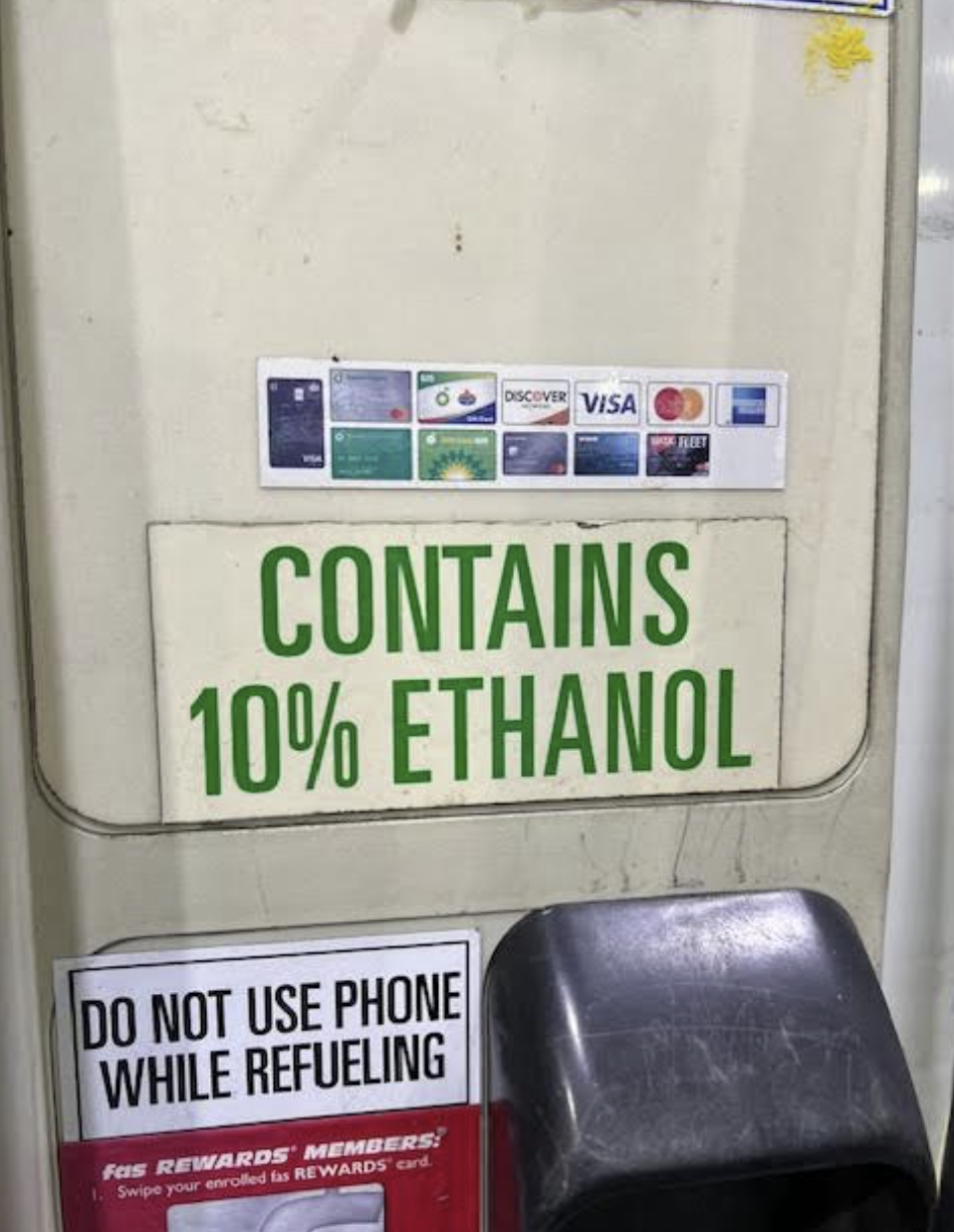
After a bit of research, I realized that I had stumbled upon a classic case of Stilger’s capture theory. The reason that I was pumping fuel that contains 10% ethanol comes from a program called the Renewable Fuel Standard. This program requires that a certain volume of “renewable” fuel be mixed in with any transportation fuel (gasoline) sold in the U.S., which, in theory, will reduce the quantity of fossil fuels used and thus help the environment by reducing emissions.
Since its implementation in 2005, the main benefactor of this program has not been the environment but instead the agricultural industry–particularly corn producers. Since the RFS was put into action, over a third of corn production in the US has been devoted to ethanol production. This new, steady demand for corn has led to negative production externalities such as the destruction of natural habitats (to turn land into corn fields) and water pollution from fertilizer runoff. Critics of the RFS have cited these environmental concerns and increased consumer costs as incentives to do away with the program.
The RFS began as a promising program. Still, its effects have not been as intended, and it now primarily serves special interests who benefit from the market for corn it creates (as well as providing a barrier to entry for alternatives such as foreign oil).
Wednesday, October 30, 2024
Stigler in Nature!
In my English class, we read Justice William O. Douglas's famous dissent in Sierra Club v. Morton. A year after Stigler published his "capture theory" paper in 1971, the US Supreme Court ruled that a ski resort in the Mineral King Valley caused no substantive harm toward the Sierra Club members, affectively siding against nature.
Douglas primarily advocates for granting legal standing to inanimate natural objects. But he also questions whether regulatory agencies can be effective protectors of the environment. Douglas observes that government regulation is often "oriented toward the interests of industry it is designed to regulate," calling out the Forest Service for being "notorious for its alignment with lumber companies."
I believe Douglas pulled from Stigler in this dissent, which means Stigler's ideas indirectly impacted the US environmental movement.

Expressively Unhappy: A Voting Dilemma
Expressively Unhappy: A Voting Dilemma
The other day I got a letter informing me that "this year more Virginians than ever are voting! Don't be left behind!" Aside from the obvious confusion of why anyone would think a postcard is the best way to convince a twenty-year-old college student to vote, my public choice immediately questioned: am I not much less inclined to vote if more Virginians than ever are voting? As more and more people vote my expected benefit of voting gets lower and lower as more and more people crowd out any chance I have at a deciding vote.
But beyond this, I wondered why it is that more people than ever are voting this year. Compared to previous years the sentiment feels like each side could be more enthusiastic about their own candidate, and as of October 1st 58% of Americans surveyed expressed they would want to see a third party according to this Gallup poll. Further, the graph below shows voter turnouts for primary elections in Virginia, which are relatively very low compared to previous years. Although you could argue that the numbers are low due to the inevitability of the two candidates, one of those two candidates is no longer running so it seems they were not so inevitable.
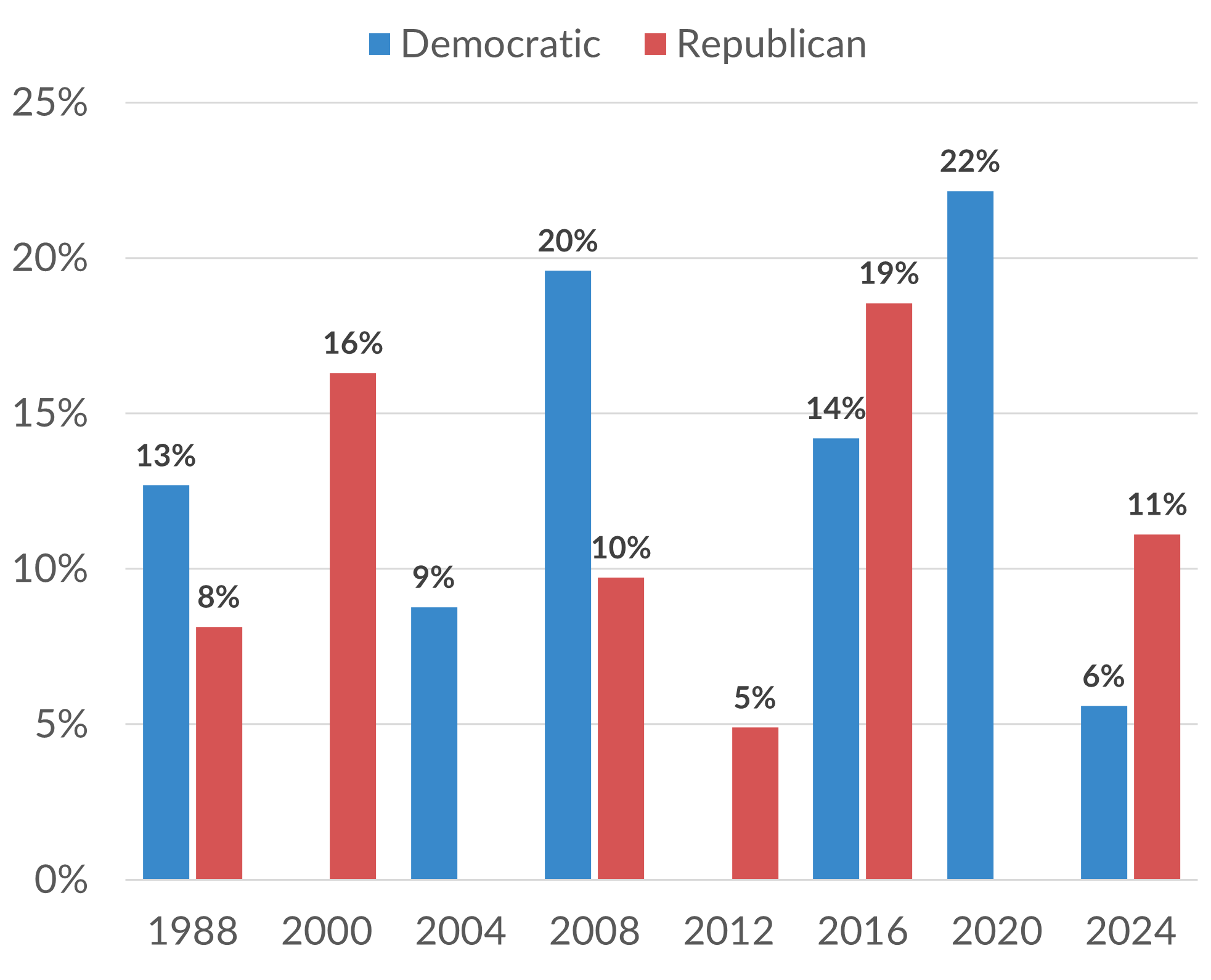
Although we talked about expressive voting to show support, we did not consider expressive voting out of severe disapproval of the alternative. The way I see it: partisan voters may feel one way or the other about their own candidate, but more so than in previous years are driven to vote so they can tell themselves they voted against the alternative.
Sunday, October 27, 2024
Regulation in ᑓᑌᑎᕮ
In Dune, interstellar travel and trade are regulated and granted to the Spacing Guild, as described on Reddit:

The Spacing Guild enjoys its profits and share of political power. However, Navigators need spice to calculate safe travel paths. The only source of spice is on the planet Arrakis, or Dune. This makes spice the most precious resource in the economy, and thus also regulated. And vulnerable…
Any disruption in spice supply would delay travels and render the Navigators powerless. The protagonist, Paul, capitalized on this when he threatened to destroy all spice fields, successfully coercing the Guild to his will. When Paul became emperor, he limited the supply of spice to the Guild, realizing how stagnant the previous regulation made the economy.
In the long run, the Guild grew obsolete in power as spice became inevitably scarce. Instead navigation computers get developed, creating efficient and renewable space travel. Thus, regulation placed a barrier on innovation. It also led to the downfall of the industry it was meant to protect; economic forces prevailed over unstable political forces.
Subscribe to:
Posts (Atom)