Showing posts with label Game Theory. Show all posts

Monday, October 01, 2012

Delicious Invisible Meat


I was really struck by our discussions in class about why it isn't economical to vote. I think the arguments for why it is unwise (if not patently irrational) to vote are very persuasive (though I still plan to vote in November because I personally derive a fair bit of utility from the act of voting). As I mentioned in class, I have many times in the past tried to persuade friends to vote (to help to raise their social benefits of voting), but have been met with strong opposition when they reply with arguments similar to the ones we made in class. Once my (very smart) friends start down this line, I usually give up -- they're just right.

So, recently, I've gone the other way, and despite my continued plans to vote, I've switched to making the case to people that they should not vote. Faced with the same airtight logic we discussed in class, all of the ones who didn't immediately agree struggled to make an argument is to why voting is a good thing. In almost every case, the eventual response was, essentially, "but if everyone did that, the political system would collapse!"
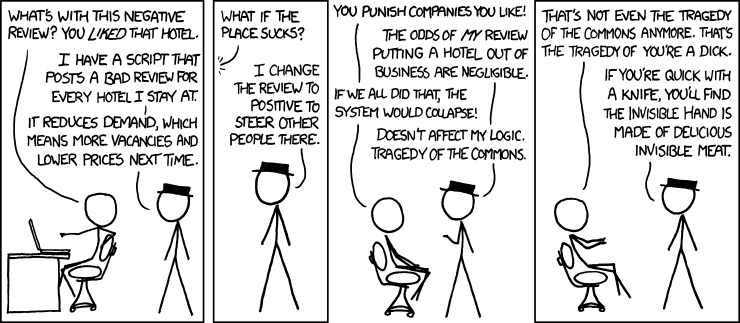

This is the same message as this issue of my favorite webcomic (this comic is about hotel feedback behavior, but the issue of "I do something rational that I'm glad not everyone else does" is identical). Black Hat Guy responds to this line of argumentation the same way I do to my friends:
"Doesn't affect my logic. Tragedy of the Commons."
There are some interesting questions about how to handle the tragedy of the commons issue of not voting (if fewer people vote because they realize how irrational it is, it becomes less irrational because fewer voters means your vote has higher electoral value and so that will reach a proper equilibrium, etc.), but given the present state of affairs, it's still irrational to vote, and concerns about "it'll ruin everything if other people decide similarly!" are unfounded, and shouldn't affect your decision to [not] vote. That's an individual choice, and it's okay to behave according to your self interest.

*  *  *

On a not-totally-related-to-this-particular-class note, Black Hat Guy's final line in the comic,
"If you're quick with a knife, you'll find the Invisible Hand is made of delicious invisible meat."
is one of my favorite quotations.

Sunday, October 03, 2010

The Economics Behind 'The Bachelor Pad'

Of the many hours I wasted watching the Bachelor Pad, I have found a way to gain some value from it—blog about it. This show relies on the economics of public choice in order to create unpredictability and drama. For those of you that are not familiar with it, it’s a TV show in which past bachelors and bachelorettes (From the TV shows of The Bachelor or The Bachelorette) compete for $250,000 and a chance of finding love along the way. At the end of each week an elimination ceremony takes place where all of the women vote individually on the man they would like to eliminate and the men do the same for the women. .

Right off the bat, the contestants divided into the “insiders” (contestants that knew each other before the show) and the “outsiders”. As a result, the women of the insider group would collaborate with the men on the insider group in order to see which man they should voted off. In return for granting the insider-men their wish, the men would place their vote based on what the insider-women requested. The outsider’s did the same. I think this is a great example of logrolling. These mutual agreements lead to both sides (men and women) gaining a better chance at achieving their preferences. Furthermore, just as Mueller describes it in Chapter 5.9, the bluffing problem certainly made its appearance on the Bachelor Pad, creating a good amount of drama. .

Mueller also mentions the problem that occurs when voting is done in sequence, as was the case on the Bachelor Pad. The holdout problem proved to be a very popular strategy for some contestants. Many times right before the last contestant was going to place his/her vote, the contestant most worried about being voted off would strike deals with the last voter. For example, Kip was on the verge of being sent home and Nikki was the last women to vote leaving Kips fate in her hands. Kip bargained with here by promising his loyalty to her in the future—a benefit Nikki only received because she was the last voter.

Finally, at the end of the show only one woman (Natalie) and one man (Dave) were left standing. Natalie and Dave were sent into separate rooms and were given the decision to either share the money or to keep it all to themselves. Who would receive the money was decided in the following manner:

  • If both Natalie and Dave decided to keep the money, neither would receive it and the quarter million dollars would be divided among all other Bachelor Pad contestants.

  • If one of them decided to share and the other decided to keep the money, the person that chose ‘keep’ would receive the whole $250,000.

  • If both decided to share the money, each would receive half of the $250,000.
This is a typical prisoner’s dilemma. In class we discussed that the dominant strategy would be for both of them to decide to keep the money, which would leave both with nothing. However, if there are other convincing incentives put in place (like an inmate breaking the leg of the person who confesses) then this may be avoided. So the burning question the show left its viewers with was whether “love” was enough of an incentive for both Natalie and Dave to decide to share the money. I’ll leave it at that…