Showing posts with label rational abstention. Show all posts

Sunday, November 02, 2014

Cheerio, median-voter

America’s upcoming midterm election has raised much debate on how the spatial distribution of voters will determine the outcome. Contrary to past elections, Democrats and Republicans have forgotten about the median-voter and instead, have become more extreme in their speech to capture those consistently liberal or conservative, respectively. As a result, more and more moderates have decided to tune out and rationally abstain from voting since their votes will not be decisive. This suggests that the spatial distribution of voters for this particular election is heavy-weighted on the tails. For instance, according to this article, a survey by the Pew Research Center found that “73% of ‘consistently conservative’ Americans are likely to cast a ballot on November 4th, along with 58% of consistent liberals”. The question then remains on which party captured more extremists and will guarantee victory this upcoming Tuesday. 

Analyzing this situation under Down’s spatial location theory, we can expect the voting turnout to be determined by the abstention rates on both sides. Thus, in this case, we need to assume away the assumption of no abstentions implied in his model. If abstention were symmetrically spread across de distribution, then the median-voter would still remain as the decisive voter. However, if abstention is more likely in young people, then Republicans will have a better chance of winning, assuming that the Republican party has more elder citizens than the Democrats. The challenge remains on moving as much citizens to the ballot box this Tuesday. As parties have said their goodbyes to the median-voter, ironically, the midterm election will be determined by abstentions, not voters.

Sunday, October 19, 2014

Race And Voting

A few days ago I found myself reflecting on the significance of voting, especially in lieu of our recent class discussions. I don't want to sound pessimistic, but given recent trends I can only find more symptoms of weakness in the democratic election process.

This PEW analysis of data from the Census Bureau reveals that black voter participation rates reached record highs during the 2008 and 2012 presidential elections. However, according to the theory of rational abstention it is often rational for voters to abstain from voting because the costs of voting outweigh the benefits. So why is the black voter participation rate increasing?

During the 2008 and 2012 elections Barrack Obama ran as the first black president. While the expected marginal benefit of a single individual would not compel him to vote for Obama, another missing benefit from voting just might. I think that many black Americans voted for Obama in order to avoid the markedly higher social pressure that was imposed on them by their fellow citizens. Some may argue that this is fine and that black Americans should vote for Obama because of his race. But I think that this argument is dangerous and often coincides with another commonly espoused view: Black Americans should vote Democrat.

I am worried what this means for the democratic election process in America. I always thought that democracy was a sign of freedom--an individual's right to express their opinion unhampered by the coercion of others. But today, I see the chains of social pressure indoctrinating and manipulating many Americans, reducing their freedom to truly express their views on America's political system. Perhaps the democratic election process is not the most salient indicator of a free society.

Sunday, September 28, 2014

Don't Cry For Me, Hong Kong

The "rational abstention" argument in David Johnson's piece on voter ignorance presents democracy-lovers with a cynical challenge: do citizens really have any stake in elections? According to Johnson's theory, voters in large democracies have very little reason to actually exercise their franchise—that is, they are rational in declining to vote. Johnson reaches this conclusion by focusing on the instrumental  value of an individual's vote. Since the probability that any single vote will decide an election is vanishingly small, even those voters who place a premium on one outcome over the other (that is, voters who value Candidate A over Candidate B to the tune of a couple thousand—or even million—dollars) can expect a laughably small expected payoff. In the face of such nihilistic odds, the real surprise is why anyone votes at all.

But the real world furnishes us with examples of ordinary citizens going to great lengths—and great personal cost—to secure their vote. Recently, Hong Kong has been wracked by protests over the slow pace of democratization in this British-colony-turned-Chinese-Special-Autonomous-Zone. The culmination of months of unease over the increasingly authoritarian control exerted by Beijing, this weekend's protests featured the use of tear gas and pepper spray, and still the protestors turned out in the tens of thousands to demand their right to democratic elections. How does such passion develop in the apathetic atmosphere predicted by Johnson's rational abstention argument? In a fully democratic Hong Kong, these protestors' votes would have low instrumental value—surely not worth the costs associated with protesting against heavily-armed and aggressive police.

Two hypothesis could explain why those in Hong Kong do, in fact, care about their franchise. The Expressive Voter hypothesis, considered by Johnson, posits that people vote to express something about themselves: civic-mindedness, for example. Going to the polls and voting for a candidate or referendum outcome gives intrinsic utility. The expressive appeal of voting may help to explain why the citizens of Hong Kong have gone to such lengths to demand free elections. A second hypothesis I would put forward is one we will likely come across later in Caplan's The Myth of the Rational Voter. In his book, Caplan argues that the so-called Self-Interested Voter Hypothesis (SIVH) is inaccurate. That is, he contends that people don't vote by considering possible pay-offs to themselves, but rather vote according to their vision of what the best society would be. Although disregarding the SIVH doesn't eliminate the cost-benefit analysis entirely, it certainly helps to divorce voting from its instrumental value to the individual voter. Under this model, the citizens of Hong Kong value their franchise because it is an integral part of their vision of the best society (a democratic one), and not because of specific benefits they expect to receive through it.

Whatever the explanation, the implication is clear: people care about their vote, regardless of the strong (and rational) forces urging apathy. This concern is on display in Hong Kong.

Tuesday, October 08, 2013

New Emphasis Put on Absentee Voting in Charlottesville

On September 30th, NBC29.com posted a video addressing the concern in Charlottesville of a lack of voter turnout for the upcoming election. On Tuesday, November 5th, the General Election for state and local offices will take place. Governor, Lieutenant Governor, Attorney General, Member House of Delegates, Commonwealth's Attorney, Sheriff, Commissioner of Revenue, Treasurer, two Members of City Council, and 3 Members of the School Board will be on the ballot. Clearly, the results of the election will affect many in the Charlottesville community. With the upcoming deadline to register of October 15th quickly approaching, voter registrars are making a last push to encourage eligible voters to register for voter registration forms and for absentees ballots.

Johnson, in his essay, "Voting, Rational Abstention, and Rational Ignorance," addresses this issue of a decline in voter turnout. He states that it was "around the turn of the century [that] the percentage of eligible individuals exercising their franchise began to drop [...] until only about one-half of the eligible population went to the polls during the 1980s" (Johnson 129). He also acknowledges a trend towards making voting easier, less restrictive, and more convenient. This is exactly what we see in this video. The voter registrars are making it much easier for the first time to be able to register for an absentee ballot online at the Virginia Board of Elections website. With the prediction of only a 40% voter turnout rate on November 5th, this push toward more convenient voting may (they hope) incentivize voters. Additionally, this low voter turnout rate may reflect what Johnson calls rational abstention theory - that is, that a rational individual would not vote, finding that the cost of voting will almost always be greater than the benefits obtained from voting, according to Johnson. Ironically, rational abstention theory is one of the most damaging theories to the democratic self-rule on which our country was founded.

Sunday, September 29, 2013

Spreading Disillusionment in Germany

      Last week Germany held its parliamentary elections.  According to our Johnson reading  between 1958 and 1976 West Germany's average voter turnout was 84%.  However, between 1998 and 2009 voter turnout dropped almost 12% to 70.8%.  This year it is expected to drop another 5%.   Johnson said that one of, if not the, strongest explanations for why people vote is the "social pressure hypothesis" which "states that individuals vote in order to avoid the social pressures that their friends, family, {and} neighbors...would place upon them if they did not."  Germany is facing a situation in which this very social pressure is rapidly declining.  According to a pollster in Germany, "There has been a change in mood among the public...you no longer have to be ashamed to be a non-voter." According to his poll only 7% of non-voters "had to deal with criticism from friends and relatives, while 57% indicated that friends and family don't care whether they vote or not."  The very groups that Johnson mentioned who should be pressuring their fellow citizens to vote no longer care, and even fewer of those that care are saying anything.       

     There are also tinges of Downs and a side comment by Johnson in this article.  Among economists, intellectuals, and journalists the race to the center to capture that median voter has left much to be desired from the parties.  They want to debate "big issues" while all they see from the parties is "kids' stuff election campaigns," "un-philosphical politics," and "a single 'mega-party.'''  Not only do they know that their vote is unlikely to determine the outcome of the election, they feel that even if their vote was to be the deciding vote it wouldn't really matter which party won.  The author tells us that if these just people took the time to read the party platforms they would see that there were real differences in the parties, but as Johnson says, its not worth their time. They are rationally ignorant.      

     The marginal benefit of voting is declining as voters increasingly see few differences between the two parties.   Voters don't care who wins because they don't see the differences effecting them.  At the same time, the net marginal cost of voting is increasing as the societal pressure to vote decreases. There is a net increase in the marginal cost of voting because the societal pressure costs of not voting no longer offset the tangible cost of voting.  Therefore, we are seeing the marginal benefits of voting declining as the marginal costs rise which, as expected, results in fewer people voting. 

Friday, September 27, 2013

Rosario Dawson Fails To Understand Rational Abstention

This CNN op-ed by Rosario Dawson seeks to persuade disenfranchised minority citizens to vote in this November's gubernatorial and mayoral elections by appealing to several unconvincing justifications for voting. Dawson appeals to a sense of civic duty, as "voting is the bedrock of our democracy” and a means for citizens to “take ownership of [their] communities.” However, such appeals are ineffective, as voter abstention and rational ignorance are both sensible consequences of the American democratic structure.
Dawson suggests "voting is the easiest way to make your opinion known on any issue,” yet disenfranchised voters are not moved to vote by utility gains, social pressure, or a sense of ‘civic duty’ to overcome the cost of voting and make it to the polls. A rational voter will only vote when his marginal benefit exceeds his marginal costs. The marginal costs for voters, particularly the lower-income minorities that this article targets, will be relatively high, in terms of lost wages or the opportunity cost of taking the time to educate oneself on important issues. In some locales, the marginal cost is even higher due to restrictive photo ID laws, limited voting locations and hours, and tedious paperwork. While the National Voter Registration Day initiative alleviates the cost of the paperwork, the costs will still exceed the expected marginal benefit derived from voting. The probability of a vote being decisive is extremely low, so that even if the magnitude of the value gained from electing a preferred representative is very high, the expected marginal benefit of the average disenfranchised voter will be negligibly low.  

Instead of appealing to a sense of civic duty, Dawson’s campaign would be more effective if it focused on making voting costless or increasing the social pressure on those who do not vote.

Monday, October 01, 2012

Delicious Invisible Meat


I was really struck by our discussions in class about why it isn't economical to vote. I think the arguments for why it is unwise (if not patently irrational) to vote are very persuasive (though I still plan to vote in November because I personally derive a fair bit of utility from the act of voting). As I mentioned in class, I have many times in the past tried to persuade friends to vote (to help to raise their social benefits of voting), but have been met with strong opposition when they reply with arguments similar to the ones we made in class. Once my (very smart) friends start down this line, I usually give up -- they're just right.

So, recently, I've gone the other way, and despite my continued plans to vote, I've switched to making the case to people that they should not vote. Faced with the same airtight logic we discussed in class, all of the ones who didn't immediately agree struggled to make an argument is to why voting is a good thing. In almost every case, the eventual response was, essentially, "but if everyone did that, the political system would collapse!"


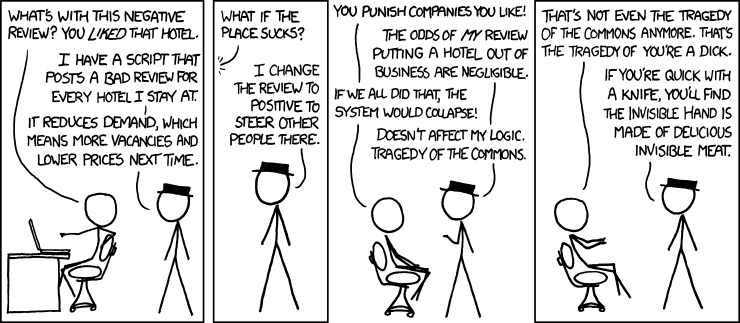
This is the same message as this issue of my favorite webcomic (this comic is about hotel feedback behavior, but the issue of "I do something rational that I'm glad not everyone else does" is identical). Black Hat Guy responds to this line of argumentation the same way I do to my friends:
"Doesn't affect my logic. Tragedy of the Commons."
There are some interesting questions about how to handle the tragedy of the commons issue of not voting (if fewer people vote because they realize how irrational it is, it becomes less irrational because fewer voters means your vote has higher electoral value and so that will reach a proper equilibrium, etc.), but given the present state of affairs, it's still irrational to vote, and concerns about "it'll ruin everything if other people decide similarly!" are unfounded, and shouldn't affect your decision to [not] vote. That's an individual choice, and it's okay to behave according to your self interest.

*  *  *

On a not-totally-related-to-this-particular-class note, Black Hat Guy's final line in the comic,
"If you're quick with a knife, you'll find the Invisible Hand is made of delicious invisible meat."
is one of my favorite quotations.

Wednesday, October 12, 2011

Children Prove to be Irrational and Altruistic at a Younger Age

When economists analyze what they believe to be rational, they often weigh the costs and the benefits to decide if it would be rational to participate or contribute to an activity. Sometimes individuals contribute or participate in an activity because they are altruistic, even though it is not rational for them to do so. This article in the Wall Street Journal analyzes if altruism begins when children are young, in this case three to four years old, and how this affects the decisions they make. Typical research has said that younger children are not altruistic and only become so when they become older and have “stronger notions of morality.” However, this study found that the majority of the three and four years olds expressed altruistic tendencies when they chose to give up some of the stickers they were given to an unknown child who they were told did not have any stickers. There are two topics from class that seem to be relevant to this study. The first is Coase and his work on the “Coasian Solution” where beneficiaries of a public good pool together their resources depending on their willingness to pay in order to provide the good. The issues that arise from this theorem are the holdout problem and the free rider problem, where it is more rational for some individuals to abstain from contributing to the provision of the good if enough other people pay and get the good provided without them having to contribute. As mentioned in the article, the only way to prevent the free rider and holdout problem is to make sure the people that benefit from the good are altruistic, so even if it is not rational for them to contribute to the provision of the good because it will be provided anyway, it is morally right for them to contribute so they do so anyway. Another instance where abstaining from contributing is rational is Johnson’s article on voting where it is irrational for people to vote when weighing the costs and benefits, but people do so anyway because people see it altruistically as their duty. Therefore, if the study holds true and children are showing altruistic tendencies at a younger age than previously thought, maybe we can expect a lot less free riders and a lot more voters in the future.