Showing posts with label vander. Show all posts

Tuesday, December 04, 2012

Uber Unfair Regulation

I'm glad that this course has given me a much better understanding of government regulation, but real-world examples still make me sad sometimes.

Uber is an awesome startup from San Francisco whose premise is immediately attractive. They designed a great iPhone app that you download. You open the app, hit a button, and within minutes a car comes to pick you up. It takes you to your destination, and you just get out -- the app already has your payment info, so they can charge you automatically. They have also created an awesome backend and give iPhones to black car drivers who can pick you up. Their algorithms for sending people to the right places are remarkably better than what most Limo companies currently use, and so through their use of technology they make people much better off.

But, as this NYT article discusses, regulators have been fighting back against Uber. They've been forced to shut down certain operations in some cities, and may soon be made to close entirely. Of course, excuses are always made:
Services like Uber, Airbnb andCraigslist can cut out the middleman and lead to more efficient markets. But regulators say they could also put consumers at risk.

One example they cite of "harming consumers" is particularly interesting to an economist. Regulators cite how for busy nights like New Years Eve or in the aftermath of Hurricane Sandy, Uber was "price-gouging" by raising their prices quite a bit. It's obvious from a moment of thinking about it that this is an efficient and good thing: by raising their prices, they prevent themselves from facing a shortage and inability to provide cars to those that ask, and instead allocate them to those who value them the most and are willing to pay, rather than just a random selection of first-come, first-served. Regulators though prey on the general public's misunderstanding of such phenomenon cast Uber as an evil, greedy organization that threatens to upset the important infrastructure of ride-for-hire transportation.

I'm hoping Uber comes out on top, but with Taxi services so entrenched and regulators so thoroughly captured by monopolistic companies, I'm not necessarily hopeful.

Update: Today, however, a major victory for Uber in Washington DC. So it's not always bad! Sometimes the good guys lobby well enough to win!

Sunday, November 04, 2012

Acquiring Liquor Regulation

Last semester, in Professor Larson's Auction Theory class, we studied Washington State's auction of their liquor stores as part of our final exam, and the story had lots of public choice implications.

Washington used to have a state monopoly for liquor sales (why this would have been the case in the first place is an interesting topic for public choice study, but I won't get into that here). As has been the case in many states, there was a movement to upend the public monopoly and allow for private sales. What many people don't realize, however, is that these efforts have been largely spearheaded by big-box retailers, namely Costco and Target. Their lobbying efforts meant that when the voter referendum to disband the state monopoly was finally on the ballot, it created a new regulation: the state would no longer be involved in liquor sales, but from that point forward only stores greater than 10,000 square feet in size would be allowed to sell liquor.

When I learned about it, this blew my mind: this regulation seems so obviously detrimental to public welfare and so clearly designed only to serve the interests of the lobbyists that it was honestly surprising to me. It hides behind the veil of
public concerns that gas stations and mini-marts would be allowed to sell liquor, 
but more realistically seems directed at preventing competition from smaller entrants. Perhaps I shouldn't have been surprising - Stigler's analysis of how firms acquire regulation to keep out new competition and support themselves appears to fit this situation perfectly.


(Note: Also of interest, though not necessarily as closely related to public choice, is the auction process that went on in this case. The existing state stores were auctioned off to public buyers, and they were granted special exemptions to the 10,000 square foot rule and allowed to continue operation.)

Sunday, October 14, 2012

Abolish Patents.

A bit of knowledge, like a mathematical formula, is often described as the platonic ideal of a public good*. This suggests that innovation might be under-provided by the market, and so the United States employs what has evolved into a highly complex patent system (trivia fact: the first patent ever issued in the US was granted by none other than the father of our great university).

This system has come under significant scrutiny recently after some high profile cases, most notably Apple v. Samsung. In response, many have advocated significantly altering the laws governing software patents. The Atlantic summarizes a paper from the research division of the Federal Reserve Bank of St. Louis that goes even further – it suggests that perhaps we should simply abolish patents altogether. The paper suggests that
[...] Strong patent systems retard innovation with many negative side-effects,
and that the best solution is to abolish patents and
to find other legislative instruments, less open to lobbying and rent-seeking, to foster innovation whenever there is clear evidence that laissez-faire under-supplies it.
This lines up with discussions we've had in class which reflect the idea that even when something appears to be a perfect public good that would be substantially under-provided by the market, it seems that these goods frequently are provided publicly and sometimes with fewer serious side-effects. They provide some interesting empirical evidence that compares findings across different countries and systems and conclude that not having a patent system is actually more conducive to innovation on net, even if it still may under-supply this public good.

Overall, I find the conclusions of the STL Fed paper a bit suspect and the notion of a patent system appeals to me, but it certainly reveals the difficulty of this particular public good provision problem.

Sunday, October 07, 2012

Just Like the Football Player

As a quick bonus post for this week:

This morning I came across an article about a new biography of Charles Tiebout and the biographer had this comment about his name:
If I could offer but one contribution to his memory, let it be to induce economists to pronounce his name correctly: It is "TEE-bow," the unstressed syllable sounding like the bow of cellos and arrows.
 The more you know.

Monday, October 01, 2012

Delicious Invisible Meat


I was really struck by our discussions in class about why it isn't economical to vote. I think the arguments for why it is unwise (if not patently irrational) to vote are very persuasive (though I still plan to vote in November because I personally derive a fair bit of utility from the act of voting). As I mentioned in class, I have many times in the past tried to persuade friends to vote (to help to raise their social benefits of voting), but have been met with strong opposition when they reply with arguments similar to the ones we made in class. Once my (very smart) friends start down this line, I usually give up -- they're just right.

So, recently, I've gone the other way, and despite my continued plans to vote, I've switched to making the case to people that they should not vote. Faced with the same airtight logic we discussed in class, all of the ones who didn't immediately agree struggled to make an argument is to why voting is a good thing. In almost every case, the eventual response was, essentially, "but if everyone did that, the political system would collapse!"


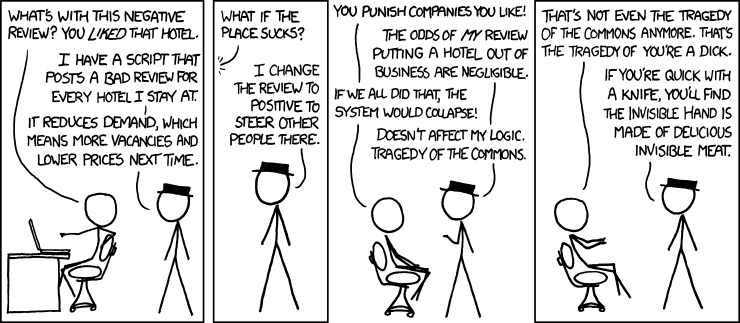
This is the same message as this issue of my favorite webcomic (this comic is about hotel feedback behavior, but the issue of "I do something rational that I'm glad not everyone else does" is identical). Black Hat Guy responds to this line of argumentation the same way I do to my friends:
"Doesn't affect my logic. Tragedy of the Commons."
There are some interesting questions about how to handle the tragedy of the commons issue of not voting (if fewer people vote because they realize how irrational it is, it becomes less irrational because fewer voters means your vote has higher electoral value and so that will reach a proper equilibrium, etc.), but given the present state of affairs, it's still irrational to vote, and concerns about "it'll ruin everything if other people decide similarly!" are unfounded, and shouldn't affect your decision to [not] vote. That's an individual choice, and it's okay to behave according to your self interest.

*  *  *

On a not-totally-related-to-this-particular-class note, Black Hat Guy's final line in the comic,
"If you're quick with a knife, you'll find the Invisible Hand is made of delicious invisible meat."
is one of my favorite quotations.