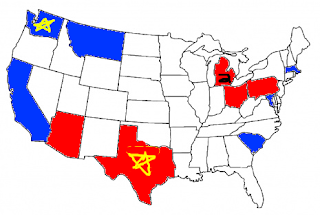
“Many political and social scientists believe that our country’s practice of putting the registration burden on individuals, coupled with outmoded, paper-intense registration systems, are major causes of the United States’ perennially low voter turnout. One study estimated that voter registration barriers in the United States depress turnout by 5 to 10 percent.”
Sunday, September 23, 2012
Easing the Burden of Voter Registration
The Importance of Voting (According to the Media)
“You might think you're too busy to vote; or that the partisan fighting makes you nauseous; or maybe you feel your vote doesn't count.”
Whether on purpose or not, Granholm spends a significant amount of her article attempting to raise the perceived marginal benefit through the promotion of civic duty:
Rising Obesity Rates in America
“By 2030, medical costs associated with treating preventable obesity-related diseases are estimated to increase by $48 billion to $66 billion per year in the United States, and the loss in economic productivity could be between $390 billion and $580 billion annually by 2030.”
“At every level of government, we must pursue policies that preserve health, prevent disease and reduce health care costs.”
Wednesday, September 19, 2012
Regulating Carbon Emissions
Consider how a gas tax would work. Because it would make gas more expensive at the pump, we would drive less. When time came to replace the old family S.U.V., we would be more likely to consider a more fuel-efficient option. As more Americans sought gas-sipping hybrids, carmakers would develop more efficient vehicles.Because the regulations signed by President Obama apply only to new vehicles, they will not have the same immediate effect on consumer behavior that a gas tax would. They are also far more expensive to administer than a gas tax would be, so much so that some economists estimate the costs outweigh the benefits.
The issue at hand is one of a negative consumption externality similar to what we have studied in class. An individual's consumption of oil negatively affects others through the carbon emissions it produces, which can cause asthma, acid rain, and have been linked to global climate change. Both options presented in the article -- the regulations signed by the President and the gas tax advocated by Porter -- involve government intervention; thus, there is no Coasian solution offered that relies purely on the market to resolve the externality. Porter's solution, however, uses government action to alter incentives and then relies on market forces to bring the market to the socially optimal equilibrium. Taxes of this kind that have the aim of reducing a behavior with a negative externality are referred to as Pigovian Taxes, after the economist Arthur Pigou, who developed the concept of externalities. Pigovian taxes may be the most efficient solution to the externality, but, as Porter notes, increased taxation is not feasible in today's political environment, leading us to the second-best solution of externally imposed regulations.
Low Military Absentee Voting Registration
The marginal cost of voting keeps getting lowered for those in the military who would need absentee ballots, but it hasn't been enough to increase or even hold constant the proportion of military absentee voters. The initiatives, such as adding more voting assistance offices, to make voting easier, have reduced the time and effort one needs to take to request an absentee ballot and vote. If we agree that the marginal cost of voting is decreasing, then since the voting turnout is also decreasing, this must indicate that the perceived marginal benefit of voting is decreasing even more than the marginal cost. This could be the case if active military believe that there is even a smaller probability now than in previous elections of their vote making a difference. Additionally, the marginal benefit could be decreasing if they don't believe there is as much of a potential difference to their future welfare between the two candidates. Alternatively, as an economist might explain the phenomenon, active military personnel may just be starting to think about their vote more logically, now beginning to realize that the marginal cost of casting their vote far outweighs the marginal benefit.
Tuesday, September 18, 2012
Strict Voter ID Laws' Impact Voting Behavior
With that, after four hours, Cheryl Ann Moore became the proud owner of a laminated Commonwealth of Pennsylvania Department of State for Voting Purposes Only ID card.
“I feel good!” she said. She grinned, kissed the card, put it inside a compartment in her knockoff Louis Vuitton purse and zippered it shut.The economic approach to voting behavior states that people vote only if their marginal benefit of voting is greater than or equal to the marginal costs associated with casting a ballot. As we see from Ms. Moore's experience, the marginal costs of getting this identification are quite high--in terms of time, energy, money, and missed work. Though for Ms. Moore the marginal benefit that she derives from voting must be incredibly high, if not infinite, since she willingly spent the entire day wading through long lines and red tape to get this new ID. Her tirelessly positive attitude at the end of the day just goes to show that her marginal benefits of voting did indeed outweigh the costs--though we can't necessarily pinpoint the precise nature of her benefit. Economic theorists like Johnson would predict that many voters have lower marginal benefits than Ms. Moore, and in this situation would forfeit their right to vote simply because the marginal costs have increased dramatically, likely well beyond their level of marginal benefit derived from voting. An individual voter realistically has little impact on the outcome of the election, and many would rather spend a day doing something other than waiting around the DMV for an ID card. The actual impact on the turnout of the affected Pennsylvania voters remains to be seen, but I personally hope that many people will be like Ms. Moore and highly value the priceless right to vote over whatever obstacles the state puts in the way.
Note: I am including the time spent getting the ID under her marginal costs of voting—even if she hasn’t voted yet—because I assume for argument's sake that she will vote since she took the time to comply.
NBA Prisoner's Dilemma
"If the owners honestly wanted to give a fair deal, they would've been satisfied with the $3 billion the players union already gave back through a 10-year period. If the union was honest with its negotiating power, it would've realized earlier that any further offers will only worsen."Both sides were trying to wait out the other, while coming to a mutual agreement would have been in their best interests. This is an example of a prisoner's dilemma, the owners and the players being the two prisoners. Both players in this game were trying to play their dominant strategy, resulting in a suboptimal outcome. Although the players and owners eventually worked the 2011-2012 lockout out, it is foreseeable that this kind of dispute could happen again. This situation justifies a constitution like document for the NBA, seeing as the two sides had such a difficult time coming to a voluntary arrangement.
The Noisy City
Tuesday, September 11, 2012
McCormick Bridge Weight Limit
Sunday, November 27, 2011
Happy Thanksgiving from PETA
Sunday, November 20, 2011
Public Goods and Philanthropy
This article from the Charlottesville NBC is very striking. In the spirit of occupy Wall Street, Occupy Charlottesville has become a very serious social movement. With growing support in this local protest against corporate greed, Occupy Charlottesville has taken a longer term position in Leigh Park in downtown Charlottesville. The protestors who are staying in tents in the park have sparked some ideas about the possibility of letting homeless people make a more permanent residence in tents in any of Charlottesville’s public parks, even when there isn’t a protest happening.
The proposal would give some of the homeless people the opportunity to have a consistent place to sleep, but not everyone is on board. Though there seems to be a decent amount of support from Charlottesville residents, including some of the homeless population, the city doesn’t seem to be very in favor of the bill. Personally, I am confident that this idea, though maybe great at heart, will not pass. Though something similar happened during the great depression, the problem comes down to a public good issue. As soon as public parks allow people to make camp there, the park becomes an incredible “rival” good.
A reason for Penn State's demise
Honor
Weingast and Moran state that “the threat of ex post sanctions creates ex ante incentives for the bureau to serve a congressional clientele.” If doubt exists in the credibility of the threat of sanctions, then the incentives will be weakened. As a result, behavior will diverge from that which is desired. This same theory can be extended to countless examples, including that of the Honor System at UVa.
The Honor System and the “community of trust” it strives to maintain rest on the principle of “single sanction.” If a student is found to have cheated, he or she will be expelled. However, as of 2001, “of the students who said they were aware of an actual honor violation, 95.4 percent said they did not report it or initiate charges of any kind.” If students do not report violations then the threat of ex post sanctions has no credibility and thus does not create ex ante incentives; that is, if students do not report honor violations then there is no incentive to adhere to the honor code. One possible solution that has been explored is that of a multi-sanction system, but such a system has failed to garner the necessary support and also does not guarantee improved incentives. In order for the honor system to function effectively – with any number of sanctions – it is necessary for students to report honor violations. If increased initiatives are taken to promote honor and support students who report violations, then perhaps the status quo of letting violations go unreported can be replaced by an expectation that students will report violators. This would increase the credibility of the threat of the honor system, and, according to Weingast and Moran, decrease instances of honor violations.
Exploitation of Votes Using Small Parties
Informative Cainpaigning
This is an example of informative campaigning, in which candidates clarify their positions on the issues, as opposed to persuasive campaigning, in which candidates attempt to convince voters that their positions are the best and try to get voters to identify with them. This is interesting because basically all campaigning is usually persuasive, so as not to risk alienating voters. If informative campaigning were to dominate, someone near the median would win, but according to Mueller, persuasive campaigning generally dominates, and the two run together to become a single factor affecting the vote percentage gained by a candidate. In the case of the Republican Primary campaign, there has been slightly more informative campaigning than in a usual campaign in order for the candidates to differentiate themselves from each other, and when candidates have revealed positions that may alienate voters their opponents have latched on and brought them to the forefront in order to draw a larger percentage of the vote.
From Preference to Policy - A Traditional View
In an ideal democracy, the preferences of a nation’s citizens would determine government policy a 100% of the time. However, with a country consisting of over 300 million people (with a wide diversity of interest and knowledge on a torrent of issues) an ideal democracy is impossible to achieve and, to be perfectly honest, most likely not wanted as it would require a tremendous amount of effort on behalf of the voter. Instead, our democracy is based on the decisions made by our elected representatives and those our elective representatives put in charge of specific operations. Nevertheless, government policy should still be roughly in line with the people’s preferences by definition of being a democracy. The question is, “is it?”
Even if our elected representatives are fully committed to carrying out the people’s choices, the likelihood that our preferences for policy are converted into results is far from certain. Because of the sheer amount of legislation that must be implemented, it is necessary for Congress to distribute the workload among different agencies. These agencies are legally liable to Congress, however the problem becomes how well is Congress able to monitor these agencies? While the article presented here might seem a little foolish, it raises a legitimate point. While I don’t doubt the general intelligence of our representatives at large, the fact is that not too many are specialized in fields outside of government and law. Agencies deciding environmental policy or nuclear waste disposal regulations are the clear experts and Congress can really only trust their judgment. This creates a certain degree of agency autonomy that Congress can only loosely regulate.
These agencies have their own utility maximizing functions that are different from Congress and are, in turn, different from preferences of voters. While Weingast and Moran have provided support for the idea that Congress does indeed possess a sufficient incentive system for keeping agency policy making decisions in line, I believe evidence for the traditional view of agency autonomy is still a more aesthetically pleasing argument if not necessarily as strongly empirically supported. If it is true that agencies are indeed somewhat autonomous of Congress, it would seem that our present governmental structure of representative democracy is not the most efficient means of transforming voter preferences into policy results. Then again, maybe turning voter preferences into 100% results isn’t the best thing for a nation anyway.
University Bureraucracies
Budget Troubles
A recent Washington Post article reported on Congress’s own frustration in meeting its budget deadline. While technically Congress should have a budget put together by April 15, this deadline is now reportedly “routinely blown.” The article outlines how the budget process is supposed to work: the House and the Senate each come up with twelve separate budgets (each one for a different agency) and then Congress comes back together and negotiates on the differences between the two to come to an eventual decision. However, in recent years, this system has failed and Congress has relied on short-term spending bills and omnibus bills that “allow greater speed but less scrutiny of agencies and programs.” This is a solution that Weingast and Moran predicted in their paper because it allows many issues to be voted on at once and thus, minimizes the chance of reneging so many people will agree to it. As a result, Congress has started to propose new solutions to help solve the problem. The ideas include shutting down Congress completely until something is passed, giving Congress two years to approve budgets, and most currently, a bipartisan super-committee.
Although the solutions to this budget deadlock seem logical and helpful, the solutions may not end up offering any relief. As we discussed in class, committees are budget-maximizing groups. That is, unlike the market sector, they do not have any incentive to keep their costs low – rather, just to keep their spending high so their budgets remain large. This obviously creates huge inefficiencies within the American bureaucracy. The current problem Congress is now facing is the simple fact that money is limited and the budgets must be more carefully constructed while each of the agencies have that continuing incentive to be budget maximizing. However, the solutions that Congress is offering to help speed up the problems may not be all that beneficial. If the three assumptions outlined by Weingast and Moran hold that agencies are monopoly suppliers, are the only ones who know the cost schedule and they follow the institutional rule of “take-it-or-leave-it” offers, merely offering more time for Congress to approve the budgets is not going to make a difference. If Congress however, could get knowledge of the 12 committees separate marginal costs, then perhaps, the budgets could become more efficient and Congress could slash budgets and start passing bills again. However, since agencies themselves cannot predict and in some cases, quantify, these costs with complete accuracy, this would be nearly impossible.
Saturday, November 19, 2011
Rational Abstention in Virginia
In this Washington Post article, the author claimed that the election this November would result in a particularly low voter turnout in Virginia. He had several reasons for this prediction. First: “quirks of the state’s calendar…produces a ballot every four years featuring no federal or statewide races to drive turnout”. Second, most of the state is not looking at a competitive election. Also, redistricting in much of Virginia may lead to some confusion of where to vote, which he said could possibly lower turnout. The last similar election similar resulted in only 30% of Virginia voters turning out as opposed to the 75% of registered voters who turned out in 2008. The author claimed that voters should care about this election because “control of the state senate hangs in the balance, and with it the possibility that Republicans could soon control all the levers of power in Richmond”, but he also recognized that voters wouldn’t vote.
Essentially the author tapped in to Johnson’s theory of rational abstention. For several reasons, voters in Virginia decided rationally not to vote. Even though control of the state senate was determined by this election, voters did not find this to be enough of a reason to incur the costs of voting. In class we discussed having to take work off, waiting in line, and confusion in the registering process as reasons not to vote. This author names another; confusion in where to vote, due to the redistricting.
The author claims that independent voters will be the ones to stay home. This could be due to the voters feeling either indifferent to the candidates, or alienated by the candidates. Either the difference in utility the voter would derive from the Republican vs. the Democrat is outweighed by the cost of voting, or both candidates are so far from the voter’s ideology that they would not gain enough utility from either candidate being elected to incur the costs of voting. Finally the voters may have decided, as Johnson would suggest, that their vote does not make enough of a difference in the overall results of the election, to be worth the costs of voting (rational abstention). The author mentions this when he notes that most of the election in Virginia will not even be contested. The fluctuation in voter turnout depending on which offices are being contested is however, not necessarily supportive of Johnson’s thesis. After all, one vote out of all Virginia voters has a higher probability of making a difference, than one vote out of every voter in the US, for a presidential candidate. Yet it is the elections to determine the president that draw the largest percentage of voters. That being said, voters are much less likely to be indifferent to who holds the office of the presidency.The Super Case-Study

Friday, November 18, 2011
The TSA and bureaucratic inefficiency
Thursday, November 17, 2011
Keeping Agencies In Line
Last summer, Representative Cardoza (D-CA) was upset that the secretary of the Department of Housing and Urban Development was flying off to various conferences rather than dealing with the housing foreclosure crisis, so he eliminated the secretary’s travel budget. He said “Frankly I want to cause officials a little personal pain. I want them to understand they’re hurting folks in my district by their lack of actions and so they need to plant their butts at their desk and do the jobs they were appointed to do”. Rep. Cardoza added this cut as an amendment to the Transportation, Housing, and Urban Development spending bill.
If we had read this news story before taking public choice we might think that representative Cardoza lost his temper or overreacted a bit. However, Weingast and Moran enlighten us by explaining this kind of behavior. The Weingast and Moran article argues that Congress has several tools at its disposal to control agency behavior. Congress has created a system of incentives for agencies by rewarding agencies that pursue congressional goals and sanctioning those that don’t. Congress probably exercises its most potent oversight of agencies through the appropriations process. Since Congress controls the purse strings, it can cut off or reduce funds to agencies. Rewards go to those agencies that pursue the policy preferences of current committee members which reflect the preferences of the voters in their district. Specific committees have more influence than the rest of Congress over a specific agency. Cardoza was offended that the secretary of the Dept. of Housing and Urban Development didn’t notice the severity of the housing crisis and how it was affecting his constituents back home who were facing foreclosures. Clearly, the members of Congressional committees play an important role in influencing regulatory policy. Congress can use sticks or carrots to influence agency action and Rep. Cardoza thought sticks might be more effective in this case.
Sunday, November 13, 2011
U.Va Coal Power and the Group
Few may realize that among the numerous coal trains that travel rumble through grounds each day, a small percentage of their cargo is actually destined for right here at U.Va. The strange “chugging” sound that is sometimes present on the corner is none other than the sound of coal being unloaded from train cars and loaded into the silos of the University power plant nestled between the corner and the hospital. According to The Daily Progress, the coal that is burned on U.Va property accounts for about 40% of the total electricity consumption of the University. In addition to this coal, U.Va also burns natural gas and heating oil at the University owned plant while at the same time importing electricity from the national grid. With the average Virginian receiving, on average, 38% of their electricity from nuclear power, the large portion of U.Va that is powered by coal generated right here on grounds has irked many environmentalists here in Charlottesville.
Olson would see the generation of power here at U.Va as a public good being provided by a relatively large group of people. The 20,000+ U.Va students who pay tuition at U.Va and the countless other faculty, staff, and visitors who also have a stake in University activities make up this group and share in the benefits and costs of generating power right here in Charlottesville. A group here at U.Va, Beyond Coal, has embodied some of the issues that Olson finds with large groups. The students among this group could be assumed to have a rather large personal interest in the elimination of coal power at U.Va and would gain a large amount of personal utility if this goal was accomplished. Their proposals for accomplishing this goal are generally a move to cleaner fuel sources such as natural gas and renewable sources such as solar power. These sources of energy would be more expensive to the U.Va community if used to supply the same amount of power currently supplied by coal. I would also argue that the majority of U.Va stakeholders would prefer to have their energy generated in the cheapest possible way and if given the choice of higher tuition costs or continued coal generation, would choose the latter. The relatively small interest group, Beyond Coal, is looking to take advantage of the size of the group by free-riding the cost increase of the cessation of coal generation among the entire U.Va community.
A small group, Beyond Coal is very focused in their interests and has little internal debate among their members about their goal. They would likely be unwilling, however, to take the entire cost that ending coal generation at U.Va would incur and internalize it in their small group. It is likely, however, that they value the cessasion of coal generation at U.Va at more than they would personally pay should the cost be divided among over 20,000 people. They would prefer instead to spread it out among the large group that is U.Va. If they succeed in eliminating coal power at U.Va they would incur a personal utility gain that would far outweigh the personal expense that they would endure once the expense is divided among the whole group. In this way we find a good example of what is wrong with large groups right here at U.Va where a small group has the possibility of gaining a large gain in personal utility at the expense of the large group.
The Man Who Can Make Larry Page Sweat
Herb Kohl is a US Senator from Wisconsin who made headlines this summer when he subpoenaed Google's CEO Larry Page. After being issued a subpoena, Larry Page reluctantly appeared before the Senate Judiciary Committee and allegedly began sweating when interrogated by Senator Kohl. Besides being known for his ability to make corporate heads sweat, Herb Kohl is also known as the CEO of the Milwaukee Bucks and the chairman of several influential committees. He is the chairman of the Senate Committee on Aging, the Judiciary Subcommittee on Antitrust, and the Appropriations Subcommittee on Agriculture.
As we read in the article "The Industrial Organization of Congress", committee assignments are based on seniority. Kohl's committee assignments can be partially explained by his ranking in the seniority system. Kohl is a four term democrat who has been in the Senate since 1989 so he is given priority when bidding on committee assignments. As chairman, he has property rights over three committees including the powerful appropriations subcommittee on agriculture. Kohl represents Wisconsin which is known as the dairy state or America's farmland. Many of his constituents are dairy farmers that enjoy receiving agriculture subsidies and Kohl has the ability to appropriate those funds to them. A congressman's reelection prospects depend on his ability to obtain benefits for his constituents therefore, legislators seek assignment to those committees that will have the greatest impact on their electoral fortunes. We know from the Weingast and Marshall paper that committees are composed of high demanders or individuals with greater than average interest in the committee's policy area and that committee members gain a greater share of the benefits from these policies. Kohl's policy interests reflect his constituent's interests and the committee system serves his electoral needs because it allows him to provide benefits to his supporters. Congress is organized to support the electoral needs of members like Kohl.