Thursday, October 11, 2012

Electoral College - another layer of complexity


In class we discussed how all candidates are “vote maximizers”. However, because of the Electoral College system that we have in place, there is an added layer of strategy to winning votes. The electoral college upholds a “winner takes all” mentality, therefore the presidential candidates will focus on states with more electoral votes than less, and more on swing states such as Virginia or North Carolina. This can lead to emphasis on specific policies that would affect those states, or even the creation of policies that primarily benefit 1/50th of the nation.

Also, the electoral college votes are decided upon by electors. As the article points out, “Americans do not vote directly for president. When voters cast a ballot for their preferred candidates, they are choosing their state's electors. As members of the Electoral College, those electors then the pick the president in December.” All of the sudden, it goes from a president that I voted for to a president that someone I voted for, voted for. I find this process to further decrease the value of my vote, which according to Johnson, the marginal benefit already deters me from voting at all.


Since the candidates seeking vote maximizing is inevitable, I think steps should be taken to ensure that those votes represent as much of the country as possible, not just simple majority in individual states. Maybe we could use the Heisman trophy system, where if a state has 5 electoral votes, every 20% of the popular vote earns him an electoral vote. As Buchanan and Tullock point out, when thinking about the group mentality, the external cost is considered inevitable. The key is to choose a leader whose external cost is the smallest for the most amount of people, and I don't believe that that is accurately portrayed by the electors.

Wednesday, October 10, 2012

Romney's Repositioning After the Presidential Debate

The Presidential debate last week highlighted Mitt Romney’s ability to appeal to the average voter.  According to an Op-Ed in the New York Times, it was the first time Romney spoke to the American people at large rather than  to just a subset of Republican voters.

As a result, “[Romney] didn’t have to worry about the nut balls he was running against in the G.O.P. primary and was not forced to cater just to the Tea Party base.  So he finally took out the Etch a Sketch and moved to the center.”
While Mr. Friedman shows some disdain for Romney’s swerve center, from an economics’ prospective, it is perfectly rational for Romney to adjust his policies for the United States presidential election.  After all, the very first assumption of the Median Voter Theorem is that candidates are vote maximizers, and therefore create their policies on what gives them the best chance of winning the election (rather than on what they actually believe).  When Romney was running in the primaries, the median voter for the Republican primaries was further right than the median voter is in the general election due to the large Tea Party base.  As a result, it makes sense that Romney’s policies would be more conservative, reflecting his attempt to gain the vote of the median Republican voter and therefore win the primaries.  Following the Republican National Convention, Romney is now officially the only Republican candidate.  Therefore, it is not surprising that his policies have adjusted accordingly and become centered. 

Tuesday, October 09, 2012

Because the electoral college is brilliant!

Boss


Hey people, over at the Business Insider, some guy named Walter Hickey is speaking the truth.  The electoral college is a common whipping boy for whatever party loses a presidential election - the Democrats hated it in 2000, the Republicans hated it in 2008 and will protest again this November.


But in class we learnt about the problems of simple majority - including the possibility of exploiting minorities.  Under straight popular vote, the big populous states would get all the attention and urban areas would have asymmetric power.  But the electoral college makes it so even small states matter.  How smart is that?

Hickey even points out that the electoral college safeguards the vote against asymmetric bad weather:
The electoral college also localizes mistakes and problems. If it rains on election day, turnout is low. ...Why should a state with precipitation have less say than a perpetually sunny locale?  With the electoral system, If Ohio is rainy, it doesn't mean it gets fewer electoral votes.
Cinnamon and gravy, that's just dadgum brilliant!

Monday, October 08, 2012

Logrolling: BP Money Spreads Out


As Marissa mentioned below, BP will pay fines to the federal government to compensate for damages from the Deep Horizon Oil Spill.  The fine money for these projects is allocated through the Resources and Ecosystems Sustainability, Tourism Opportunities and Revived Economies Act (RESTORE). In order to ensure this bill passed last summer, senators added an amendment to create the National Endowment for the Oceans. It uses revenue from the BP fines to fund projects benefiting coastlines throughout the nation, including California and the Great Lakes. 
 The Deal: The endowment attracts non-Gulf senators to support the RESTORE Act. With this wider base of support, it could be included in the Senate's version of a massive omnibus and transportation bill and could pass both chambers. Gulf senators get the 80 percent of total funds for their home states, and other senators get federal money for pet-projects in their states. 
 The endowment made it into the final transportation bill because of Sen. Barbara Boxer (D-CA). She, like other Senators, would not have cared about RESTORE without the endowment provision. She was also “a key member of the conference committee that is meeting to work out the differences between the House and Senate transportation bills” (Gaffney). The House version did not include the endowment. With Sen. Boxer’s support, the Senate version of RESTORE was included in the final transportation bill. Non-Gulf senators got the benefit for their vote. 
 By expanding the scope of a bill through amendments, representatives exchange votes for projects in a more subtle way. It is streamlined logrolling. Explicit vote trading across bills is illegal and hard to track. Including the endowment meant 1. The bill had a broad support and 2. The Senate version was the one brought to the final vote, because of Sen. Boxer’s role. 

See Also: Marco Rubio's remarks on RESTORE

Sunday, October 07, 2012

Long term effects of the BP oil spill

              The 2010 BP oil spill has had long term effects on the marine organisms in the Gulf as well as on the fisherman that depend on the marine organisms for a living. Fishing in the area might never be the same and research is ongoing as to how long-lasting this oil spill will be on the marine life. The BP oil spill exerted negative externalities on the fishing industry and almost caused the shutdown of many businesses dependent on the marine life in the Gulf. BP is trying to internalize the externality by forced compensation of some $7.8 billion to tens of thousands of Gulf residents and businesses damaged by the spill. However, Ryan Lambert, one of many affected fishermen, is not satisfied with BP's offer to pay them off: “The settlement won’t do us any good if there aren’t any fish,” Lambert says.

            According to the Coase theorem, parties should be able to negotiate and reach an allocatively efficient outcome without government intervention. For this outcome to be possible, there must be a clear definition of all property rights as well as no transaction costs to bargaining. Unfortunately, neither of these are true in this case: the Gulf is a public good and thus property rights are not defined. Additionally, transaction costs are high because of the high number of people affected by the negative externality causing a holdout problem. Lambert contributes to the high transaction costs by not accepting BP's offer easily. Due to these problems, an allocatively efficient outcome is unlikely to be reached without government intervention. Further proving this point is the legal battle between BP and the Justice Department. According to the Times-Picayune: "If BP and the government can't agree on the company's gross negligence, that's a matter to be resolved at trial, not in hearings over BP's settlement with private parties. That's why the Justice Department's warning is not only appropriate, but welcome." The externality will hopefully be internalized once an agreement can be reached on the amount of liability BP must take responsibility for. In this particular case, the goods would be the marine organisms while the consumers would be the fishermen and residents of the Gulf.

Romney's Repositioning


As we approach Election Day, President Obama and Gov. Mitt Romney claim that the American electorate will have a clear choice between two competing visions for the country.  This analysis, however, argues that Gov. Romney has repositioned himself near the middle of the political spectrum, a common move for politicians, according to political experts.  They claim, 
It's not that unusual for a candidate to…move toward the center as a general election nears. The idea is to capture undecided voters, who generally are found in the middle, political experts say.”
Public choice economists would not fault Mr. Romney for his strategic shift.
            The Median Voter Theorem holds that, under certain specific assumptions, two candidates will converge near the middle of the political spectrum, since the median voter will decide the election outcome.  One of the key assumptions in the model requires a unimodal, symmetric distribution of voters.  A cursory look at the composition of the American electorate may suggest that the electorate is not unimodal; rather, it may have two modes, one representing each political ideology.  Even with 2 modes, however, as long as the distribution is symmetric, the MVT still applies, and Gov. Romney is acting rationally by trying to capture the median voter.  While moving to the middle, however, he still tries to appeal to the extreme right, as evidenced by his “47%” comments, in an attempt to hold on to their votes.
            In conclusion, it would not be unreasonable to apply this analysis to President Obama as well.  The article claims that liberals are upset with Obama for claiming that he and Romney have similar positions on social security, but, according to the MVT, given the American electorate, it is certainly in Obama’s interest to move towards the middle to capture the crucial median voter.

Just Like the Football Player

As a quick bonus post for this week:

This morning I came across an article about a new biography of Charles Tiebout and the biographer had this comment about his name:
If I could offer but one contribution to his memory, let it be to induce economists to pronounce his name correctly: It is "TEE-bow," the unstressed syllable sounding like the bow of cellos and arrows.
 The more you know.

Saturday, October 06, 2012

Redistribution: Public Good turned Tyranny of the Majority?


As we discussed in class, one popular view is that redistribution is a public good, to help out those less fortunate than ourselves.  However, this group of “less fortunate” people has grown exponentially in the last couple decades.  According to the article Tax Equity and the Growth of Non-Payers:

“42 percent of citizens had no income tax liability after taking deductions and credits.  In addition to these 42 percent, there are millions of Americans that do not earn enough to be required to file an income tax return.  When these non-filers are added to the number of non-payers, the total number of Americans outside the income tax system jumps to roughly 50 percent of all households by some estimates.” 

The group of “less fortunate” people in this country, whom we want to help out because of our interdependent utility functions, will soon become the majority if they have not already.  Those outside of this majority, which used to have somewhat of a say in whether or not they felt compelled to help out those “less fortunate”, will now fall under the tyranny of the majority.  Of course the non-payers will vote to continue not paying income taxes, why wouldn't they?  After all, they are rational, self-interested citizens, who want what is best for them.  And since they have the majority of the votes, there will be nothing the minority of tax-payers will be able to do to stop them. 

Have Wheels, Will Travel. (...to the Median)

Though this post may not have to do strictly with Public Choice, it is a relevant example of Spatial Location Theory--the basis of the Median Voter Theorem. Our stimulating discussion of hotdog stand placement really got me thinking about whether or not real businesses can afford to move strategically towards each other in order to garner the most business. The largest costs of starting a business are typically the 'bricks and mortar' expenses that you incur to putting up a storefront, so it would be financially unwise to periodically move toward the median location with your competitors. The only way you can exercise the Spatial Location Theory would be in the initial placement of your business or in the placement of your next branch or franchise, right?? Not if your business is based on wheels...


Apparently the three big car dealers of Charlottesville understand this theory and have put together "Car Wars" as a joint event to sell inventory and compete for business. This is only a short term event and not a final equilibrium, but it is probably the closest that any major business can get to shifting locations to the median. After some searching on google maps, it turns out that JPJ is actually located more or less equidistant from all three dealers. JPJ is 4.8 miles from Pantops (where Battlefield and Brown have locations) and 4.5 miles from the north end of Seminole Trail (where Brown and Jim Price have locations). Coincidentally, JPJ is also one of the few places in Charlottesville that can handle the inventory capacity of these three dealers. There are definitely many advantages of having a joint event--sharing costs of advertising, location rental, and converging on prices/rates--but the long term goal is to garner repeat business from those customers who are geographically on the other side of town, who would probably under normal circumstances go to one of the dealers closer to home So, if a dealer can somehow make their business/cars more attractive at this joint event, then they don't have to permanently move to a median location to steal long term business from the other dealers! It's actually quite a genius plan and a great advantage of having a mobile product.

This is a slight deviation on the theorem because these dealers do not have strictly identical products, but from a buyer's perspective there probably isn't a substantial difference between a Chevy, Ford, and Toyota.

Tuesday, October 02, 2012

Bringing Morals into the Voting Debate


            In my family, there is always a heated debate around election time because my dad, while being an eligible and well-informed citizen, refuses to vote.  Try as they might, my dad’s siblings, nephews, nieces and children cannot get him to go to the polls.  I had obviously been thinking about this predicament a lot while reading the Johnson article, so much so that when I finished it, I called him to get a straight answer.  I knew that Johnson’s arguments of rational abstention and rational ignorance did not apply to my dad.  He would gladly give up an hour of his day to vote if he someday changed his mind and he is not rationally ignorant nor indifferent.  After convincing him that I was not another family member attacking him and that I really just wanted to know, he explained his opinions clearly.  Basically, he does not vote because he “does not like the candidates our political system produces.” The founder of the Center for Morality in Public Life, Andrew Haines, seems to express similar opinions to my dad.   

The act of voting, in this case, isn’t something we can assess under a utility-driven approach to social welfare (e.g., sorting out the lesser of two political evils). Instead, voting is a reflection of right reason in action—and because of this, it can only engage positively (i.e., we can only cast an unspoiled ballot) when the intellect is given enough fodder to make an informed judgment.”

After our discussion in class today, I feel I can possibly see his point of view.  Because the U.S. is a two party system, the candidates tend to race toward the median voter, as we talked about in class.  This makes them very similar and moderate, leaving someone like my dad, who holds more extreme views, alienated without an ideal choice.  He then applies Haine’s argument above in that instead of choosing a lesser of two evils, he abstains altogether.  This point of view is more philosophical than economical because his actions are not consistent with his best interests.  He could save a lot of time (by not having to always argue) and avoid a lot of social pressure by just voting.  Rather, his actions are consistent with his morals so he refuses to participate in anything he feels will jeopardize this.  Life would be much easier if there was a candidate he felt was "worthy" of his vote.  However, if a candidate were to move far enough down the political spectrum to persuade my dad to vote, they would probably lose all the moderate and ample median voters they set out to get.  
        

Obamney

Today we talked about the median voter theorem (MVT).  A key implication of the MVT is that, under certain circumstances, two  candidates will begin to look eerily alike.  Oh peaches!! I just came across this video that shows how Romney and Obama may have already morphed into one candidate!


Notice how they both stick to similar topics when they are apart.

Old Gus is curious to see if the upcoming debates will clarify any distinctions between the two candidates.  Downs might suggest that they will use the debates to try to magnify policy stances of their opponent that are far from the median. 

Monday, October 01, 2012

Delicious Invisible Meat


I was really struck by our discussions in class about why it isn't economical to vote. I think the arguments for why it is unwise (if not patently irrational) to vote are very persuasive (though I still plan to vote in November because I personally derive a fair bit of utility from the act of voting). As I mentioned in class, I have many times in the past tried to persuade friends to vote (to help to raise their social benefits of voting), but have been met with strong opposition when they reply with arguments similar to the ones we made in class. Once my (very smart) friends start down this line, I usually give up -- they're just right.

So, recently, I've gone the other way, and despite my continued plans to vote, I've switched to making the case to people that they should not vote. Faced with the same airtight logic we discussed in class, all of the ones who didn't immediately agree struggled to make an argument is to why voting is a good thing. In almost every case, the eventual response was, essentially, "but if everyone did that, the political system would collapse!"


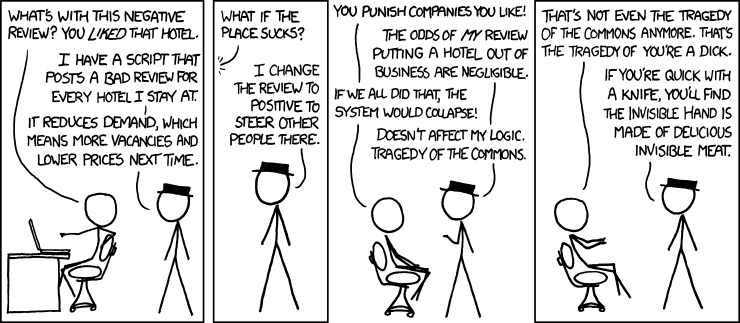
This is the same message as this issue of my favorite webcomic (this comic is about hotel feedback behavior, but the issue of "I do something rational that I'm glad not everyone else does" is identical). Black Hat Guy responds to this line of argumentation the same way I do to my friends:
"Doesn't affect my logic. Tragedy of the Commons."
There are some interesting questions about how to handle the tragedy of the commons issue of not voting (if fewer people vote because they realize how irrational it is, it becomes less irrational because fewer voters means your vote has higher electoral value and so that will reach a proper equilibrium, etc.), but given the present state of affairs, it's still irrational to vote, and concerns about "it'll ruin everything if other people decide similarly!" are unfounded, and shouldn't affect your decision to [not] vote. That's an individual choice, and it's okay to behave according to your self interest.

*  *  *

On a not-totally-related-to-this-particular-class note, Black Hat Guy's final line in the comic,
"If you're quick with a knife, you'll find the Invisible Hand is made of delicious invisible meat."
is one of my favorite quotations.

Talkin' Bout (Y) Generation

We've all experienced the relentless social media barrage of pleas, primarily by the Obama campaign, for young Americans to replicate the stunningly adequate turnout of young voters in 2008. However, in a piece sure to appall those young ideologues hopeful of a similarly impressive showing from college-age voters, Forbes contributor J. Maureen Henderson claims  that the contingent of young voters she broadly designates as "Generation Y" has demonstrated far less interest in 2012 despite the pressing economic issues looming over new and hopeful entrants into the job market.

Henderson cites an array of polls and figures to highlight that, even though the value of a favored candidate winning has ostensibly risen due to spiraling loan debts and diminishing quality of life, Generation Y's concerns "don't seem to translate into political engagement." Certainly, as Johnson indicated by noting that "less than one-fourth" of eligible voters under 25 participate in Congressional elections, young voters have never enjoyed a sterling voting record. But on the heels of a staggering 51% turnout for "eligible youth" in '08, the plummeting enthusiasm in voting or in even keeping abreast of election coverage imply that young voters, in addition to the concerns about low probability of making a difference that often fuel rational abstention and ignorance, actually place a lower value on the winning candidate despite the seemingly astronomical stakes. Given Henderson's discoveries that only 37% of women feel that politicians "reflect the interests of young Americans" and that 50% less young people have followed election coverage, it follows logically that Generation Y places comparatively less weight on the impact of their political involvement on their welfare than they did four years ago--and that what Johnson calls the "optimal amount of information" lies at a far lower quantity.

Of particular interest is Henderson's contention that young voters "tend to adopt a 'What's in it for me?' attitude." Imbued with such a mentality, young voters are more inclined to conclude, rationally, that respect for the "men and women who have sacrificed their resources" does not  retain the infinite benefit of voting which so many Americans irrationally seem to assign. When making the decision to vote with a far lower "sacrifice" value in mind--and, again, with a lower monetary value stemming from sentiments of disillusionment or insignificance--many Generation Y voters will rationally decide to "opt out on November 6."

On a brief concluding note, the statistical discrepancy between those "planning" to vote and the quantity of actual voters reinforces the conjecture that the urge to "seem involved" and conform to social norms influences voting behavior.


Sunday, September 30, 2012

But What About The Walruses?


            For years, scientists have been concerned about the effects of greenhouse gas emission. By trapping heat and preventing it from dispersing into outer space (the greenhouse effect), global warming is considered to be the most concerning effect of these emissions. A recent focus has been placed on encouraging human activity that decreases emission of these gases, such as turning lights off when not in the room and reusing goods whenever possible. This article examines a negative externality of greenhouse gas emission that is imposed on walruses of the Arctic: 

            “Scientists blame a combination of natural fluctuations and climate change caused by human emission of greenhouse gases, like carbon dioxide, for the recent record lows in sea ice… The melting sea ice raises a host of questions about the walrus, according to Jay. Will it affect the calves' survival? Are they spending more energy to swim further offshore to feed? Is the availability of their prey changing?”

            Although sea ice typically retreats north in the summer, the edge usually remains over the continental shelf where the water is shallow enough for walruses to feed. In the last 5 years, however, the sea ice has retreated farther north, over deeper waters where the walruses are unable to feed as easily. Thus, production of consumption goods, via emission of greenhouse gases, imposes negative production externalities on the walruses. The resulting decrease in sea ice has placed a burden on the walruses in several ways. As previously mentioned, acquiring food in deeper waters is more difficult for the walruses, causing them to expend more energy. This difficulty has caused record numbers of walruses to migrate to the coast, which presents another issue. Where as walruses historically spread out into smaller groups surrounding the Alaskan coast, they now congregate in large groups. This can present a problem if the walruses are startled, however, because it can lead to problems with lethal stampedes. These are all negative production externalities because they are costs due to the production of greenhouse gases that are borne by a party different from the producers greenhouse gases. Thus, these costs are not taken into account in the decision of the producers to produce.
One way of compensating for this market failure that we learned about in class is government regulation. Rather than government regulation of production that emits these gases, however, the article notes that some costal communities are trying to reduce the effects of this negative externality by implementing flight restrictions to keep planes from getting too close and startling the walruses. Unlike the examples of government regulation in class, this solution does not impose restrictions on the actual production goods requiring emission of greenhouse gases, and thus does not fully compensate for all effects on the walruses. In order to fully internalize the negative externality, government regulations or taxes should be placed on the actual emission of these gases, such that ozone depletion will occur at a slower rate than ozone creation and former environmental conditions can be restored.

Some Economist Love (and Politician Hate)

There's nothing worse than sub-optimal economic policy, however, time and time again, policies that would deliver positive net benefits don't get passed. Six policies, summarized in Six Policies Economists Love (And Politicians Hate), are prime examples. On NPR's Planet Money podcast, five economists, each having a different political ideology, are given "a simple task: Identify major economic policies they could all stand behind."

I'm going to discuss the public choice context of Proposal One- eliminate the mortgage tax deduction (I'll leave Proposal Six--legalize marijuana-- for somebody else to rant about).

When I read Mueller 5.1, on majority rule and redistribution, I thought of this proposal as a good example of the majority imposing a tax on the whole to subsidize the consumption of one group. Apart from home ownership being a quintessential part of the American dream, it doesn't provide any positive externalities over renting. However, this deduction discourages renting (which is a better option for lots of people, it lubricates their employment possibilities), redistributes money to the middle and upper-class individuals who purchase homes, and, worse yet, distorts both the housing and loan markets (causing inefficient allocation of scarce resources).

A politician who votes in favor of dismantling the mortgage tax deduction, however, wouldn't get to stay a politician for long. According to the US census, about 70% of homes are occupied by their owners. A proposal that would increase taxes for 70% of people isn't going to win a majority. People vote, not for fair policy (this is just one of many regressive redistribution schemes!), but to maximize their own utility.

Economists don't like to agree with each other, so when 5 different economists unanimously see positive net benefit that could be inexpensively realized, decision makers should listen. In a representative democracy, considering the well-being of, not just the majority, but the whole, is the only ethical (and by ethical I of course mean economical) way to act. Ethics, however, never got anyone elected twice.


Pollution/Coasian Solutions


Recently, a coal power plant in Alexandria run by the company GenOn has closed.  The coal plant had been in operation for 63 consecutive years, and drew public protest due to the large amounts of pollution it released into the air.  Ultimately, the plant was closed not due to the activism but the "changing economics" of running a large coal plant.

The article demonstrates the difficulty of implementing Coasian solutions to externalities in the real world, where property rights are not clear and many costs and benefits are not easily quantifiable.

GenOn's Alexandria coal plant, described as a air polluter, had a clear negative production externality.  The smog it produced was not only unsightly, but, according to activists, had significant deleterious long-term health effects.  Yet it was one that was never resolved through private or government channels; the problem simply went away on its own due to other considerations.  Partly this is due to unclear property rights.  There is no mention of a court case where a ruling was made in one way or another about the plant's right to pollute the air (or de facto air ownership).  Presumably, no mutually beneficial transfer payments would be made until such a case has been heard and property rights established.  Secondly, it is impossible to quantify the damage the smog caused to the community not only due to logistical considerations, but because one cannot force people to reveal their true preferences.  While negative health effects may be approximated through hospital bills from conditions related to smog exposure, such estimates would be tentative at best (causality in medicine is often complex and unclear).  Additionally,  costs would be greater than simply the medical bills, but would include opportunity cost of lost time due to illness, and some compensation for lost utility from healthiness itself.  The cost of the "unsightliness" of the plant is similarly difficult to quantify, because there is no current mechanism to force people to reveal their true preferences.

Higher Education: a Public Good

In a recent New York Times article, Andrew Rice discusses the reasons for President Sullivan’s resignation this past June.  One part of this article in particular stood out in relation to our class.  Rice quotes Hunter Rawlings, the chief executive of the Association of American Universities:

“There was once a consensus in America that higher education was a public good,” Rawlings says. “What is new now, and radically different, is that after five, six, seven years in reductions in state funding for higher education, the whole system is under stress.” 
I’ve never thought of higher education as a public good.  After all, at the University of Virginia (a public school), there is both excludability and rivalrous consumption.  Many students who would want to attend UVA are kept out (excludability) and even those admitted find themselves fighting to gain one of the limited spots in the classes they hope to enroll in. The classes are limited in size because they, on average, exhibit the qualities of rivalrous consumption – the more people in the class, the less you enjoy it [can’t participate/ask questions as much, distracted by classmates who are on Facebook, etc].   So from that view, it is not clear at all that higher public education is a public good. 
 
However, Rawlings was considering not the actual education but the effects of higher education when declaring it to be a public good.  Bill Clinton explained it well in his speech at the Democratic National Convention:

“It turns out that advancing equal opportunity and economic empowerment is both morally right and good economics, because discrimination, poverty and ignorance restrict growth, while investments in education, infrastructure and scientific and technological research increase it, creating more good jobs and new wealth for all of us.
The benefits of having public colleges affect everyone.  More people are educated, which means they (theoretically at least) have better jobs or are more productive at their jobs.  Consequently, they are able to create better products or perform services better for the rest of us to buy.  They can also create new technology.  Since others having an education makes us all collectively better, the idea behind public goods is that we should all help pay for this education; otherwise public education will be under-consumed.  Since people won’t help pay on their own (due to the free rider effect), the government enforces it through taxation.