Sunday, November 24, 2013

MVP of ECON 333?

I don't know how many of you keep up with Major League Baseball, but Andrew McCutchen of the Pittsburgh Pirates was just elected National League MVP. Miguel Cabrera was elected American League MVP, but that is not important. What is important is how these men earned the MVP title.

Many moons ago, we discussed Mueller’s alternatives to majority rule. One of these alternatives was the Borda count in which the candidates are ranked in a voter’s preference ordering. The candidate with the highest number of points is deemed the winner. Since there are many candidates/players for the MVP award (over 10), Mueller would agree that the Borda count (or Hare/Coombs systems) is the most Condorcet efficient voting system. The Borda count is efficient because it satisfies neutrality, cancellation, faithfulness, and consistency in choosing the Condorcet winner.


Here is the voting breakdown of the NL MVP candidates. Andrew McCutchen is the clear winner with 409 points, followed by Goldschmidt (242 points), then Molina* (219 points). First place votes earn 14 points (4 point bonus from the traditional Borda Count), second place votes earn 9 points, and it declines one point from there. According to the breakdown, McCutchen would have still won in majority rule (28 first place votes out of 30), plurality rule, Condorcet criterion (behind Molina twice and Carpenter once), Hare system, and Coombs system; however, some years the majority rule winner isn't necessarily the Borda count winner (See: 2011 AL MVP voting). 

*Side note: in a Hare system, Molina would’ve gotten second place since he had two more 1st place votes than Goldschmidt.

The Origin of Persuasive TV Campaign Ads


When did television advertisements for campaigns really become important or influential? Many would agree that it all started with the "Daisy Girl" ad that aired only ONCE on behalf of incumbent Lyndon B. Johnson in 1964. In it, a young girl is standing in a field picking the petals off of a flower. She is counting the number of petals as she goes. When she reaches nine, there is a loud noise and the camera zooms into the blackness of her pupil where there is the image of a nuclear bomb and the Johnson shouts, “These are the stakes! To make a world in which all of God's children can live, or to go into the dark. We must either love each other, or we must die.” This shocked audiences like no ad before it had ever done. The most interesting element of this ad is how it fits in to the Downsian models of persuasive and informative campaigning. To read a little more about the history behind the ad, click here!

As the Downsian model explains, a persuasive advertisement increases the probability that every voter will vote for the candidate. It tells you that there’s something you might like about this candidate or something that you won’t like about the other. The distinction between informative and persuasive campaigning is how it affects the probabilities that groups of voters will vote for the candidate. An increase in persuasive campaign expenditures for Johnson would increase the probability of democratic voters for him without decreasing the probability that republican voters will not vote for him. In this case, Goldwater was painted to be a dangerous extremist who wanted to use nuclear bombs in Vietnam therefore. Johnson won with 68.1% of the popular vote and 44 states. The subject matter of the ad and the voting numbers show that this ad would be classified as a persuasive campaign expenditure using the Downsian model and likely one of the most successful ads in campaign history.

Using Emotion to Influence Regulation?

As we discussed in class, lobbying efforts by small, politically unconnected groups are nearly always unsuccessful as the costs of lobbying by such groups are high while expected benefits are low. As a result, it is typically large firms that succeed in their lobbying efforts: They have the money to spend on lobbying, and they often have much to gain from the passing of certain industry regulations. This article, however, gives an example of successful lobbying by a small group of extremely committed individuals with limited political and financial resources. Family members of victims of the 2009 crash of Continental Airlines Flight 3407 managed to out-lobby highly influential airline industry opponents to influence legislation on pilot training and flight schedules that will cost airlines $7 billion over the next 10 years. Amazingly, the families out-lobbied their airline opponents not with money, but by using emotional stories, the media, and dogged persistence to win the support, one by one, of key politicians. The airlines fought back, with several large airlines spending more than $50 million in total on lobbying during 2010, but ultimately it was the families that were successful in having legislation passed.

As these new safety regulations are clearly not beneficial to the airline industry, this story seems to run counter to Stigler’s theory that “regulation is acquired by the industry and is designed and operated primarily for its benefit.” How, then, did the Families of Continental Flight 3407 succeed in having their safety regulations passed when confronted with the substantial funding and lobbying power of major airlines? First, all members of the small group had homogeneous interests and thus were able to lobby as a cohesive unit. Second, they used emotional persuasion effectively, narrating tearful stories of family members lost in the crash in order to gain the support of influential politicians. What does their success mean? Perhaps it points to the fact that, at the margin, the expected benefits of lobbying exceeded the expected costs for families but not for airlines. It could also just mean that the airline industry opposition was too fragmented to effectively lobby on its behalf.  Whatever the answer, this example proves that money is not everything when it comes to influencing regulation - cohesion and unrelenting pressure can get you places too.

Young People Say No to Obamacare

As the initial technical issues with Healthcare.gov are resolved, another concern about the policy itself is becoming apparent: healthy young people don't want to pay for healthcare. According to an article from CNN, only around 3% of the target 7 million people have signed up for healthcare under Obamacare. Of these, only around 21% are in the 18-35 age bracket, with the target being 38%. The penalty for failing to sign up under an approved plan by 2014 is $95 or 1% of gross income that exceeds $10,150, whichever is larger. This penalty will sharply increase in subsequent years. If this cost grows large enough, even young citizens will eventually find it worthwhile to sign up.

In effect, the insurance companies have the national government incentivizing everyone to buy their services. If we accept the theory of regulation posed by Stigler, this is not a coincidence. Indeed, this video created by PBS states that the chief lobbyist for the insurance industry said that she would support a healthcare bill only if it included an individual mandate. The healthcare industry knew what it was getting when it agreed to participate in the healthcare "marketplaces" established under Obamacare. They were aligning the desires of the controlling political party to see the policy succeed, with their desire to expand the number of people buying healthcare. Now they get young, healthy people with low expected costs for healthcare who would have otherwise been out of reach.

It will be interesting to see how the profits of insurance companies change over the next few years as the penalties for being uninsured go up. My guess is, they grow.

TransCana-Don’t

The Keystone Pipeline debate hinges on two key arguments — reason and opinion. Reason says, as argued in this article and elsewhere, that the project would create jobs, energy independence and would lower consumer prices. On top of that many studies have found that the project will not cause harm to the environment and is widely considered safer and more environmentally-friendly than alternatives, namely railway transportation of gas and oil. The opinion argument — of the opinion that approving the pipeline would be a environmental apocalypse and which comes from only 23% of Americans — is essentially winning the debate with social media, sharing posts and tweeting themselves to the center of public opinion. Policy makers see the incredible mobilization ability of this minority and are left with “a false sense of where public sentiments really lie.” This influence of social media seems to be outweighing the traditional lobbying efforts of groups like the American Petroleum Institute, who has spent $22 million in lobbying efforts supporting the pipeline alone.


The author of this article attributes the victory of the opinionated activists to a public policy paradigm shift saying, “Gone are the days when television and newspaper advertising, campaign contributions, and heavy lobbying fees all but guaranteed a successful corporate outcome.” Group theory might suggest that the cost of contributing to a group for an individual against the pipeline is significantly decreased by social media, exponentially increasing the amount of pressure this small group can apply. The regulator is in this case officially the State Department, in charge of international issues (the pipeline crosses the Canadian-US border). State sees this pressure and Kerry doesn’t approve the pipeline (some might say this decision may really be a White House decisions as the president could use executive order to grant permission to TransCanada). Weingast and Moran might disagree. Secretary of State is appointed by the White House but affirmed by Congress, and Congress controls State Dept. appropriations. They might suggest that the Keystone Pipeline is awaiting some kind of rent-transfer to the committee or committee chair who is the real decision maker. This could be Harold Rogers, KT, chair of Appropriations, or Fred Upton, MI, chair of Energy & Commerce or Doc Hastings, WA, chair of Natural Resources, or any number of subcommittee chairs. At this point it is only conjecture, but it is very curious why such a positive enterprise, which “By any measure…should have been approved by now,” is at a halt.

Wednesday, November 20, 2013

Billionaire Political Contributions

Sheldon Adelson cares a fair amount about politics in this country like a lot of people, but unlike a lot of people he has reported net worth of around $28 billion. Adelson, who made his money as the gambling mogul behind Las Vegas Sands, was also generous with his contributions, which totaled around $150 million to various Republican campaigns around the country. In this this article it is shown that Adelson also tried to hide the total amount of his political contributions though giving to non profits who don't have to disclose donors.

While looking at these contributions in terms of utility it would lead us to assume Adelson values political action higher than other ways he could spend his fortune. However, I think the secretive aspect may change this somewhat. I think it may be more applicable to look at the contributions through the lens of rent seeking. During our rent seeking game in class, what made it hard to determine our strategy was the uncertainty of how much everyone else was spending. I think this might have been the situation Adelson was trying to create in the elections. If no one knows how much money is being shoveled in and from where, and in this case it was a very large amount, they may be tempted to be conservative therefore not inducing another heavy weight billionaire to compete with Adelson in Democrat contributions.

And the rent being sought? My best guess would be continuation of lower, Bush-era tax cuts on dividends (the source of much of Adelson's income as the largest shareholder of Las Vegas Sands) and the estate tax. When you've got $28 billion, a few percentage points here and there are worth a lot more than $150 million

Dealing with an overly-powerful beuracacy: "Crowdfunded Assaination Market"


There is now a crowd funded "Assassination Market' in which people pay Bitcoins to have public figures assassinated.  I thought this article was to crazy not to share, in showing how fed up citizens are of overly powerful bureaucracies.  This site, similar to Silk Road, gets people to anaonmously donate money to the killing of a certain political leader. Once the assassination has occurred, the bounty can then anonymously collect the reward.  "In the four months in which Assassination Market has been online, six targets have been submitted, including NSA director Keith Alexander, Federal Reserve chairman Ben Bernanke and President Barack Obama." (elitedaily.com) The site was inspired by the Edward Snowden NSA leaks. The founder of the site told Forbes, “after about a week of muttering ‘they must all die’ under my breath every time I opened a newspaper or turned on the television, I decided something had to be done. This is my contribution to the cause.”

Although this is an extreme example, many other citizens are fed up with overly powerful bureaucracies.  I looked a bit deeper into one of the targets, NSA director Keith Alexander, and found this article called American's Secerest 4th Branch of the Government, NSA kept even Obama in the Dark  (http://www.juancole.com/2013/10/americas-branch-government.html)  Edward Snowden's leaks showed the NSA was spying on many political leaders, and even Obama was not informed. The implications for citizens are that a "bureaucracy funded at $52 billion a year by [tax dollars] keeps our elected leaders in the dark about it's activities."  America was founded on the idea of democracy,
"but the NSA appears to be a secret kingdom that appropriates our money with no oversight or accountability. We didn’t elect it, and if it doesn’t let our chosen representatives know what it is up to, then it is taxing us without giving us any representation. It is a tyrant. It is an ominous homunculus within the body politic." Although this article specifically talks about the NSA, the ideas we have discussed in class about how bureaucracies led by senior leaders are not being run efficiently, effectively or ethically can be applied to many different bureaus. 

Sunday, November 17, 2013

Idaho Interest Group Uses Billboards to Fight Obamacare

"They didn't need to implement Obamacare". This phrase is printed on billboards near Burley, Idaho. An interest group known as the "'Idaho Freedom Foundation" is responsible for the implementation of these negative advertisements, as seen in this article. Their actions are in part an attempt to implicate  the District 27 legislators for inadvertently supporting Obamacare. Some believe this to be false advertising. They have chosen to incur the costs of  this negative advertising initiative as a means to achieve their group's objective, the repeal of the state insurance exchange expected to happen in 2014. They are hoping to influence voters to take a stand against Obamacare and the state insurance exchange program, using the billboards as a means to promote collective action. The president of the Idaho Freedom Foundation, Wayne Hoffman, explains that "the foundation's intentions are threefold...to tell people that the legislators didn't have to pass 'Obamacare,' identify the legislators who voted for the state health insurance exchange and inform people that there will be a chance to repeal it next year."

We can better understand this scenario through Olson's theory of groups. The Idaho Freedom Foundation has been willing to incur the costs of this advertising because they are competing for collective good benefits that would follow if the state insurance exchange were to be successfully repealed. These collective benefits may not be preferred by everyone however, especially those who support the state insurance exchange. Furthermore, the efficient provision of this public good would be hampered by the free rider problem; if the state exchange program were successfully repealed, there would be many more "beneficiaries", or people who would have also preferred for the repeal of this state insurance exchange than those who actually contributed to the efforts of the Idaho Freedom Foundation. It would infeasible to impose costs on all the beneficiaries of their actions because the Idaho Freedom Foundation is seeking the provision of a public good.

Allowing Congressional Committees to Function

          In his article for the NWI Times, Doug Ross discusses the need to let Congressional Committees function, in response to what he calls the atrophy of the committee system over the last twenty years. The committee system in congress is meant to act as a system of property rights that only allows members of certain committees to affect the status quo. Ross quotes Representative Pete Visclosky D-Merrillville, a member of the highly sought after appropriations committee, who is disgruntled that
"[the bill that resulted in the shutdown] was an appropriations bill," and that "our committee had nothing to do with it." It took a long time for Visclosky to get on to the appropriations committee, and he is disappointed that the purpose of the committee system seems to have gone by the wayside, with house leadership "hammering out deals that bypass the committee."
         It makes sense that a member of a committee would be upset that his committee was not getting the chance to do its job, because public choice implies that the institution of congressional committees are put in place to help congressmen realize their objective of being reelected. When the committee system appears to be losing influence in congress, it clearly follows that committee members will seek to prevent this change.

Testing the Reason for Committee Formation

We talked in class about the theory that congressional committees are formed to serve the interests of congresspeople. This was supported by the fact that the members on certain committees are often representatives of areas that are strongly affected by the actions of the committee. For example, representatives from Nebraska are more likely to be on the agriculture committee.

I would like to propose an alternate way of testing this theory: find out who initially supported the formation of Senate committees and what they stood to gain from the formation of the committee. If committees are frequently proposed by those who then derive benefit from them, this raises the probability that committees in general are created to benefit congresspeople. I found information on the formation of two committees which are listed below. They seem to support the hypothesis provided in class. It would be interesting to see a more comprehensive list of committee founders to further test this idea.

1. The Senate Committee on Agriculture was started in 1825 and proposed by Sen. William Findlay. He then went on to serve as the first committee chair. Also important to note is that he was the owner of a farm and represented Pennsylvania.

2. The Senate Committee on Banking, Housing, and Urban Affairs was started in 1913 and proposed by Sen. Robert Owen. He was previously a banker.

It’s Morning Again in America

Although this presidential election took place in 1984, I think Reagan’s campaign ad “It’s Morning Again in America” is the perfect and best example of persuasive campaigning, thus I had to share it. If you are an American, how could you possibly dislike this video?

We discussed two types of political campaigning in class: persuasive and informative. A candidate uses persuasive campaigning in order to gain support from all voters, regardless of their party affiliation. In contrast, informative campaigning focuses on the candidate’s political platform and where exactly they stand on an issue. Of the two, Mueller favors persuasive campaigning because it can only have positive impacts on the candidate, if used right.

In his ’84 re-election campaign, Reagan listened to Mueller and utilized persuasive campaigning. “It’s Morning Again in American” campaign ad is persuasive because Reagan reminds how wonderful America has been the last four years, since he has been president. Instead of telling voters where he stands on an issue, he illustrates how more Americans are getting married, buying more houses, and getting more jobs. Reagan has made America “prouder, stronger, and better” and that’s all he explains in this ad. An informative campaign would have had little benefit to Reagan as he would have gained support from the voters with the same political beliefs, but would have pushed other voters further away. 

The result: Reagan received 525 out of 538 electoral votes (the highest ever by a presidential candidate), which Mueller would attribute to his persuasive campaign ad.
  

Duck [Political] Dynasty?


We’ve talked in class about prominent interest groups like the NRA and AARP, but there may a new interest group at work in Louisiana.

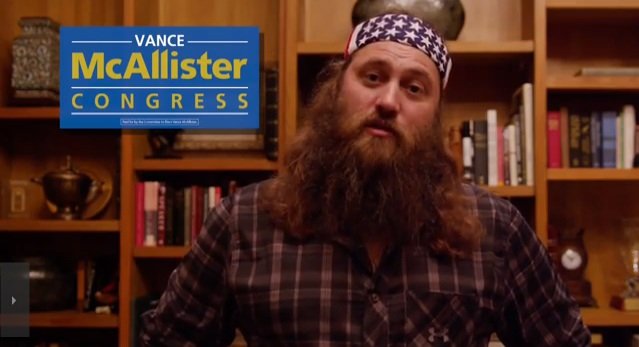
Saturday was the runoff round of the special election in Louisiana to replace Republican congressman Rodney Alexander, who recently resigned to join governor Bobby Jindal’s cabinet as the secretary of veteran affairs. The two top vote-getters in the first round were both Republicans – state senator Neil Riser received close to 32%, while businessman Vance McAllister received 17.8%.

McAllister, who has never held political office, was a clear underdog going into the runoff but he picked up a big endorsement ahead of the polls from Willie Robertson, Louisiana resident and star of A&E’s “Duck Dynasty”. Robertson touted McAllister as an outsider, and urged Louisiana residents to support him at the polls. It certainly worked – McAllister cruised to victory Saturday, picking up 59.7% of the vote.


This would seem to fit Olson’s description of large interest groups. “Duck Dynasty” commands a large audience – the show’s most recent season premiere had 11.8 million viewers, although many are not Louisiana voters – but it is not inherently political. The group is instead held together by a mutual interest in the show. But after building a huge audience, the shows stars now have a huge basis of support with which to affect actual political change. Riser, a state politician, was the logical favorite for the seat, and his large margin in the primary seemed to signal an easy win. Robertson, however, was able to use his television status, and thus his “interest group”, to elect a complete political outsider who better supported his interests.

More on the Value of Campaign Spending

This article discusses the value of campaign spending and extends our recent class discussion on the subject. The author claims that the value of campaign spending is often largely overstated, and he gives data from the 2012 elections to back up his claims. He shows that the relationship between an incumbent’s margin of victory and the amount by which he outspent his opponent is statistically insignificant. The relationship between the incumbent vote share and the amount of money spent by the challenger, however, is negative and highly statistically significant. This relationship shows as a logarithmic curve, where returns to challenger campaign spending are initially very high but decrease after $200,000 has been raised. This data seems to further back up the s-curve relationship between campaign spending and votes documented by Mueller: Challengers begin at the bottom portion of the s-curve, where they initially experience increasing returns to their campaign expenditures. These increasing returns are experienced up until the $200,000 mark is reached, at which point diminishing returns begin to set in Incumbents, however, begin at or above the inflection point in the curve and therefore receive diminishing returns or no returns at all to their additional dollars spent.

As noted by the author of the article, an important extension of the fact that campaign spending matters more for challengers than incumbents is that U.S. campaign contribution limits serve to protect incumbents. The fact that individuals may not contribute more than $2,600 to any given campaign means that it is very difficult for challengers to raise enough money to threaten the incumbent’s position. Challengers are often less well-connected than incumbents and furthermore start at a point further down on the s-curve. While this means that each additional dollar they raise has a higher impact, it also means they must raise more money than the incumbent in order to be able to effectively compete - something that is not easily done without connections.

Interest groups and the Trans-Pacific Partnership Agreement

From an economic point of view, lowering barriers to trade between nations is widely seen as valuable policy reform. However, as this article describes, the Trans-Pacific Partnership Agreement is "A free trade agreement that is neither about trade nor freedom." In fact, information from leaked papers suggests that of the 29 chapters under negotiation, only 5 actually negotiate trade while the 24 others "aim to influence many issues, such as food and environmental standards, intellectual property, and pharmaceutical formularies." 

The TPPA is a clear example of how legislation is supplied in accordance with demand, and the demand in this case is largely derived from firms in industries sensitive to intellectual property issues. Trade agreements have potential create massive new rents in nearly every industry, so the secrecy and focus on pleasing the firms providing input to the negotiations doesn't come as a surprise based on our studies in public choice.

Monday, November 11, 2013

Benefactors of Immigration Lobby


            Nearly six months ago Facebook’s Mark Zuckerberg teamed up with other tech industry big names like Bill Gates, Netflix’s CEO, and founders of companies like Dropbox and LinkedIn to form FWD.us. As this article highlights, FWD.us is an organization that lobbies for immigration reform; specifically an increase in the number of H-1B Visas which are visas for high-skilled STEM workers. Because of the STEM shortage in the United States tech companies across the country are desperately seeking qualified work to fill their growing demand for STEM employees and have begun to look overseas to find that talent.
            While nearly all technology companies would like to see an increase in the H-1B visa cap, FWD.us is composed of only a few major tech firms that are collectively funding a major lobbying effort on behalf of their entire industry, making the members of FWD.us benefactors to a privileged group.
            This is an example of a privileged group because members of FWD.us have enough to gain from H-1B reform that they are willing to bear lobbying costs on behalf of the entire high-tech industry while smaller firms have the opportunity to free-ride on FWD.us’ efforts. As discussed in class, whatever gains FWD.us receives will greatly benefit the industry, and will help FWD.us’ members, but will never quite reach Q* for the entire high-tech market because of the smaller firms who are free-riding on the group’s lobbying efforts.


Sunday, November 10, 2013

Airline Regulations eased or new ones added?

          This CNN article describes major airline reactions to the latest change to Airline regulations  electronic devices are now allowed during all parts of a flight.  The only hitch is that you have to get each aircraft approved by the FAA to be able to do this.  US Air and Southwest will be among the first to  receive approval (They are also among the largest airlines in the US).  Spirit Airlines (a smaller airline) on the other hand did not give a time table of when their aircraft will be approved.
          While this may seem like deregulation, this could be another example of rent seeking by the large players in the airline industry.  The cost of filing the additional paperwork to get the luxury of allowing electronics at all times on aircraft is more easily covered by the incumbents in the industry with larger market shares and deeper pockets.  At first glance, this appears to benefit passengers, but the new regulations could concentrate the market even further raising both profits for larger airlines and prices for their passengers.