Showing posts with label Olson. Show all posts

Sunday, November 17, 2013

Duck [Political] Dynasty?


We’ve talked in class about prominent interest groups like the NRA and AARP, but there may a new interest group at work in Louisiana.

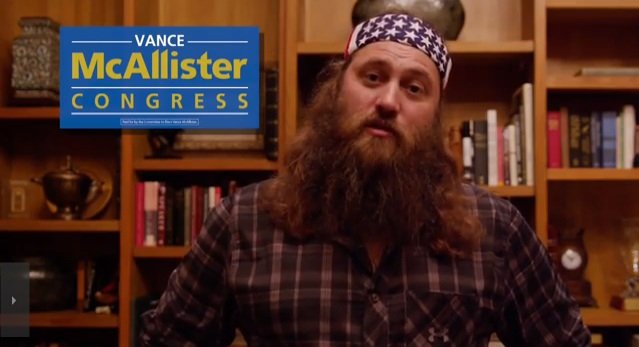
Saturday was the runoff round of the special election in Louisiana to replace Republican congressman Rodney Alexander, who recently resigned to join governor Bobby Jindal’s cabinet as the secretary of veteran affairs. The two top vote-getters in the first round were both Republicans – state senator Neil Riser received close to 32%, while businessman Vance McAllister received 17.8%.

McAllister, who has never held political office, was a clear underdog going into the runoff but he picked up a big endorsement ahead of the polls from Willie Robertson, Louisiana resident and star of A&E’s “Duck Dynasty”. Robertson touted McAllister as an outsider, and urged Louisiana residents to support him at the polls. It certainly worked – McAllister cruised to victory Saturday, picking up 59.7% of the vote.


This would seem to fit Olson’s description of large interest groups. “Duck Dynasty” commands a large audience – the show’s most recent season premiere had 11.8 million viewers, although many are not Louisiana voters – but it is not inherently political. The group is instead held together by a mutual interest in the show. But after building a huge audience, the shows stars now have a huge basis of support with which to affect actual political change. Riser, a state politician, was the logical favorite for the seat, and his large margin in the primary seemed to signal an easy win. Robertson, however, was able to use his television status, and thus his “interest group”, to elect a complete political outsider who better supported his interests.

Saturday, November 09, 2013

Econ 3330 loves Gander Mountain


Gander Mountain and guns seem to be a reoccurring subject in our class recently. After talking about Olson, Becker and interest groups, it occurred to me… how does the NRA get members to join?

According to this article, the NRA claims to have about 4.5 million members. We learned in class that Olson favors smaller groups because there is a free rider problem for larger groups. When a group gets larger, the individual contribution of the next member decreases, so people start free riding the benefits without incurring any costs. On the other hand, Becker would contradict Olson and argue that NRA is powerful because of their large membership base. With more people, there are more resources for the group to use and the free rider problem is mitigated.

The NRA has an annual membership fee of $35. That means the group gets roughly 150 million dollars a year for their collective goods (safety programs, gun advocacy, lobbying against gun restrictions, etc.), which upholds Becker's theory. However, Olson does explain that large groups like the NRA exist because the NRA is organized to promote firearm competency, safety, and ownership (lobbying is a byproduct), which lessens the free rider problem and their members enjoy selective incentives. Examples of positive selective incentives from joining the NRA would be discounts on restaurants, attorney referral services, and insurance. Negative incentives: exclusion from private shooting clubs because public shooting locations are rare. So join today!

Tuesday, November 05, 2013

Illinois Unions Hold Strong

In this article published on November 3rd, Sara Burnett discusses the recent debate between political parties in Illinois over collective bargaining and the surprising stronghold that organized labor still has in Illinois despite the hits it has taken in other states across the nation. Burnett notes Illinois as an exception because its public employees are still receiving their defined benefit pensions and unions are still collecting dues from their members.

As we discussed in class, many southern states in the U.S. have adopted "right-to-work" policies that prohibit unions from requiring their members to pay dues; however, in Illinois, Burnett tells us that "a right-to-work bill introduced earlier this year didn't get as much as a committee hearing." While Olson in The Logic of Collective Action, demonstrates that he is scared of such collective interest groups bringing down the industry through their asymmetric power, high-profile government officials in both political parties in Illinois are showing a slightly positive acceptance of the significant role of the state's organized labor groups. As quoted at the end of the article, "In Illinois, 'there's an acceptance that the labor movement isn't alien [...] and isn't bad." Perhaps legislative officials in Illinois would side more with Becker in his argument that the presence of special interest groups isn't of highest concern, but instead we should attempt to attain optimal pressure, determined by the effect of the state's political expenditures on the individual members' utilities. 

Sunday, October 17, 2010

How Small Businesses Exploited Wal-Mart

When I was home for fall break, I discussed the recent debit card fee regulation with my father (who works for the Star debit network). This NY times article explains the regulation that will allow the Federal Reserve Bank to set the fees debit card companies charge merchants. Merchants will benefit from the lower fees (and maybe consumers, but that remains to be seen), while Visa and MasterCard will receive lower profits. Additionally, cards issued by big banks with at least $10 billion in assets are the only ones affected by the legislation. Visa and MasterCard give banks 80% of the merchant fees, and so this is also a heavy blow to the banking industry. The Federal Reserve Bank has not yet enacted the new fees, and so the full effect of the regulation on retailers, consumers, big banks, and debit card companies remains to be seen.

Major retailers such as Wal-Mart and Amazon heavily lobbied for this regulation. This is a clear example of Olson’s “privileged” group, where a few members had an incentive to bear the entire cost of obtaining a collective good. The major retailers paid the cost for lobbying the regulation, knowing they had much to gain. On the other hand, small businesses that accept debit cards now also reap the benefits of the regulation without any of the cost. The small businesses had no individual incentive to bear the cost of lobbying, and so they acted as free riders while Wal-Mart and Amazon paid all the costs. It happens rarely that one can say that small businesses exploited Wal-Mart.