Wednesday, November 20, 2013
Dealing with an overly-powerful beuracacy: "Crowdfunded Assaination Market"
There is now a crowd funded "Assassination Market' in which people pay Bitcoins to have public figures assassinated. I thought this article was to crazy not to share, in showing how fed up citizens are of overly powerful bureaucracies. This site, similar to Silk Road, gets people to anaonmously donate money to the killing of a certain political leader. Once the assassination has occurred, the bounty can then anonymously collect the reward. "In the four months in which Assassination Market has been online, six targets have been submitted, including NSA director Keith Alexander, Federal Reserve chairman Ben Bernanke and President Barack Obama." (elitedaily.com) The site was inspired by the Edward Snowden NSA leaks. The founder of the site told Forbes, “after about a week of muttering ‘they must all die’ under my breath every time I opened a newspaper or turned on the television, I decided something had to be done. This is my contribution to the cause.”
Although this is an extreme example, many other citizens are fed up with overly powerful bureaucracies. I looked a bit deeper into one of the targets, NSA director Keith Alexander, and found this article called American's Secerest 4th Branch of the Government, NSA kept even Obama in the Dark (http://www.juancole.com/2013/10/americas-branch-government.html) Edward Snowden's leaks showed the NSA was spying on many political leaders, and even Obama was not informed. The implications for citizens are that a "bureaucracy funded at $52 billion a year by [tax dollars] keeps our elected leaders in the dark about it's activities." America was founded on the idea of democracy,
"but the NSA appears to be a secret kingdom that appropriates our money with no oversight or accountability. We didn’t elect it, and if it doesn’t let our chosen representatives know what it is up to, then it is taxing us without giving us any representation. It is a tyrant. It is an ominous homunculus within the body politic." Although this article specifically talks about the NSA, the ideas we have discussed in class about how bureaucracies led by senior leaders are not being run efficiently, effectively or ethically can be applied to many different bureaus.


Sunday, November 17, 2013
Idaho Interest Group Uses Billboards to Fight Obamacare
"They didn't need to implement Obamacare". This phrase is printed on billboards near Burley, Idaho. An interest group known as the "'Idaho Freedom Foundation" is responsible for the implementation of these negative advertisements, as seen in this article. Their actions are in part an attempt to implicate the District 27 legislators for inadvertently supporting Obamacare. Some believe this to be false advertising. They have chosen to incur the costs of this negative advertising initiative as a means to achieve their group's objective, the repeal of the state insurance exchange expected to happen in 2014. They are hoping to influence voters to take a stand against Obamacare and the state insurance exchange program, using the billboards as a means to promote collective action. The president of the Idaho Freedom Foundation, Wayne Hoffman, explains that "the foundation's intentions are threefold...to tell people that the legislators didn't have to pass 'Obamacare,' identify the legislators who voted for the state health insurance exchange and inform people that there will be a chance to repeal it next year."
We can better understand this scenario through Olson's theory of groups. The Idaho Freedom Foundation has been willing to incur the costs of this advertising because they are competing for collective good benefits that would follow if the state insurance exchange were to be successfully repealed. These collective benefits may not be preferred by everyone however, especially those who support the state insurance exchange. Furthermore, the efficient provision of this public good would be hampered by the free rider problem; if the state exchange program were successfully repealed, there would be many more "beneficiaries", or people who would have also preferred for the repeal of this state insurance exchange than those who actually contributed to the efforts of the Idaho Freedom Foundation. It would infeasible to impose costs on all the beneficiaries of their actions because the Idaho Freedom Foundation is seeking the provision of a public good.
We can better understand this scenario through Olson's theory of groups. The Idaho Freedom Foundation has been willing to incur the costs of this advertising because they are competing for collective good benefits that would follow if the state insurance exchange were to be successfully repealed. These collective benefits may not be preferred by everyone however, especially those who support the state insurance exchange. Furthermore, the efficient provision of this public good would be hampered by the free rider problem; if the state exchange program were successfully repealed, there would be many more "beneficiaries", or people who would have also preferred for the repeal of this state insurance exchange than those who actually contributed to the efforts of the Idaho Freedom Foundation. It would infeasible to impose costs on all the beneficiaries of their actions because the Idaho Freedom Foundation is seeking the provision of a public good.
Allowing Congressional Committees to Function
In his article for the NWI Times, Doug Ross discusses the need to let Congressional Committees function, in response to what he calls the atrophy of the committee system over the last twenty years. The committee system in congress is meant to act as a system of property rights that only allows members of certain committees to affect the status quo. Ross quotes Representative Pete Visclosky D-Merrillville, a member of the highly sought after appropriations committee, who is disgruntled that
"[the bill that resulted in the shutdown] was an appropriations bill," and that "our committee had nothing to do with it." It took a long time for Visclosky to get on to the appropriations committee, and he is disappointed that the purpose of the committee system seems to have gone by the wayside, with house leadership "hammering out deals that bypass the committee."
It makes sense that a member of a committee would be upset that his committee was not getting the chance to do its job, because public choice implies that the institution of congressional committees are put in place to help congressmen realize their objective of being reelected. When the committee system appears to be losing influence in congress, it clearly follows that committee members will seek to prevent this change.
"[the bill that resulted in the shutdown] was an appropriations bill," and that "our committee had nothing to do with it." It took a long time for Visclosky to get on to the appropriations committee, and he is disappointed that the purpose of the committee system seems to have gone by the wayside, with house leadership "hammering out deals that bypass the committee."
It makes sense that a member of a committee would be upset that his committee was not getting the chance to do its job, because public choice implies that the institution of congressional committees are put in place to help congressmen realize their objective of being reelected. When the committee system appears to be losing influence in congress, it clearly follows that committee members will seek to prevent this change.
Testing the Reason for Committee Formation
We talked in class about the theory that congressional committees are formed to serve the interests of congresspeople. This was supported by the fact that the members on certain committees are often representatives of areas that are strongly affected by the actions of the committee. For example, representatives from Nebraska are more likely to be on the agriculture committee.
I would like to propose an alternate way of testing this theory: find out who initially supported the formation of Senate committees and what they stood to gain from the formation of the committee. If committees are frequently proposed by those who then derive benefit from them, this raises the probability that committees in general are created to benefit congresspeople. I found information on the formation of two committees which are listed below. They seem to support the hypothesis provided in class. It would be interesting to see a more comprehensive list of committee founders to further test this idea.
1. The Senate Committee on Agriculture was started in 1825 and proposed by Sen. William Findlay. He then went on to serve as the first committee chair. Also important to note is that he was the owner of a farm and represented Pennsylvania.
2. The Senate Committee on Banking, Housing, and Urban Affairs was started in 1913 and proposed by Sen. Robert Owen. He was previously a banker.
I would like to propose an alternate way of testing this theory: find out who initially supported the formation of Senate committees and what they stood to gain from the formation of the committee. If committees are frequently proposed by those who then derive benefit from them, this raises the probability that committees in general are created to benefit congresspeople. I found information on the formation of two committees which are listed below. They seem to support the hypothesis provided in class. It would be interesting to see a more comprehensive list of committee founders to further test this idea.
1. The Senate Committee on Agriculture was started in 1825 and proposed by Sen. William Findlay. He then went on to serve as the first committee chair. Also important to note is that he was the owner of a farm and represented Pennsylvania.
2. The Senate Committee on Banking, Housing, and Urban Affairs was started in 1913 and proposed by Sen. Robert Owen. He was previously a banker.
It’s Morning Again in America
Although this presidential election took place in 1984, I
think Reagan’s campaign ad “It’s
Morning Again in America” is the perfect and best example of persuasive campaigning, thus I had to share it.
If you are an American, how could you possibly dislike this video?
We discussed two types of political campaigning in class:
persuasive and informative. A candidate uses persuasive campaigning in order to
gain support from all voters, regardless of their party affiliation. In
contrast, informative campaigning focuses on the candidate’s political platform
and where exactly they stand on an issue. Of the two, Mueller favors persuasive
campaigning because it can only have positive impacts on the candidate, if used
right.
In his ’84 re-election campaign, Reagan listened to Mueller
and utilized persuasive campaigning. “It’s Morning Again in American” campaign
ad is persuasive because Reagan reminds how wonderful America has been the last
four years, since he has been president. Instead of telling voters where he
stands on an issue, he illustrates how more Americans are getting married,
buying more houses, and getting more jobs. Reagan has made America “prouder,
stronger, and better” and that’s all he explains in this ad. An informative
campaign would have had little benefit to Reagan as he would have gained
support from the voters with the same political beliefs, but would have pushed
other voters further away.
The result: Reagan received 525 out of 538 electoral
votes (the highest ever by a presidential candidate), which Mueller would
attribute to his persuasive campaign ad.
Duck [Political] Dynasty?
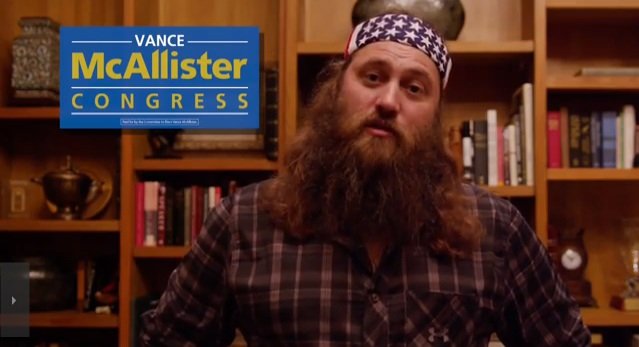
We’ve talked in class about prominent interest groups like
the NRA and AARP, but there may a new interest group at work in Louisiana.
Saturday was the runoff round of the special election in
Louisiana to replace Republican congressman Rodney Alexander, who recently
resigned to join governor Bobby Jindal’s cabinet as the secretary of veteran
affairs. The two top vote-getters in the first round were both Republicans –
state senator Neil Riser received close to 32%, while businessman Vance
McAllister received 17.8%.
McAllister, who has never held political office, was a clear
underdog going into the runoff but he picked up a big endorsement ahead of the
polls from Willie Robertson, Louisiana resident and star of A&E’s “Duck
Dynasty”. Robertson touted McAllister as an outsider, and urged Louisiana
residents to support him at the polls. It certainly worked – McAllister cruised to victory Saturday, picking up 59.7% of the vote.
This would seem to fit Olson’s description of large interest
groups. “Duck Dynasty” commands a large audience – the show’s most recent
season premiere had 11.8 million viewers, although many are not Louisiana
voters – but it is not inherently political. The group is instead held together
by a mutual interest in the show. But after building a huge audience, the shows
stars now have a huge basis of support with which to affect actual political
change. Riser, a state politician, was the logical favorite for the seat, and
his large margin in the primary seemed to signal an easy win. Robertson,
however, was able to use his television status, and thus his “interest group”,
to elect a complete political outsider who better supported his interests.
More on the Value of Campaign Spending
This article discusses the value of campaign spending and extends our recent class discussion on the subject. The author claims that the value of campaign spending is often largely overstated, and he gives data from the 2012 elections to back up his claims. He shows that the relationship between an incumbent’s margin of victory and the amount by which he outspent his opponent is statistically insignificant. The relationship between the incumbent vote share and the amount of money spent by the challenger, however, is negative and highly statistically significant. This relationship shows as a logarithmic curve, where returns to challenger campaign spending are initially very high but decrease after $200,000 has been raised. This data seems to further back up the s-curve relationship between campaign spending and votes documented by Mueller: Challengers begin at the bottom portion of the s-curve, where they initially experience increasing returns to their campaign expenditures. These increasing returns are experienced up until the $200,000 mark is reached, at which point diminishing returns begin to set in Incumbents, however, begin at or above the inflection point in the curve and therefore receive diminishing returns or no returns at all to their additional dollars spent.
As noted by the author of the article, an important extension of the fact that campaign spending matters more for challengers than incumbents is that U.S. campaign contribution limits serve to protect incumbents. The fact that individuals may not contribute more than $2,600 to any given campaign means that it is very difficult for challengers to raise enough money to threaten the incumbent’s position. Challengers are often less well-connected than incumbents and furthermore start at a point further down on the s-curve. While this means that each additional dollar they raise has a higher impact, it also means they must raise more money than the incumbent in order to be able to effectively compete - something that is not easily done without connections.
As noted by the author of the article, an important extension of the fact that campaign spending matters more for challengers than incumbents is that U.S. campaign contribution limits serve to protect incumbents. The fact that individuals may not contribute more than $2,600 to any given campaign means that it is very difficult for challengers to raise enough money to threaten the incumbent’s position. Challengers are often less well-connected than incumbents and furthermore start at a point further down on the s-curve. While this means that each additional dollar they raise has a higher impact, it also means they must raise more money than the incumbent in order to be able to effectively compete - something that is not easily done without connections.
Interest groups and the Trans-Pacific Partnership Agreement
From an economic point of view, lowering barriers to trade between nations is widely seen as valuable policy reform. However, as this article describes, the Trans-Pacific Partnership Agreement is "A free trade agreement that is neither about trade nor freedom." In fact, information from leaked papers suggests that of the 29 chapters under negotiation, only 5 actually negotiate trade while the 24 others "aim to influence many issues, such as food and environmental standards, intellectual property, and pharmaceutical formularies."
The TPPA is a clear example of how legislation is supplied in accordance with demand, and the demand in this case is largely derived from firms in industries sensitive to intellectual property issues. Trade agreements have potential create massive new rents in nearly every industry, so the secrecy and focus on pleasing the firms providing input to the negotiations doesn't come as a surprise based on our studies in public choice.
Monday, November 11, 2013
Benefactors of Immigration Lobby
Nearly
six months ago Facebook’s Mark Zuckerberg teamed up with other tech industry
big names like Bill Gates, Netflix’s CEO, and founders of companies like
Dropbox and LinkedIn to form FWD.us. As
this article highlights, FWD.us is an organization that lobbies for
immigration reform; specifically an increase in the number of H-1B Visas which
are visas for high-skilled STEM workers. Because of the STEM shortage in the
United States tech companies across the country are desperately seeking qualified
work to fill their growing demand for STEM employees and have begun to look
overseas to find that talent.
While
nearly all technology companies would like to see an increase in the H-1B visa
cap, FWD.us is composed of only a few major tech firms that are collectively funding
a major lobbying effort on behalf of their entire industry, making the members
of FWD.us benefactors to a privileged group.
This
is an example of a privileged group because members of FWD.us have enough to
gain from H-1B reform that they are willing to bear lobbying costs on behalf of
the entire high-tech industry while smaller firms have the opportunity to
free-ride on FWD.us’ efforts. As discussed in class, whatever gains FWD.us
receives will greatly benefit the industry, and will help FWD.us’ members, but
will never quite reach Q* for the entire high-tech market because of the
smaller firms who are free-riding on the group’s lobbying efforts.
Sunday, November 10, 2013
Airline Regulations eased or new ones added?
This CNN article describes major airline reactions to the latest change to Airline regulations electronic devices are now allowed during all parts of a flight. The only hitch is that you have to get each aircraft approved by the FAA to be able to do this. US Air and Southwest will be among the first to receive approval (They are also among the largest airlines in the US). Spirit Airlines (a smaller airline) on the other hand did not give a time table of when their aircraft will be approved.
While this may seem like deregulation, this could be another example of rent seeking by the large players in the airline industry. The cost of filing the additional paperwork to get the luxury of allowing electronics at all times on aircraft is more easily covered by the incumbents in the industry with larger market shares and deeper pockets. At first glance, this appears to benefit passengers, but the new regulations could concentrate the market even further raising both profits for larger airlines and prices for their passengers.
While this may seem like deregulation, this could be another example of rent seeking by the large players in the airline industry. The cost of filing the additional paperwork to get the luxury of allowing electronics at all times on aircraft is more easily covered by the incumbents in the industry with larger market shares and deeper pockets. At first glance, this appears to benefit passengers, but the new regulations could concentrate the market even further raising both profits for larger airlines and prices for their passengers.
Saturday, November 09, 2013
Econ 3330 loves Gander Mountain

Gander Mountain and guns seem to be a reoccurring subject in
our class recently. After talking about Olson, Becker and interest groups, it occurred
to me… how does the NRA get members to join?
According to this
article, the NRA claims to have about 4.5 million members. We learned in
class that Olson favors smaller groups because there is a free rider problem for
larger groups. When a group gets larger, the individual contribution of the
next member decreases, so people start free riding the benefits without
incurring any costs. On the other hand,
The NRA has an annual membership fee of $35.
That means the group gets roughly 150 million dollars a year for their
collective goods (safety programs, gun advocacy, lobbying against gun
restrictions, etc.), which upholds Becker's theory. However, Olson does explain that large groups like the NRA exist because the NRA is organized to promote firearm competency, safety, and ownership (lobbying is a byproduct), which lessens the free rider problem and their members enjoy selective incentives. Examples of positive selective incentives from joining the NRA would be discounts on restaurants, attorney referral services, and insurance. Negative incentives: exclusion from private shooting clubs because public shooting locations are rare. So join today!
Friday, November 08, 2013
Christmas is Coming Early For Venezuela This Year
This
week the Venezuelan President, Nicolas Maduro declared the official arrival of
“early Christmas.” As this
article explains, Venezuelan early Christmas means all workers will receive
two-thirds of their holiday bonuses this week, nearly two months before the 25th
of December.
While
participating in a variety of holiday traditions this week, Madura said “Merry Christmas
2013, Christmas early, early victory, early happiness for the whole
family," leading many to believe his recent actions are nothing more than
a tactic to gain votes in the upcoming December 8th elections. While
early Christmas and bonuses may be appealing to many Venezuelans, Maduro’s Christmas
movement says nothing of his position or policy plans for the future and is
therefore not informative campaigning. Aside from having nothing to do with
Madero’s actual political beliefs, the new Christmas policy benefits every one
of his constituents in an effort to bring all voters closer to his platform
without driving any farther away.
Maduro’s
tactic is an example of persuasive campaigning because the new Christmas
policies are nothing more than an attempt to gain votes. His unconventional new holiday policy
is targeting every single Venezuelan regardless of their political beliefs and
is aimed at “persuading” voters of all kinds to support Madero in the upcoming
election.
Thursday, November 07, 2013
US-Israeli Relations
In one of my foreign policy classes I am writing a paper on US-Israeli relations and one of the books I came across is particularly pertinent to this class. The NYT's article here gives a nice summary of the arguments presented by two of the most prominent realist thinkers in the field. Their first argument is that a long, well documented, and violent history of anti-Semitism has resulted in such a climate that makes it nearly impossible to criticize Israel. They argue that the Israel Lobby is just like any interest group- the NRA, AARP, etc- except they have no counter-balancing organization. Therefore, they possess disproportionate influence, or using Olson's terminology "asymmetric power." They argue that because the public views anything other than pro-Israel as anti-semetic, the costs to a politician of questioning the current policies are extremely high.
Their second argument is about the concentrated benefits of this policy. Because the benefits are concentrated in such a small group of people, they have massive incentives to organize and lobby politicians. It is not that there is a vast, pernicious, well-connected conspiracy as racists argue. There exists a group who has strong incentives to organize, over-come collective action problems, and capture the concentrated benefits available to them. It is true that organizations have successfully lobbied for pro-Israel policies, but using Olson, and other authors we've read in this class, we see the sober person can see how concentrated benefits have given a group an incentive to organize and exert its influence.
Mearsheimer and Walt, do however, come to the dreary conclusion that Olson predicted. They argue that the US's consistent support for Israel has negatively effected US national security. To them, the latent group has not been brought to life by selective incentives and because the general public is such a large group it consistently falls short of the optimal amount of the collective good, in this case, national security.
Their second argument is about the concentrated benefits of this policy. Because the benefits are concentrated in such a small group of people, they have massive incentives to organize and lobby politicians. It is not that there is a vast, pernicious, well-connected conspiracy as racists argue. There exists a group who has strong incentives to organize, over-come collective action problems, and capture the concentrated benefits available to them. It is true that organizations have successfully lobbied for pro-Israel policies, but using Olson, and other authors we've read in this class, we see the sober person can see how concentrated benefits have given a group an incentive to organize and exert its influence.
Mearsheimer and Walt, do however, come to the dreary conclusion that Olson predicted. They argue that the US's consistent support for Israel has negatively effected US national security. To them, the latent group has not been brought to life by selective incentives and because the general public is such a large group it consistently falls short of the optimal amount of the collective good, in this case, national security.
Tuesday, November 05, 2013
Should the Government Control Toilet Paper Production?
The country of Venezuela has found themselves in a sticky situation. After the government placed a price ceiling on toilet paper (thinking it would help make it more affordable for all) Venezuela has found itself deep in a toilet paper shortage. The government induced price ceiling left producers of toilet paper in Venezuela no incentive to produce at the lower price. Even after limiting purchases to 12 rolls a customer, and importing 50,000 rolls from abroad, citizens of Venezuela are struggling to find toilet paper--a good in high demand! Lines extend far beyond stores, and there is even an app that can help people find stores with toilet paper.
The government's new solution to the problem (after importing didn't seem to work) is to take control of the production of toilet paper. They have recently taken over one of the largest the toilet paper factories. Many citizens are upset seeing that it was the government who got them in the mess in the first place. The government seeks to blame private companies for charging prices too high, but this begs the question, is it really the role of government to control the production of a good like toilet paper? Free market Economists like Friedman would argue that all might be better off if the production of toilet paper was left to the private market. Considering the government's track record, this may be something better left to the private market and not a role of the government.
The government's new solution to the problem (after importing didn't seem to work) is to take control of the production of toilet paper. They have recently taken over one of the largest the toilet paper factories. Many citizens are upset seeing that it was the government who got them in the mess in the first place. The government seeks to blame private companies for charging prices too high, but this begs the question, is it really the role of government to control the production of a good like toilet paper? Free market Economists like Friedman would argue that all might be better off if the production of toilet paper was left to the private market. Considering the government's track record, this may be something better left to the private market and not a role of the government.
Illinois Unions Hold Strong
In this article published on November 3rd, Sara Burnett discusses the recent debate between political parties in Illinois over collective bargaining and the surprising stronghold that organized labor still has in Illinois despite the hits it has taken in other states across the nation. Burnett notes Illinois as an exception because its public employees are still receiving their defined benefit pensions and unions are still collecting dues from their members.
As we discussed in class, many southern states in the U.S. have adopted "right-to-work" policies that prohibit unions from requiring their members to pay dues; however, in Illinois, Burnett tells us that "a right-to-work bill introduced earlier this year didn't get as much as a committee hearing." While Olson in The Logic of Collective Action, demonstrates that he is scared of such collective interest groups bringing down the industry through their asymmetric power, high-profile government officials in both political parties in Illinois are showing a slightly positive acceptance of the significant role of the state's organized labor groups. As quoted at the end of the article, "In Illinois, 'there's an acceptance that the labor movement isn't alien [...] and isn't bad." Perhaps legislative officials in Illinois would side more with Becker in his argument that the presence of special interest groups isn't of highest concern, but instead we should attempt to attain optimal pressure, determined by the effect of the state's political expenditures on the individual members' utilities.
Sunday, November 03, 2013
Sriracha Shortage? Not Quite Yet
For
about a day, food-lovers everywhere were upset at the prospect of a Sriracha shortage when a lawsuit was brought against Huy Fong Foods, Inc. One of their plants in southern California was creating a chili odor in the air that was so strong that it was said to be a public nuisance, causing
"burning eyes, irritated throats, and headaches." Luckily, a judge
denied the town’s attempt to get the plant to cease production until they can
reduce the odor. This article on the recent development of the suit says, “Huy
Fong executives said they were cooperating with the city to reduce the smell,
but balked at the city's suggestion of putting in a new, $600,000 filtration
system that may not be necessary. The company said it was looking into other
alternatives when the city sued”.
This
odor is an example of a negative externality of production. It is reducing the
well being of others who are not being compensated by the firm. In this case,
the town of Irwinsville attempted to implement a solution to the externality
similar to the example of the confectioner that we looked at in lecture. The
producer is liable, but the marginal benefit of production is greater than the
marginal cost of production, therefore the output is still produced. This still
requires negotiations in order to reach a solution. As Huy Fong agrees, jumping
to the solution of spending $600,000 on a new filtration system might lead to a
lower level of odor but that does not mean it is the optimal solution. In order
to internalize the externality, government action might be necessary. A
corrective tax seems like a reasonable solution to this externality; Huy Foods
would pay the tax, which would be an input cost, raising their MC of production
(PMC curve shifts up) and reaching the socially optimal level.
Mining in Maine
In his, Logic of Collective Action, Olson argues that an agent will pursue collective action until the marginal benefit of their share of the collective benefit is greater than their personal cost incurred in obtaining the benefit. When the group size is incredibly small, the cost of coordinating efforts is low and the greater the expected payoff, the greater the incentive becomes to contribute towards the acquisition. A fantastic example of this is the newest piece of mining regulation set to pass the Maine State Legislature. As this article outlines, one single private actor, J.D. Irving Ltd., has essentially dictated the State's environmental policy in this area. At issue in this case is the loosening of regulations concerning metallic mining practices that environmentalist claim protect the community from pollution and contamination. Irving is the owner of Bald Mountain, and after presumably discovering it's money making potential, Irving has, "begun considering the possibility of mining on the land and pushed to write new regulations more favorable to the industry." Legislators have been extremely responsive to Irving's 'request', justified as an attempt to create '700 jobs', and the regulation weakening bill is set to pass the house in January. The incredible responsiveness of Maine's Department of Environmental Protection to Irving's request demonstrates the power of Olson's theory, that an extremely small group with an incredible amount to gain will be highly efficient in it's lobbying efforts.
Wisconsin Organic Farmers Seek Regulation
According to
this article from two weeks ago in the LaCrosse Tribune, approximately half of
organic farmers in Wisconsin will be denied their $750 annual federal subsidy
this year, which has traditional gone towards the certification process
required to be “certified organic.” The program for the subsidy was cancelled
back in January, but many small time farmers are realizing only now that they
will not be eligible to receive their funds. This change in regulation effects
mostly small-time farmers for whom $750 is a relatively large percentage of the
value of their crop. Being certified organic is absolutely necessary for these
farmers, as it is more of a niche market and non-organic farms are able to
produce much more food at lower costs.
One of Stigler’s four ways that the
State can benefit an industry is through the direct subsidy of money, and this
is exactly the type of regulation these Wisconsin farmers are being denied and
so desperately are seeking. In an economy when so many people think that
good-producing firms are all for free markets and Laissez Faire government, it
is interesting to see these small time farmers fighting and appealing for the government
to step back into the picture and provide the regulation that they desperately
need. Regulation on Cigarette Packaging in Australia - For the Public Good?
This article discusses new regulations on cigarette packaging in Australia aimed at reducing smoking. No longer are brand images allowed to appear on cigarette wrappers - rather, it is required that cigarettes have “drab wrappers” with warning labels and graphic images of the negative health effects of smoking. This has severely limited the ability of tobacco manufacturers to brand and market their products in Australia, and has prompted significant backlash against regulations by large tobacco companies and cigarette-producing countries alike. Several countries are filing WTO cases against Australia on the grounds that the country is using these regulations as a way to limit cigarette imports rather than simply to improve health.
The other countries’ fight against Australia’s cigarette packaging regulation struck me as interesting. In class we discussed advertising regulations as actually proving beneficial to cigarette companies, as they limit the entry of new firms into the industry. The WTO cases brought against Australia prove that cigarette companies see the reduction in their sales due to packaging restrictions as greater than the gain due to the entry restrictions it imposes, however. This case seems to run counter to Stigler’s theory, which says that regulation is acquired by an industry and is designed and operates for its benefit. It seems here that an alternative explanation of regulation - that it is for the public good - seems most applicable. Unless there are deeper issues at work here, Australia’s cigarette packaging regulations seem to be aimed at promoting health rather than protecting the cigarette industry.
The other countries’ fight against Australia’s cigarette packaging regulation struck me as interesting. In class we discussed advertising regulations as actually proving beneficial to cigarette companies, as they limit the entry of new firms into the industry. The WTO cases brought against Australia prove that cigarette companies see the reduction in their sales due to packaging restrictions as greater than the gain due to the entry restrictions it imposes, however. This case seems to run counter to Stigler’s theory, which says that regulation is acquired by an industry and is designed and operates for its benefit. It seems here that an alternative explanation of regulation - that it is for the public good - seems most applicable. Unless there are deeper issues at work here, Australia’s cigarette packaging regulations seem to be aimed at promoting health rather than protecting the cigarette industry.
Profit-maximizers in Utah
Coming to the United States “the land of freedom” I
never thought to encounter rules such as blue laws and/or alcohol beverage
restrictions that help create monopoly markets. Last readings and the Thursday
class were a bit of a shock to me so I started reading more on the subject. I realized
that Utah has one of the strictest alcohol distribution and consumption regulations.
A Fox News article explains how these rules make it hard to get a drink in Utah. For
example, you cannot order a drink at a restaurant without having food first, there
are three different license categories for restaurants that allow them to sell
alcohol at a certain time period and specify the kinds of alcoholic beverages
to be served, and wine and beer are only to be supplied by a state-run store
(at 86% markup). Francis Liong, an LA relocate that owns Lamb's Grill in Salt
Lake City expressed that "makes it hard for a restaurant to appease guests
and to make money, too." Not only that but recent regulations require that
new restaurants and bars keep a curtain over the location of alcohol in
restaurants and bars. The justification that the Utah Department of Alcoholic
Beverage Control gives is that
"The purpose of
control is to make liquor available to those adults who choose to drink
responsibly -- but not to promote the sale of liquor,” the department states on
its website. “By keeping liquor out of the private marketplace, no economic
incentives are created to maximize sales, open more liquor stores or sell to
underage persons."
However, as Coppock’s students, we know that the reasoning
behind such restrictions is the rent-seeking opportunities they bring for the
local government and the old-dominant restaurants and bars. These restrictions
exemplify three of Stigler’s types of regulations: control over entry by new
rivals, regulation on related industries (substitutes in this case), and
price-fixing.
Subscribe to:
Posts (Atom)